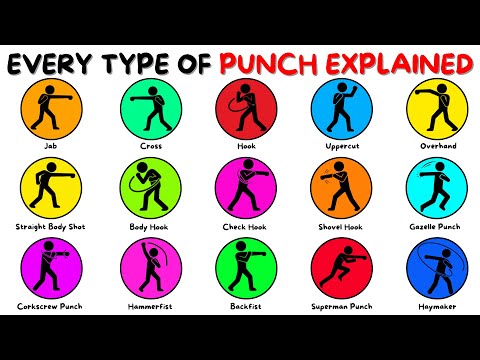
Every Type Of Punch Explained
0
Fundamental Punch·MMA Unpacked
FULL COMBAT CONDITIONING GUIDE: http://bit.ly/4r04JBS Every Type Of Punch Explained If you enjoyed please like, subscr…
Translation: fundamental punch
The Fundamental Punch family covers punching techniques that span multiple martial arts traditions beyond Western boxing — including backfists, hammer fists, spinning backfists, and superman punches that appear across karate, MMA, kickboxing, and other striking systems. [1] While boxing provides the four foundational punches (jab, cross, hook, uppercut), many martial arts have developed additional fist-based striking techniques that use different striking surfaces, trajectories, and tactical applications. [1],[2] The backfist (uraken) and hammer fist (tetsui) use the back of the fist and the bottom of the fist respectively, offering strikes that can be delivered from angles inaccessible to standard boxing punches. [2],[3] In MMA, the spinning backfist and superman punch have become signature highlight-reel techniques that blend traditional martial arts with modern fighting. [3]
These fundamental punches come from diverse martial arts traditions. [1] The backfist (uraken) is a traditional karate technique documented in Okinawan martial arts for centuries. [1],[2] The hammer fist has been used throughout combat history as a natural striking motion. [2] The spinning backfist gained prominence in MMA and kickboxing in the 2000s, while the superman punch was popularised by GSP in the UFC and by Muay Thai fighters in Thai stadiums. [2],[3]
Fundamental punches complement boxing basics by adding angles and striking surfaces that standard boxing does not cover. [1] In MMA, hammer fists are the most common finishing technique from top position (ground-and-pound TKO finishes). [2] The spinning backfist has produced multiple highlight-reel knockouts in UFC history. [3]
No images yet for this technique.
Sign in to suggest an image.
FULL COMBAT CONDITIONING GUIDE: http://bit.ly/4r04JBS Every Type Of Punch Explained If you enjoyed please like, subscr…
No instructional courses yet for this technique.
Sign in to suggest a course.
Risk of injury to the person this technique is applied to
High — spinning strikes carry risk of missing and being off-balance; hammer fists to the head carry concussion risk; hand injuries are possible without proper technique, though hammer fists reduce metacarpal fracture risk compared to standard punches
Skill level needed to execute this technique reliably
Whether this technique is allowed under major competition rule sets
Dynamic Karate (Masatoshi Nakayama, 1966)
Description sources — [1] Dynamic Karate (Nakayama, 1966) on uraken and tetsui [2] Tao of Jeet Kune Do (Lee, 1975) on non-classical striking [3] UFC/MMA competition analysis
Description sources — [1] Dynamic Karate (Nakayama, 1966) on uraken and tetsui [2] Tao of Jeet Kune Do (Lee, 1975) on non-classical striking [3] UFC/MMA competition analysis
rotational speed (spinning strikes), coordination (superman punch timing), hand conditioning
athletic/explosive body type, good balance, spatial awareness for spinning techniques
core (rotation for spinning), shoulders (whipping motion for backfist), hip flexors (jumping for superman punch)
Every move, in any martial art, shares a few universal traits. Mix and match below to pinpoint the right tool — or compare equivalents across styles.
Seiken Ago Uchi is a Kyokushin karate rising punch specifically targeting the chin from below, driving the fore-fist (seiken — the index and middle finger knuckles) upward into the underside of the opponent's jaw in a trajectory similar to a boxing uppercut but with the karate-specific fist formation and body mechanics. [1] The technique differs from a standard boxing uppercut in several critical ways: the karate version uses the seiken (front two knuckles) rather than the flat of the fist, the arm travels on a more vertical path (rising straight up rather than arcing from below), and the power generation uses the karate hip-rotation and kime (focus) system rather than the boxer's leg-driven rising body mechanics. [1,2] The chin (ago, 顎) is the primary target because the human jaw acts as a first-class lever: when struck from below, the mandible rotates the head backward and laterally with angular acceleration that exceeds the brain's tolerance for shearing forces, producing immediate knockout via diffuse axonal injury — this is why the chin is called 'the button' in boxing. [1,2] Masutatsu Oyama demonstrated the Seiken Ago Uchi in This Is Karate (1965) as a fundamental close-range weapon, emphasising that the vertical rising path of the karate version is faster than the looping arc of a standard boxing uppercut because it travels a shorter distance (straight up rather than curving up from the side). [1] In Kyokushin competition, the Ago Uchi is ILLEGAL (face punches prohibited), but it is trained extensively for kata, kihon, and self-defence application — and when Kyokushin fighters cross-train in MMA or kickboxing, the Ago Uchi becomes a devastating tool because the knuckle conditioning from years of makiwara training produces unusually hard and focused impact on the chin. [1] The technique appears in several traditional karate kata, often as a close-range counter executed immediately after a block, targeting the chin of the off-balance attacker. [2]
Seiken Chudan Tsuki is the fundamental middle-level straight punch in traditional karate, delivering the fore-fist (seiken — the front two knuckles of the index and middle fingers) to the opponent's midsection, targeting the solar plexus, floating ribs, or liver. [1] The technique is one of the most basic and most practised movements in all karate styles, taught from the very first class and refined throughout a practitioner's entire career. [1,2] In Kyokushin karate, founded by Masutatsu Oyama, the Chudan Tsuki holds special importance because Kyokushin's full-contact ruleset prohibits punches to the face — making body punches the primary hand weapon in competition. [1] This ruleset quirk has produced arguably the most powerful body punchers in martial arts: Kyokushin competitors develop devastating body attacks that would be unnecessary in styles where head punches are the primary target. [1,2] The mechanical execution follows karate's universal punching principle: the punch begins from the chambered position at the hip (hikite), travels in a straight line toward the target while rotating the fist from palm-up to palm-down (pronation) at the moment of impact, and retracts immediately along the same line — the opposite hand simultaneously retracts to the hip, creating a reciprocal pulling action (hikite) that adds torque to the punching motion. [1,2] Oyama wrote in This Is Karate (1965) that the Chudan Tsuki should be practised thousands of times daily on the makiwara (striking post) until the knuckles are hardened and the punch can penetrate through the opponent's body. [1] The technique's simplicity is deceptive: while the basic movement can be learned in minutes, the generation of full-body power through hip rotation, stance alignment, and breath control requires years of dedicated practice to master. [1,2]
Seiken Jodan Tsuki is the fundamental upper-level straight punch in traditional karate, delivering the fore-fist (seiken — the front two knuckles of the index and middle fingers) to the opponent's face, jaw, nose, or temple. [1] The technique shares identical body mechanics with the Seiken Chudan Tsuki (middle-level punch) — the punch begins from the chambered position at the hip, travels in a straight line with a 180° forearm pronation at impact, accompanied by hikite (pulling the opposite hand back to the hip for counter-rotational torque) — but the trajectory is elevated to head height. [1,2] In the context of Kyokushin karate, the Jodan Tsuki holds a paradoxical position: it is extensively practised in kihon (basics) and kata (forms) but is ILLEGAL in Kyokushin full-contact competition, where punches to the face are prohibited — only kicks are permitted to target the head. [1] This rule means that Kyokushin fighters train the Jodan Tsuki for kata grading, self-defence application, and for use in mixed-rules competition (MMA, kickboxing, point karate) but cannot use it in their own style's tournament format. [1] In Shotokan, Goju-Ryu, and other traditional karate styles that compete under WKF rules, the Jodan Tsuki is a primary scoring technique — controlled punches to the face score points in WKF competition. [2] Masutatsu Oyama wrote in This Is Karate (1965) that the Jodan Tsuki to the chin or temple should be trained as a fight-ending weapon, with the knuckles hardened on the makiwara until the punch can shatter boards and tiles. [1] The elevation from chudan to jodan introduces additional technical challenges: the shoulder must elevate to direct the punch upward, which naturally opens the body to counter-attacks unless the hikite and guard positioning compensate. [1,2]
Punching is the most fundamental striking skill — 'punch' appears in thousands of passages across our corpus. The four basic punches (jab, cross, hook, uppercut) form the foundation of all hand striking. Jack Dempsey's Championship Fighting (1950) remains the definitive text on punching mechanics. (200+ books; Dempsey, Championship Fighting)
The cross is thrown with your rear hand across your body, and power is generated through full body rotation—you rotate your hips and shoulders and drive off your back foot to let that rotation transfer into the punch.
The check hook works when your opponent overcommits forward; they meet your punch with their own momentum, multiplying the impact. Timing is absolutely critical, as demonstrated when Juan Manuel Marquez knocked out Manny Pacquiao with a perfectly timed check hook while Pacquiao rushed forward.
The overhand generates massive power through its looping trajectory and is designed to beat a high guard or counter an opponent ducking under punches, but it telegraphs your intent clearly and leaves you open to counters—making it a high-risk, high-reward technique.
The haymaker is a wild looping power punch with maximum knockout potential if it lands clean, but it's easy to counter and rarely lands against skilled opponents because everyone sees it coming from a mile away; it's most effective in street fights against untrained people.
The Fundamental Punch family covers punching techniques that span multiple martial arts traditions beyond Western boxing — including backfists, hammer fists, spinning backfists, and superman punches that appear across karate, MMA, kickboxing, and other striking systems. While boxing provides the four foundational punches (jab, cross, hook, uppercut), many martial arts have developed additional fist-based striking techniques that use different striking surfaces, trajectories, and tactical applications.
These fundamental punches come from diverse martial arts traditions. The backfist (uraken) is a traditional karate technique documented in Okinawan martial arts for centuries.
Unified MMA: legal — Legal striking technique; WBC/Boxing: legal — Legal — punches are the core technique of boxing; WKF: legal — Legal, jodan/chudan punch scores 1 point (yuko) — controlled contact required; Kyokushin: restricted — Body punches legal at full power, head punches banned; WT: restricted — Punches to trunk only (1 point), punches to head banned; ITF: legal — Legal — hand techniques to head and body both permitted; WAKO: legal — Legal in Full Contact and Low Kick formats; K: legal — 1/GLORY — Legal — full power punches to head and body; IFMA: legal — Legal
Danger rating 6/10. Moderate-high — spinning strikes carry risk of missing and being off-balance; hammer fists to the head carry concussion risk; hand injuries are possible without proper technique, though hammer fists reduce metacarpal fracture risk compared to standard punches
The standard setup chain: Set Up with Standard Punches → Feint or Disguise → Commit → Land → Follow Up → Recover.
Standard counters include: Duck Under Spinning Strikes — ducking under the spinning backfist as the opponent turns / Takedown on Spinning Miss — shooting for a takedown when the opponent's back is turned after a missed spin / Step Back — creating distance to make the spinning or superman punch fall short / Counter Cross — timing a straight punch as the spinner completes the rotation.
Common variants: Backfist (uraken) (striking with the back of the knuckles in a horizontal or…); Hammer fist (tetsui) (striking with the bottom of the fist in a downward motion…); Spinning backfist (full-body rotation to deliver a backfist with centrifugal…); Superman punch (leaping forward punch that disguises the level change as …); Ridge hand (haito) (striking with the inside edge of the hand between the thu…); Overhand punch (a looping arc punch from boxing that crosses over the opp…).
Hammer fists are the #1 ground-and-pound finishing technique in MMA. The spinning backfist has produced numerous UFC knockouts.
Top errors to watch for: Over-committing to spinning strikes — if a spinning backfist misses, you are turned away from the opponent and vulner… / Landing hammer fists with fingers instead of the ulnar side — improper hammer fist striking surface can injure the fi… / Telegraphing the superman punch — without a convincing knee feint, the jump is easily read and countered / Using backfists from too far away — backfists have shorter effective range than crosses; closing distance is necessary.
The Fundamental Punch is also known as Fandamentaru Panchi, Closed Fist Strike, Fist Punch, General Punch.