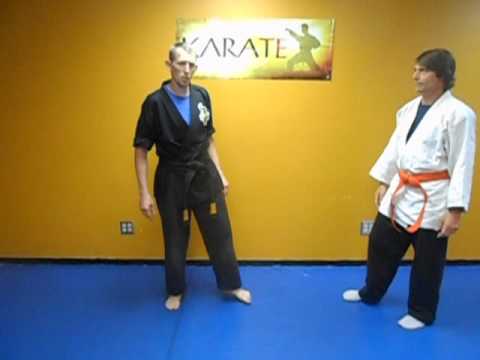
KaRaTe BacKfist VS. BoXer JaB
0
Backfist·shodan1197
Check out our other channel The.Grimesfactor
Translation: backfist
The backfist (uraken in Japanese) is a strike delivered with the back of the knuckles in a snapping motion, found across multiple martial arts traditions. [1] In karate, Funakoshi documented uraken uchi as a fundamental technique in Karate-Do Kyohan, noting its Okinawan origins. [2] Nakayama further elaborated on the backfist in Best Karate, describing it as one of the fastest hand strikes due to its whipping mechanics. [3] The backfist has been a standard technique in karate, taekwondo, and kung fu, valued for its speed and ability to strike from unusual angles. [1]
The backfist strikes with the back of the knuckles in a snapping motion. [1]
Backfists are found in karate, kung fu, and have been adopted into MMA. [1]
The spinning backfist has produced notable knockouts in MMA. [1]
No images yet for this technique.
Sign in to suggest an image.
Check out our other channel The.Grimesfactor
No instructional courses yet for this technique.
Sign in to suggest a course.
Risk of injury to the person this technique is applied to
Spinning/standing backfist; metacarpal fracture risk to striker
Skill level needed to execute this technique reliably
Whether this technique is allowed under major competition rule sets
Karate-Do Kyohan: The Master Text (Gichin Funakoshi, 1935)
Alias sources — [1] Dynamic Karate (Nakayama, 1966) [2] Dynamic Karate (Nakayama, 1966)
History sources — [1] The Art of Striking (Blauer, 2004) [2] Karate-Do Kyohan (Funakoshi, 1935) [3] Best Karate Vol. 3 (Nakayama, 1978)
Official karate technique names (和語/漢語)
Established Japanese martial arts naming convention — native Japanese term (和語/漢語)
Alias sources — [1] Dynamic Karate (Nakayama, 1966) [2] Dynamic Karate (Nakayama, 1966)
History sources — [1] The Art of Striking (Blauer, 2004) [2] Karate-Do Kyohan (Funakoshi, 1935) [3] Best Karate Vol. 3 (Nakayama, 1978)
hand speed, hip rotation, wrist alignment on impact
proportional reach, strong wrists, fast-twitch shoulder muscles
deltoids, pectorals, triceps, core rotators, forearms
Every move, in any martial art, shares a few universal traits. Mix and match below to pinpoint the right tool — or compare equivalents across styles.
A backfist delivered after a full 360-degree spin of the body, using the rotational momentum to generate significant power through the back of the hand.
A backfist delivered from a stationary position without spinning, using a snapping motion of the wrist and elbow to strike with the back of the knuckles.
Uraken Ganmen Uchi is a back-fist strike targeting the face — the back of the fist whips outward in a snapping horizontal arc to the opponent's nose, temple, or jaw. [1] The striking motion uses the wrist as a pivot point, snapping the back of the knuckles into the target. [1] One of the fastest hand strikes in karate due to the whipping mechanic. [1]
Uraken Mawashi Uchi is a spinning back-fist strike where the attacker rotates the body and whips the back of the fist in a wide horizontal arc, powered by the full body rotation. [1] Unlike the standard uraken which uses only wrist snap, the mawashi (roundhouse) version adds body rotation for significantly more power. [1] It is the karate equivalent of the spinning back fist in MMA. [1]
The backfist (uraken uchi in karate) uses the knuckles of the back of the hand in a whipping motion. Fast but less powerful than a standard punch — primarily used as a counter or surprise technique. (Nakayama, Dynamic Karate; Funakoshi, Karate-Do Kyohan)
The backfist is effective when your opponent is angled away or positioned at an angle where a traditional jab won't generate power or could injure your shoulder. According to shodan1197, if you're sideways relative to your target, attempting a jab has minimal power and risks shoulder injury, whereas the backfist works well from these angled positions.
Start from your guard position and bring your hand down before extending the backfist, being careful not to open yourself up by moving your guard too early. Shodan1197 emphasizes keeping proper guard alignment and only dropping your hand as you execute the technique to minimize defensive gaps.
You want to be on the center line with proper stance alignment. Shodan1197 notes that if your opponent leaves an opening while angled or if you sidestep to create separation, the backfist becomes a strong counter, whereas jabbing from these same positions lacks power.
A strike delivered with the back of the knuckles using a snapping or spinning motion, generating power through centrifugal force rather than linear extension.
The backfist (uraken in Japanese) is a strike delivered with the back of the knuckles in a snapping motion, found across multiple martial arts traditions. In karate, Funakoshi documented uraken uchi as a fundamental technique in Karate-Do Kyohan, noting its Okinawan origins.
Unified MMA: legal — Legal striking technique; WBC/Boxing: legal — Legal — punches are the core technique of boxing; WKF: legal — Legal, jodan/chudan punch scores 1 point (yuko) — controlled contact required; Kyokushin: restricted — Body punches legal at full power, head punches banned; WT: restricted — Punches to trunk only (1 point), punches to head banned; ITF: legal — Legal — hand techniques to head and body both permitted; WAKO: legal — Legal in Full Contact and Low Kick formats; K: legal — 1/GLORY — Legal — full power punches to head and body; IFMA: legal — Legal
Danger rating 5/10. High — spinning/standing backfist; metacarpal fracture risk to striker
The standard setup chain: Assume Fighting Stance → Generate Power → Execute Strike → Recover to Guard.
Standard counters include: Block — absorb the strike with a protective guard position / Evasion — move the target out of the strike's path / Counter-Attack — time an offensive response during the recovery phase of the strike.
Common variants: Standing backfist (snapping the back of the fist outward from a lead position); Spinning backfist (full rotation before striking with the back of the fist); Jumping spinning backfist (adding an airborne component for extra speed and power).
The spinning backfist has produced notable knockouts in MMA.
Top errors to watch for: Using excessive windup, which eliminates the surprise factor that makes the backfist effective / Hitting with the fingers or the back of the hand instead of the knuckle ridge — causes hand injuries / Throwing the backfist without a setup, making it easy to slip or block / Following through too much and leaving the back exposed to counter-attacks.
The Backfist is also known as Uraken-uchi, Uraken, Back Knuckle Strike.