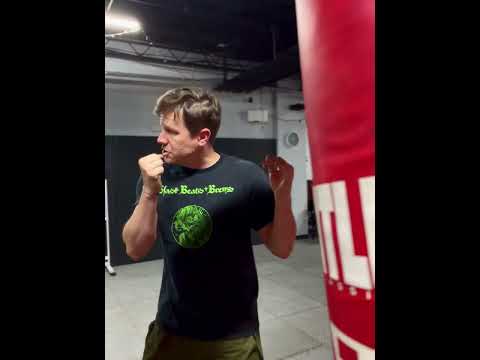
Straight v. Slightly Curved Punch Delivery
0
Curved Punch·The Combat Arts Academy
Small adjustments can yield big differences in how punches affect targets!
Translation: curved punch
Curved punches — hooks, uppercuts, and their variants — developed as distinct techniques within Western boxing as the sport evolved from bare-knuckle fighting to gloved competition. [1] Under bare-knuckle rules, looping punches were common but often injured the hands; the introduction of padded gloves under the Queensberry Rules (1867) enabled fighters to throw hooks and uppercuts with greater force and safety. [2] Dempsey codified the biomechanics of curved punches in Championship Fighting (1950), describing the hook as the 'most devastating' punch when thrown correctly and the uppercut as essential for inside fighting. [1] In Muay Thai, curved punches received less emphasis historically due to the art's focus on kicks, knees, and elbows, but gained importance as Muay Thai integrated with Western boxing in the late 20th century. [3]
Curved punches are fundamental in boxing. [1]
Hooks and uppercuts are among the highest-KO-rate punches in boxing and MMA. [1]
No images yet for this technique.
Sign in to suggest an image.
Small adjustments can yield big differences in how punches affect targets!
No instructional courses yet for this technique.
Sign in to suggest a course.
Risk of injury to the person this technique is applied to
Hooks/uppercuts; generate rotational force, high KO rate (Walilko et al. 2005)
Skill level needed to execute this technique reliably
Whether this technique is allowed under major competition rule sets
Karate-Do Kyohan: The Master Text (Gichin Funakoshi, 1935)
Alias sources — [1] Championship Fighting (Dempsey, 1950) [2] Championship Fighting (Dempsey, 1950)
History sources — [1] Championship Fighting (Dempsey, 1950) [2] The Art of Boxing and Manual of Training (Price, 1867) [3] Muay Thai Unleashed (Delp, 2006)
Official karate technique names (和語/漢語)
Established Japanese martial arts naming convention — native Japanese term (和語/漢語)
Alias sources — [1] Championship Fighting (Dempsey, 1950) [2] Championship Fighting (Dempsey, 1950)
History sources — [1] Championship Fighting (Dempsey, 1950) [2] The Art of Boxing and Manual of Training (Price, 1867) [3] Muay Thai Unleashed (Delp, 2006)
hand speed, hip rotation, wrist alignment on impact
proportional reach, strong wrists, fast-twitch shoulder muscles
deltoids, pectorals, triceps, core rotators, forearms
Every move, in any martial art, shares a few universal traits. Mix and match below to pinpoint the right tool — or compare equivalents across styles.
A dramatic, winding punch that uses a large circular arm motion to generate momentum and disguise the actual strike, popularized by fighters like Kid Gavilan and Sugar Ray Leonard.
A short, powerful punch delivered in a horizontal or semi-circular arc with the elbow bent at approximately 90 degrees, targeting the head or body from the side.
Ippon Ken is a single-knuckle fist strike where the middle finger's knuckle protrudes from the fist to create a concentrated point of impact. [1] The fist is formed by extending the middle finger's second knuckle forward while the remaining fingers are tightly closed, and the thumb braces the formation. [1] The concentrated pressure point is used to attack small, precise targets — the temple, philtrum (between nose and upper lip), and pressure points. [1]
Nihon Ken is a karate striking technique using the extended middle and index finger knuckles as the impact surface. [1] The hand forms a partial fist with the index and middle fingers extended at the second knuckle joint, creating two protruding points that concentrate force into a narrow striking area. [1] This formation allows precise targeting of vulnerable areas such as the philtrum (upper lip groove), the space between the eyes (nasion), and the throat — areas too small for a standard seiken fist to effectively target. [1] Like ippon ken (single-knuckle fist), nihon ken requires extensive knuckle conditioning through makiwara and sand bag training to prevent self-injury. [1]
A vertical punch thrown upward from a lowered position, traveling along a rising arc to strike beneath the opponent's guard, targeting the chin, solar plexus, or body.
The Uppercut to Body drives the fist upward into the opponent's midsection, targeting the solar plexus or liver. [1] Unlike the head uppercut, the body uppercut can be delivered with less risk of counter-punching. [1] It is one of the most devastating body shots in boxing when delivered to the liver. [1]
Hooks and uppercuts travel in curved trajectories to bypass the guard. The left hook is statistically the most common KO punch in professional boxing. (CompuBox boxing statistics; Dempsey, Championship Fighting)
Keeping your elbow down changes the trajectory of your punch compared to a fully extended arm. The Combat Arts Academy emphasizes practicing this during warm-ups to develop better punch delivery mechanics.
If you throw a curved punch while out of range, you'll miss your target and risk hyperextending your elbow, which can cause injury. The Combat Arts Academy stresses the importance of distance management when throwing this variation.
Blade your shoulders more and rotate into the punch, which gives you the ability to land the punch without exposing your chin excessively while maintaining mobility. The Combat Arts Academy recommends this positioning to improve both safety and effectiveness.
Punches that travel along a circular or angular path to the target, bypassing the opponent's guard by attacking from the side or below.
Curved punches — hooks, uppercuts, and their variants — developed as distinct techniques within Western boxing as the sport evolved from bare-knuckle fighting to gloved competition. Under bare-knuckle rules, looping punches were common but often injured the hands; the introduction of padded gloves under the Queensberry Rules (1867) enabled fighters to throw hooks and uppercuts with greater force and safety.
Unified MMA: legal — Legal striking technique; WBC/Boxing: legal — Legal — punches are the core technique of boxing; WKF: legal — Legal, jodan/chudan punch scores 1 point (yuko) — controlled contact required; Kyokushin: restricted — Body punches legal at full power, head punches banned; WT: restricted — Punches to trunk only (1 point), punches to head banned; ITF: legal — Legal — hand techniques to head and body both permitted; WAKO: legal — Legal in Full Contact and Low Kick formats; K: legal — 1/GLORY — Legal — full power punches to head and body; IFMA: legal — Legal
Danger rating 6/10. High — hooks/uppercuts; generate rotational force, high KO rate (Walilko et al. 2005)
The standard setup chain: Assume Fighting Stance → Generate Power → Execute Strike → Recover to Guard.
Standard counters include: Slip — move the head off the centre line to evade the punch / Parry — deflect the incoming punch with a quick hand redirection / Counter Cross — time a straight punch over the incoming attack.
Common variants: Standard variation (primary execution of the strike from the most common stance); Power variation (modified mechanics for maximum force generation); Speed variation (minimised telegraph for a faster, harder-to-read attack); Counter variation (timed to exploit the opponent's offensive commitment).
Hooks and uppercuts are among the highest-KO-rate punches in boxing and MMA.
Top errors to watch for: Winding up by pulling the arm back or cocking the elbow — the punch should fire from the guard position / Throwing wide, looping punches that travel excessive distance and are easy to see coming / Neglecting straight punches entirely and only throwing hooks and uppercuts — they need setups to land / Dropping the opposite hand during delivery, leaving the other side of the head exposed.
The Curved Punch is also known as Kyokusen-tsuki, Circular Punch, Angular Punch.