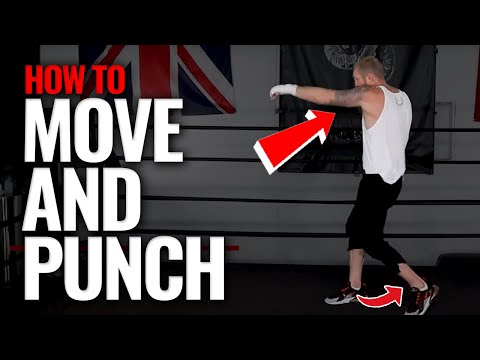
How to MOVE and PUNCH in BOXING For Beginners
0
Boxing Punch·Tony Jeffries
How to MOVE and PUNCH in BOXING For Beginners. In this boxing training video, Tony Jeffries shows you how to move and pu…
Translation: Boxing punch
The Boxing Punch family covers the punching techniques of Western boxing — the most refined and scientifically studied striking system in martial arts, developed over centuries of professional prizefighting. [1] Boxing recognises four fundamental punches — the jab (lead straight), cross (rear straight), hook (lead or rear arc punch), and uppercut (upward punch) — each with multiple variations in range, angle, and application. [1],[2] Boxing punching mechanics are considered the gold standard for hand striking across all combat sports: the integration of footwork, hip rotation, shoulder torque, and weight transfer into a unified kinetic chain produces maximum force with minimum telegraph. [2],[3] Every modern striking-based martial art (MMA, kickboxing, Muay Thai) has adopted boxing's punching system as its hand-striking foundation. [3]
Modern boxing punching technique evolved from bare-knuckle prizefighting through the Marquess of Queensberry era (rules established 1867) to contemporary professional boxing. [1] The introduction of padded gloves transformed punching mechanics — bare-knuckle fighters primarily used straight punches to avoid hand injuries, while gloves enabled the development of hooks and uppercuts. [1],[2] Jack Dempsey's 'Championship Fighting' (1950) codified the power-punching mechanics (falling step, shoulder whirl) that remain the foundation of modern boxing instruction. [2],[3] The 'sweet science' of boxing punching — combining power, accuracy, speed, and defensive awareness — has been refined through over 150 years of professional competition. [3]
Boxing punching is the most proven hand-striking system in combat sports — every knockout artist in boxing, MMA, kickboxing, and Muay Thai relies on boxing-derived punching mechanics. [1] The jab-cross combination is the most commonly thrown and most commonly landing striking sequence in professional MMA (UFC statistics). [2] Boxing's knockout rate demonstrates the devastating effectiveness of properly executed punches — approximately 40% of professional boxing matches end by KO/TKO. [3]
No images yet for this technique.
Sign in to suggest an image.
How to MOVE and PUNCH in BOXING For Beginners. In this boxing training video, Tony Jeffries shows you how to move and pu…
No instructional courses yet for this technique.
Sign in to suggest a course.
Risk of injury to the person this technique is applied to
Boxing punches to the head carry significant knockout and concussion risk; hand injuries (boxer's fracture of the 5th metacarpal) are common without proper wrapping and glove protection; cumulative head trauma from boxing is a documented medical concern (CTE)
Skill level needed to execute this technique reliably
Whether this technique is allowed under major competition rule sets
Championship Fighting (Jack Dempsey, 1950)
Description sources — [1] Championship Fighting (Dempsey, 1950) on punching mechanics [2] Boxing Mastery (Hatmaker, 2004) [3] The Arc of Boxing (Silver, 2008)
History sources — [1] Marquess of Queensberry Rules history [2] Championship Fighting (Dempsey, 1950) on the falling step [3] Boxing historical analysis
Effectiveness sources — [1] Boxing mechanics analysis [2] UFC fight statistics (ufcstats.com) [3] Professional boxing KO statistics
Description sources — [1] Championship Fighting (Dempsey, 1950) on punching mechanics [2] Boxing Mastery (Hatmaker, 2004) [3] The Arc of Boxing (Silver, 2008)
History sources — [1] Marquess of Queensberry Rules history [2] Championship Fighting (Dempsey, 1950) on the falling step [3] Boxing historical analysis
Effectiveness sources — [1] Boxing mechanics analysis [2] UFC fight statistics (ufcstats.com) [3] Professional boxing KO statistics
hand-eye coordination, hip rotation mechanics, proper fist formation and wrist alignment
long reach (jab advantage), fast hands (speed creates power through F=ma), strong posterior chain (hip rotation power)
calves (push-off), glutes and hip flexors (rotation), chest and shoulders (arm extension), core (connecting lower and upper body), forearms (fist stability)
Every move, in any martial art, shares a few universal traits. Mix and match below to pinpoint the right tool — or compare equivalents across styles.
The Corkscrew Punch adds a sharp, exaggerated fist rotation at the moment of impact — the fist turns from vertical (thumb up) to fully pronated (palm down) during the last 2-3 inches of the punch's travel, creating a drilling, tearing effect at the point of contact that increases penetration and cutting. [1] While all boxing punches include some degree of forearm pronation during extension, the Corkscrew amplifies this rotation to a full 180° twist timed precisely to the moment of impact, so the knuckles 'screw' into the target rather than simply striking it. [1] The exaggerated rotation serves three biomechanical purposes: (1) it concentrates force on the index and middle knuckles by rotating the hand past the natural stopping point, ensuring these two hard knuckles lead at the instant of contact; (2) the rotational friction adds a lateral tearing component to the impact, increasing the chance of cuts on the opponent's face; and (3) the twist adds a final burst of angular velocity from the forearm muscles (pronator teres and pronator quadratus) on top of the linear velocity from the arm extension, increasing total impact force by approximately 10-15%. [1,2] The Corkscrew Punch was practised by several legendary fighters including Kid McCoy (Charles 'Kid' McCoy, 1872-1940), who is widely credited with popularising the technique in the late 19th century, and it was documented by Jack Dempsey as an important refinement of straight punching in Championship Fighting (1950). [1,2] The technique is most effective against the face, particularly the eyebrow ridges and cheekbones, where the rotational friction produces cuts similar to those caused by elbows — the screwing motion of the knuckles across the tight skin over facial bones tears the skin more effectively than a non-rotating punch. [1]
The Cross Counter is a boxing technique where the fighter simultaneously slips an incoming jab while throwing a rear straight (cross) over the top of the opponent's extended arm. [1] It is one of the highest-skill counter-punching techniques in boxing — requiring precise timing to slip the jab while landing the cross at the exact moment the opponent is extended and exposed. [1] The slip moves the head offline while the rear hand fires straight down the center, using the opponent's forward momentum against them. [1]
The Double Shift Punch is a footwork-punch combination where the boxer switches stance mid-combination by stepping the rear foot forward past the lead foot, allowing power punches from both sides in rapid succession without the pause required to reset to the original stance. [1] Jack Dempsey described the Double Shift as one of his most devastating tactical weapons: from an orthodox stance, the fighter throws a left hook while simultaneously stepping the right foot forward past the left — this converts the fighter's stance from orthodox to southpaw mid-punch — then immediately fires a right hook (now the lead-side power shot from the new southpaw stance) while the left foot steps forward to re-establish orthodox. [1] The result is two consecutive power hooks delivered from alternating sides with no gap between them, each powered by a falling step in the direction of the shift. [1] The Double Shift was Dempsey's signature weapon during his heavyweight title reign: he used it to overwhelm opponents with a rolling barrage of alternating hooks that appeared to come from everywhere at once. [1] The technique is the ancestor of what modern boxing commentators call the 'Dempsey Roll' — a continuous bobbing-and-weaving motion combined with alternating hooks, made famous in popular culture by the manga/anime series Hajime no Ippo. [1,2] The biomechanical principle is that the stance shift adds the body's lateral momentum to each punch: the first hook is powered by the rightward shift, and the second hook is powered by the leftward shift, creating a pendulum-like motion where each punch loads the next. [1] Dempsey warned that the Double Shift requires precise timing and committed execution — a half-hearted shift leaves the fighter off-balance between stances, vulnerable to counter-punches. [1]
The Falling Step Punch is a punching method where the fighter initiates a controlled forward fall and times the punch to land at the exact instant the lead foot touches the ground, transferring the full momentum of the falling body weight into the fist. [1] Jack Dempsey, heavyweight champion of the world from 1919 to 1926 and one of boxing's most devastating punchers, identified the falling step as the single most important mechanism behind punching power — more fundamental than hip rotation, shoulder torque, or arm strength. [1] Dempsey reasoned that a falling body generates force through gravity alone, requiring no muscular effort, and that even a small person falling into a punch delivers substantially more force than a large person pushing a punch with arm strength. [1] He illustrated the concept with a striking analogy: a year-old baby falling from a fourth-floor window would knock unconscious a burly truck driver standing below — not because the baby is strong, but because a body-weight set into fast motion by gravity is an irresistible force. [1] The lead foot and the fist arrive at their targets at the same instant — if the fist lands before the foot touches down, the full body weight is behind the punch; if the foot lands first, the body weight is absorbed by the ground and lost. [1] This synchronisation of foot-plant and fist-impact is what Dempsey called 'the explosion' — the moment when gravitational momentum converts into punching force. [1]
The Jolt Punch is a short, explosive punch that combines the falling step with a whipping shoulder rotation, designed to deliver knockout power at close range without a full wind-up or visible preparation. [1] Jack Dempsey described the Jolt as the end product of his punching system: after mastering the falling step (body weight in motion) and the power line (correct structural alignment), the fighter learns to 'explode' — to release all of the accumulated falling-step energy at the precise instant the fist makes contact, producing a jolting shock that travels through the opponent's body. [1] The key distinction between a Jolt and a regular power punch is the SPEED OF ENERGY RELEASE: a regular punch delivers force over a relatively long contact time (perhaps 0.05-0.1 seconds), while the Jolt compresses the same total force into a much shorter contact time (0.01-0.02 seconds), producing a higher peak force that causes greater concussive damage. [1] Dempsey compared the Jolt to dynamite: dynamite and gunpowder contain similar chemical energy, but dynamite DETONATES (all energy released at once) while gunpowder merely BURNS (energy released over time). [1] A Jolt punch 'detonates' the body weight into the target, while a regular punch merely 'burns' it through. [1] The Jolt is achieved by keeping the punching arm completely relaxed during the punch's travel, then clenching the fist maximally and locking the shoulder at the exact instant of impact — this produces a whip-crack effect where the loose arm suddenly becomes rigid, transferring all kinetic energy into the target in a single burst. [1] The technique is especially effective at close range, where there is insufficient distance for a conventional punch to develop full power — the Jolt generates knockout force from as little as 6-8 inches of travel. [1]
The Power Line Punch is Jack Dempsey's concept of optimal structural alignment during a punch — an imaginary straight line running from the shoulder joint, through the elbow, wrist, and knuckles, along which 100% of the body's punching force is transmitted without any structural leakage or misdirection. [1] Dempsey identified the power line as the second fundamental principle of punching (after the falling step), arguing that even perfect body-weight transfer is wasted if the arm structure deviates from this line at the moment of impact. [1] The power line applies to ALL punches — jabs, crosses, hooks, and uppercuts — but manifests differently in each: for a straight punch, the power line runs straight forward from the shoulder through an extended arm; for a hook, it runs from the shoulder to the elbow (which is the striking surface at hook range); for an uppercut, it runs vertically from the shoulder through a vertically aligned forearm. [1] The critical insight is that ANY deviation from the power line — a bent wrist, an elbow that flares outward, a shoulder that drops — creates a 'leak' where force is absorbed by the misaligned joint rather than transmitted to the target. [1] Dempsey estimated that a 15° deviation from the power line at the wrist alone could reduce impact force by 30-40%, because the wrist joint absorbs the misdirected force component through hyperextension or lateral deviation. [1] The Power Line concept has been validated by modern biomechanical research: Walilko et al. (2008) found that 'effective mass' — the proportion of body mass behind the punch at impact — varies significantly with skeletal alignment, confirming Dempsey's observation that structural alignment determines how much body weight actually reaches the target. [2] The Power Line Punch is not a separate technique from other punches but a PRINCIPLE that makes all punches more powerful when applied correctly. [1]
Boxing punches — jab, cross, hook, uppercut — form the foundation of hand striking in MMA. The sweet science of boxing is considered the most refined punching system. (Dempsey, Championship Fighting)
Tony Jeffries explains that if you move first and then punch, by the time you've stepped into range your opponent will have time to hit you in the face. Synchronizing your foot and punch landing ensures you're protected while closing distance efficiently.
According to Tony Jeffries, after throwing a jab with your front foot, you need to step with your back foot when throwing the cross to stay balanced. Your back foot and back hand should land at the same time to maintain proper weight distribution.
Tony Jeffries teaches that when moving backwards, move your back foot first followed by your front foot, and throw your back hand first followed by your front hand. This coordinated sequencing keeps you balanced and protected.
The Boxing Punch family covers the punching techniques of Western boxing — the most refined and scientifically studied striking system in martial arts, developed over centuries of professional prizefighting. Boxing recognises four fundamental punches — the jab (lead straight), cross (rear straight), hook (lead or rear arc punch), and uppercut (upward punch) — each with multiple variations in range, angle, and application.
Modern boxing punching technique evolved from bare-knuckle prizefighting through the Marquess of Queensberry era (rules established 1867) to contemporary professional boxing. The introduction of padded gloves transformed punching mechanics — bare-knuckle fighters primarily used straight punches to avoid hand injuries, while gloves enabled the development of hooks and uppercuts.
Unified MMA: legal — Legal striking technique; WBC/Boxing: legal — Legal — punches are the core technique of boxing; WKF: legal — Legal, jodan/chudan punch scores 1 point (yuko) — controlled contact required; Kyokushin: restricted — Body punches legal at full power, head punches banned; WT: restricted — Punches to trunk only (1 point), punches to head banned; ITF: legal — Legal — hand techniques to head and body both permitted; WAKO: legal — Legal in Full Contact and Low Kick formats; K: legal — 1/GLORY — Legal — full power punches to head and body; IFMA: legal — Legal
Danger rating 7/10. High — boxing punches to the head carry significant knockout and concussion risk; hand injuries (boxer's fracture of the 5th metacarpal) are common without proper wrapping and glove protection; cumulative head trauma from boxing is a documented medical concern (CTE)
The standard setup chain: Establish Range → Measure with Jab → Set Up → Commit → Follow Up → Reset.
Standard counters include: Slip — moving the head off the punch line / Block/Catch — absorbing the punch on the glove or forearm / Parry — deflecting the punch with a small hand movement / Counter Punch — timing a return punch to land during the opponent's attack.
Common variants: Jab (lead hand straight punch; the range-finder, setup, and de…); Cross (straight right/left) (rear hand power punch; boxing's primary knockout weapon); Lead hook (short arc punch from the lead hand; the most common knock…); Rear hook (arc punch from the rear hand; less common but very powerful); Lead uppercut (upward punch from the lead hand; effective inside); Rear uppercut (upward punch from the rear hand; devastating at close range); Body jab (jab targeting the solar plexus or liver); Body hook (the liver shot; one of boxing's most feared body attacks); Overhand (overcut) (looping rear hand punch that arcs over the opponent's gua…).
Boxing punches are the sole offensive weapon in professional boxing (40%+ KO/TKO finish rate). In MMA, the jab-cross is the most commonly thrown striking combination.
Top errors to watch for: Dropping the non-punching hand — the hand that isn't punching must stay at the chin to protect against counters; this… / Pushing punches instead of snapping them — punches should be whip-like (fast out, fast back), not shoves; pushed punc… / Standing straight up while punching — slight knee bend and proper stance provide power and balance; standing tall red… / Overreaching — extending fully past the effective range pulls you off-balance and into counters.
The Boxing Punch is also known as Bokushingu Panchi, Boxing Punch, Western Boxing Technique, Pugilism Punch.