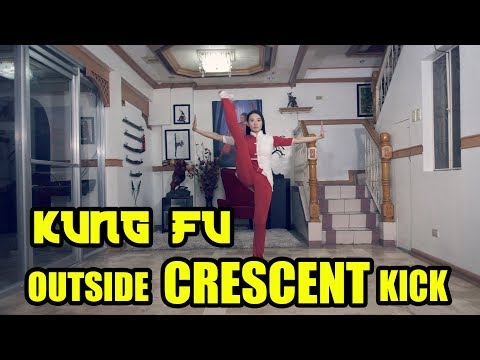
KUNG FU OUTSIDE CRESCENT KICK
0
Outside Crescent Kick·Janice Hung
There are several kicks in Kung Fu but it is important to first learn the basic kicks. The crescent kick is done in othe…
Translation: outside crescent kick
The Outside Crescent Kick subfamily covers crescent kicks that travel from the inside to the outside in a sweeping arc, with the kicking leg swinging away from the body's centreline as it strikes. [1] The outside crescent kick uses hip abduction to swing the extended leg outward, impacting with the outer edge of the foot or heel against the opponent's head, shoulder, or extended arm. [1],[2] This kick can be used to sweep aside an opponent's guard or to strike the temple with a powerful outward-swinging arc. [2],[3]
The outside crescent kick sweeps from inside to outside. [1]
A TKD and karate technique. [1]
Used in competition. [1]
No images yet for this technique.
Sign in to suggest an image.
There are several kicks in Kung Fu but it is important to first learn the basic kicks. The crescent kick is done in othe…
#martialarts #kicks Crescent Kick with Sifu Vincent Raimondi. https://martialboutique.gumroad.com/l/chinatownjkd
No instructional courses yet for this technique.
Sign in to suggest a course.
Risk of injury to the person this technique is applied to
Arcing kick; primarily used for guard manipulation
Skill level needed to execute this technique reliably
Whether this technique is allowed under major competition rule sets
Karate-Do Kyohan: The Master Text (Gichin Funakoshi, 1935)
Alias sources — [1] Kukkiwon Taekwondo Textbook (Kukkiwon, 2006) [2] Karate-Do Kyohan (Funakoshi, 1935) [3] Dynamic Karate (Nakayama, 1966)
Effectiveness sources — [1] Comprehensive Asian Fighting Arts (Draeger & Smith, 1969)
Official karate technique names (和語/漢語)
Established Japanese martial arts naming convention — native Japanese term (和語/漢語)
Alias sources — [1] Kukkiwon Taekwondo Textbook (Kukkiwon, 2006) [2] Karate-Do Kyohan (Funakoshi, 1935) [3] Dynamic Karate (Nakayama, 1966)
Effectiveness sources — [1] Comprehensive Asian Fighting Arts (Draeger & Smith, 1969)
speed, power generation through kinetic chain, striking surface conditioning
athletic build with fast-twitch muscle fibres
varies by strike — hip rotators, shoulders, core
Every move, in any martial art, shares a few universal traits. Mix and match below to pinpoint the right tool — or compare equivalents across styles.
Make sure your body is fully warmed up and stretched before attempting the kick. Janis Hung recommends doing a kung fu wall stretch first to help prepare your body for kicking.
While the outside crescent kick term is used across different martial arts and combat sports, there are variations in how it is performed. Janice Hung notes that kung fu or wushu has its own specific way of executing this kick.
Balance is critical—the JKD Wednesday Night Group instructor emphasizes that you must always work on your balance, as losing it means losing everything when executing the kick.
Always recover after executing the kick. The JKD Wednesday Night Group instructor stresses the importance of recovery as a fundamental part of the technique.
The Outside Crescent Kick subfamily covers crescent kicks that travel from the inside to the outside in a sweeping arc, with the kicking leg swinging away from the body's centreline as it strikes. The outside crescent kick uses hip abduction to swing the extended leg outward, impacting with the outer edge of the foot or heel against the opponent's head, shoulder, or extended arm.
The outside crescent kick parallels the inside variant in its development within Korean and Chinese martial arts. In taekwondo, both inside and outside crescent kicks are standard curriculum techniques, practised in forms and applied in free sparring.
Unified MMA: legal — Legal striking technique; WBC/Boxing: banned — All kicks prohibited in boxing; WKF: legal — Legal, chudan (body) kick scores 2 points, jodan (head) kick scores 3 points; Kyokushin: legal — Legal at full power to body and head; WT: legal — Legal, body kick 2 points, head kick 3 points, spinning body 4 points, spinni…; WAKO: legal — Legal in Full Contact and Low Kick formats; K: legal — 1/GLORY — Legal; IFMA: legal — Legal — kicks are a core Muay Thai technique
Danger rating 5/10. High — arcing kick; primarily used for guard manipulation
The standard setup chain: Stance and Range → Chamber the Leg → Execute the Kick → Recover.
Standard counters include: Check (Shin Block) — raise the shin to intercept the kick before it lands / Catch and Sweep — catch the kicking leg and sweep the standing leg / Step Inside — close distance inside the kick's effective range to smother it.
Common variants: Standard variation (primary execution of the strike from the most common stance); Power variation (modified mechanics for maximum force generation); Speed variation (minimised telegraph for a faster, harder-to-read attack); Counter variation (timed to exploit the opponent's offensive commitment).
Used in competition.
Top errors to watch for: Swinging too wide and losing the tight arc that makes the kick accurate and effective / Not reaching target height — the leg must come up to head level for the kick to work / Crossing the standing legs during the setup, which destroys balance / Over-rotating the body with the outward swing, exposing the back.
The Outside Crescent Kick is also known as Soto Mikazuki-geri, Bakkat Bandal Chagi, Soto Mikazuki Geri, Outward Crescent.