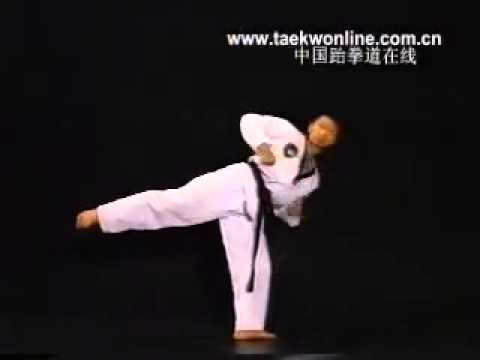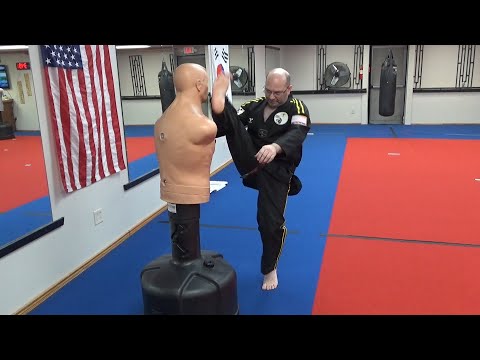
Crescent Kick Tutorial
0
Inside Crescent Kick·Technical Taekwondo
kicking tutorial on the inside and outside crescent kicks with a few variations Thank You for Watching. Subscribe for M…
Translation: inside crescent kick
The Inside Crescent Kick subfamily covers crescent kicks that travel from the outside to the inside in a sweeping arc, with the kicking leg crossing the body's centreline as it strikes. [1] The inside crescent kick uses hip adduction to swing the extended leg inward, impacting with the sole or ball of the foot against the opponent's temple, jaw, or the side of the head. [1],[2] This kick can also be used to slap down an opponent's guard or deflect a lead hand, opening a path for follow-up strikes. [2],[3]
The inside crescent kick developed within Korean and Chinese martial arts traditions that emphasised versatile, circular kicking techniques for both offensive striking and defensive parrying applications. [1] In taekwondo, the inside crescent kick is taught as a fundamental technique and is used in both forms (poomsae) and sparring. [2],[3]
The inside crescent kick sweeps from outside to inside. [1]
A TKD and karate technique. [1]
Used in competition. [1]
No images yet for this technique.
Sign in to suggest an image.
kicking tutorial on the inside and outside crescent kicks with a few variations Thank You for Watching. Subscribe for M…
No instructional courses yet for this technique.
Sign in to suggest a course.
Risk of injury to the person this technique is applied to
Arcing kick; primarily used for guard manipulation
Skill level needed to execute this technique reliably
Whether this technique is allowed under major competition rule sets
Karate-Do Kyohan: The Master Text (Gichin Funakoshi, 1935)
Alias sources — [1] Kukkiwon Taekwondo Textbook (Kukkiwon, 2006) [2] Karate-Do Kyohan (Funakoshi, 1935) [3] Dynamic Karate (Nakayama, 1966)
Effectiveness sources — [1] Comprehensive Asian Fighting Arts (Draeger & Smith, 1969)
Official karate technique names (和語/漢語)
Established Japanese martial arts naming convention — native Japanese term (和語/漢語)
Alias sources — [1] Kukkiwon Taekwondo Textbook (Kukkiwon, 2006) [2] Karate-Do Kyohan (Funakoshi, 1935) [3] Dynamic Karate (Nakayama, 1966)
Effectiveness sources — [1] Comprehensive Asian Fighting Arts (Draeger & Smith, 1969)
hip rotation power, rear foot pivot, full kinetic chain coordination
reach advantage, strong hips for power transfer
glutes, obliques, pectorals, triceps, deltoids
Every move, in any martial art, shares a few universal traits. Mix and match below to pinpoint the right tool — or compare equivalents across styles.
Technical Taekwondo recommends swinging your leg up and making a big circle from one shoulder across to the opposite shoulder to loosen your hips, even though you won't make such an exaggerated motion during the actual kick.
The snap crescent kick has a tighter range than a front snap kick because you're carrying the hip through into a circular motion while lifting the knee and popping it out, according to Technical Taekwondo.
Stellar Martial Arts recommends lifting your leg at around a 45-degree angle between the front and the side; if you lift too far toward the front, your opponent's hands or shoulder may block the kick.
Technical Taekwondo notes that the rear leg snap crescent is compact and folds in quickly, popping up almost like a vertical front kick, making it difficult for opponents to detect.
The Inside Crescent Kick subfamily covers crescent kicks that travel from the outside to the inside in a sweeping arc, with the kicking leg crossing the body's centreline as it strikes. The inside crescent kick uses hip adduction to swing the extended leg inward, impacting with the sole or ball of the foot against the opponent's temple, jaw, or the side of the head.
The inside crescent kick developed within Korean and Chinese martial arts traditions that emphasised versatile, circular kicking techniques for both offensive striking and defensive parrying applications. In taekwondo, the inside crescent kick is taught as a fundamental technique and is used in both forms (poomsae) and sparring.
Unified MMA: legal — Legal striking technique; WBC/Boxing: banned — All kicks prohibited in boxing; WKF: legal — Legal, chudan (body) kick scores 2 points, jodan (head) kick scores 3 points; Kyokushin: legal — Legal at full power to body and head; WT: legal — Legal, body kick 2 points, head kick 3 points, spinning body 4 points, spinni…; WAKO: legal — Legal in Full Contact and Low Kick formats; K: legal — 1/GLORY — Legal; IFMA: legal — Legal — kicks are a core Muay Thai technique
Danger rating 5/10. High — arcing kick; primarily used for guard manipulation
The standard setup chain: Stance and Range → Chamber the Leg → Execute the Kick → Recover.
Standard counters include: Check (Shin Block) — raise the shin to intercept the kick before it lands / Catch and Sweep — catch the kicking leg and sweep the standing leg / Step Inside — close distance inside the kick's effective range to smother it.
Common variants: Standard cross (rear-hand straight punch with full hip rotation); Counter cross (pull counter) (leaning back to avoid the jab, firing the cross as a counter); Step-in cross (stepping forward with the punch for added reach and power); Body cross (targeting the solar plexus or liver with the straight rea…).
Used in competition.
Top errors to watch for: Not swinging the leg high enough to reach the head — the arc must rise to target height / Bending the knee during the swing, which shortens the reach and weakens the whipping force / Over-crossing the centre line and losing balance as the leg pulls the body sideways / Not controlling the foot after impact — the leg continues past the target and you must pull it back.
The Inside Crescent Kick is also known as Uchi Mikazuki-geri, An Bandal Chagi, Uchi Mikazuki Geri, Inward Crescent.