Crescent Kick Tutorial - Inside & Outside (Standing, Spinning & Jumping)
0
360 Spin Crescent Kick·Adventure Tae Kwon Do
Master Rana breaks down both inside and outside cresent kick techniques, including striking areas, chambering options, s…
Translation: 360-do (360度) = 360 degrees, Kaiten (回転) = rotation, Mikazuki (三日月) = crescent moon, Geri (蹴り) = kick — a crescent kick delivered after a complete 360-degree body rotation for maximum centrifugal force
The 360 Spin Crescent Kick completes a full 360-degree body rotation before delivering the crescent kick, generating maximum centrifugal force through the longest possible spinning path — the entire body serves as a flywheel that accelerates the kicking leg to its highest possible velocity. [1] While a standard spinning crescent kick uses a 180-degree rotation (half turn), and a tornado kick uses approximately 270 degrees, the 360 Spin Crescent completes the full circle: the practitioner begins facing the opponent, rotates an entire revolution, and delivers the crescent kick upon returning to the original facing direction. [1] This means the kick arrives from the SAME direction the practitioner was originally facing, but with an entire revolution's worth of rotational momentum behind it — the foot travels through the longest possible arc, building speed continuously throughout the rotation. [1] The 360 Spin Crescent is a high-risk, high-reward technique: the full rotation is slow (approximately 0.8-1.2 seconds), highly telegraphed (the opponent sees the spin developing), and leaves the practitioner off-balance during the rotation — but if the kick connects, the accumulated centrifugal force produces one of the most powerful single impacts achievable with a human body. [1] De Bremaeker and Faige document the 360 Spin Crescent as the final technique in the crescent kick chapter of their 89-kick compilation, noting that it represents the extreme end of the power-versus-risk spectrum in kicking martial arts. [1] In taekwondo competition (particularly WT rules, which award bonus points for spinning and jumping techniques), the 360 Spin Crescent and related full-rotation kicks are used as dramatic scoring techniques, especially in the final seconds of a round when a high-value technique is needed to overcome a points deficit. [2] In demonstration and exhibition martial arts (XMA, tricking, wushu), the 360 Spin Crescent and its airborne variants are among the most visually spectacular techniques performed. [3]
Full-rotation spinning kicks have been practised in martial arts for centuries, appearing in Northern Chinese kung fu (which favours dynamic, acrobatic kicking), Korean martial arts (where spinning kicks are a defining characteristic of taekwondo), and in capoeira (where the roda encourages spectacular, flowing movements). [1] The 360 Spin Crescent specifically developed in competitive taekwondo and wushu, where full-rotation techniques are valued both for their scoring potential (bonus points) and their visual impact in demonstrations. [1],[2] In WT taekwondo competition, the 2008 rule change that introduced bonus points for spinning techniques incentivised fighters to develop increasingly complex rotational kicks, including the 360° crescent and its variants. [2] The technique reached mainstream awareness through martial arts cinema (the spinning crescent is a staple of Hong Kong action films and Korean martial arts movies) and through competitive tricking/XMA, where full-rotation kicks are foundational movements. [3] De Bremaeker and Faige documented the 360 Spin Crescent as Section 6.10 in their 2010 compilation, the final and most dramatic technique in the crescent kick chapter. [1]
The 360 Spin Crescent is the martial arts equivalent of a 'Hail Mary' play in American football: when it works, the result is spectacular and fight-ending; when it doesn't, the attempt leaves the practitioner vulnerable. [1] In WT taekwondo competition, full-rotation kicks account for a small percentage of total techniques thrown but a disproportionate percentage of highlight-reel knockouts — the accumulated centrifugal force of the full rotation produces impacts that exceed 1,000 pounds of force in elite practitioners. [2] The technique's practical effectiveness is limited by its telegraphing (the opponent has 0.8-1.2 seconds to react), its balance demands (the full rotation is inherently unstable), and its commitment (once initiated, the spin cannot be aborted mid-rotation). [1] These limitations make it a specialist technique for specific situations (trapped opponent, final-seconds scoring attempt, demonstration) rather than a reliable primary weapon. [1]
Used in WT taekwondo competition as a high-value scoring technique (bonus points for spinning and head kicks). The 360 Spin Crescent and related full-rotation kicks have produced numerous highlight-reel knockouts in taekwondo World Championships and Olympic Games. In wushu competition, the technique is a standard element of competitive forms. In XMA/tricking, 360° and 540° spinning crescents are foundational competition movements.
No images yet for this technique.
Sign in to suggest an image.
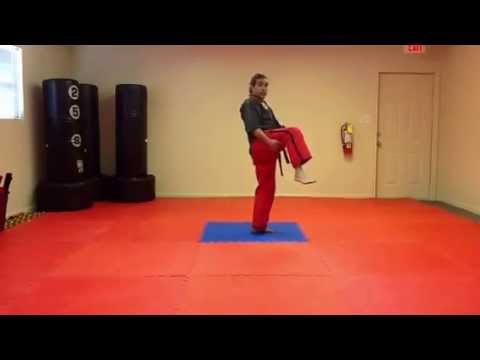
Master Rana breaks down both inside and outside cresent kick techniques, including striking areas, chambering options, s…
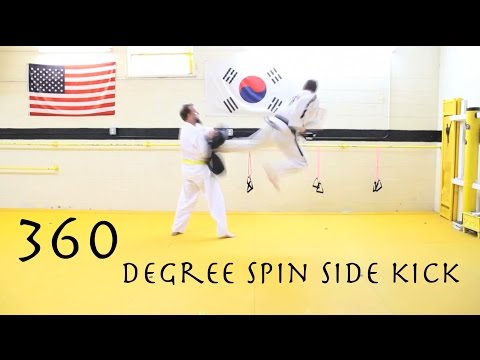
This is a tutorial on how to perform the 360 degree spin side kick. This is an advanced and difficult version of the sid…
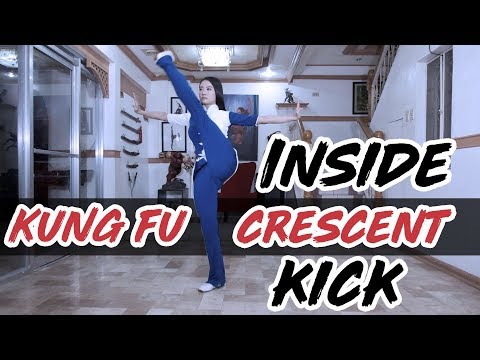
#kungfu #kick #insidecrescentkick There is another type of kick that is fundamental in doing Kung Fu. By doing the diff…
The 360 spin crescent kick represents an advanced rotational kicking technique combining elements of spinning mechanics with crescent-kick trajectories. Simon Scher emphasizes the 360 spin as a variation of the spin sidekick, requiring prerequisite mastery of fundamental sidekick mechanics, spin sidekicks, and jump spin sidekicks before attempting the full rotation. Scher's progression involves stepping forward while allowing the rear leg to initiate upward momentum without touching the ground, executing a jump spin sidekick after two full body rotations. He notes the technique can travel forward or remain stationary, and presents an advanced variation combining a flying sidekick with a subsequent spinning sidekick. Adventure Tae Kwon Do provides broader crescent-kick context, distinguishing inside and outside crescent variations with both straight-leg and chambered (whipping) versions, the latter generating greater power through hip torque. Adventure TKD demonstrates a spinning 540 crescent kick incorporating a small cheater step to facilitate rotation. Janice Hung covers the inside crescent kick fundamentals in Kung Fu, emphasizing the semicircular foot path from outside to inside, proper ankle flexion, and upper-body stillness. While Scher focuses on the sidekick-derived rotation and forward momentum, Adventure TKD and Hung address crescent mechanics separately. All instructors agree the technique demands substantial foundational skill development. Scher characterizes the 360 spin as primarily demonstrative rather than practical for sparring applications.
Synthesized from 3 instructors
No instructional courses yet for this technique.
Sign in to suggest a course.
Risk of injury to the person this technique is applied to
When the 360 Spin Crescent connects — particularly to the head — the accumulated centrifugal force produces devastating knockout power. The foot travels through the longest possible arc, building speed throughout the rotation, and the impact at the end of the arc delivers the peak velocity. However, the danger is primarily to the kicker: the extended rotation time, the balance challenges, and the telegraphed nature of the technique make it easy to counter if the opponent is prepared. A missed 360 Spin Crescent leaves the kicker off-balance and vulnerable. [1]
Skill level needed to execute this technique reliably
Whether this technique is allowed under major competition rule sets
Essential Book of Martial Arts Kicks (De Bremaeker & Faige, 2010)
description: [1] De Bremaeker 2010 pp.251-253, [2] Pieter 1997 force data
Mixed Japanese-Western terminology — combines traditional Japanese terms with katakana loanwords
description: [1] De Bremaeker 2010 pp.251-253, [2] Pieter 1997 force data
Requires excellent balance and proprioception during the full 360° rotation
Strong core (obliques) for fast, controlled rotation
Good hip flexibility for the crescent kick at the end of the rotation
Fast-twitch leg muscles for explosive spinning
Above-average cardiovascular fitness (the full rotation is physically demanding)
Practitioners with gymnastics, dance, or wushu backgrounds adapt faster due to rotational familiarity
Practice all the same movements but focus on taking the energy upward instead of forward. Simon Scher recommends starting stationary to build control before adding distance.
Practice on a kicking shield that your opponent is holding, but make sure you have accurate aim to avoid accidentally striking their head or elbow instead of the shield. Simon Scher emphasizes proper targeting during partner drills.
Simon Scher recommends practicing variations like the flying sidekick into spinning sidekick combination on a heavy bag or Wavemaster for safety and feedback.
The 360 Spin Crescent Kick completes a full 360-degree body rotation before delivering the crescent kick, generating maximum centrifugal force through the longest possible spinning path — the entire body serves as a flywheel that accelerates the kicking leg to its highest possible velocity. While a standard spinning crescent kick uses a 180-degree rotation (half turn), and a tornado kick uses approximately 270 degrees, the 360 Spin Crescent completes the full circle: the practitioner begins facing the opponent, rotates an entire revolution, and delivers the crescent kick upon returning to the original facing direction.
Full-rotation spinning kicks have been practised in martial arts for centuries, appearing in Northern Chinese kung fu (which favours dynamic, acrobatic kicking), Korean martial arts (where spinning kicks are a defining characteristic of taekwondo), and in capoeira (where the roda encourages spectacular, flowing movements). The 360 Spin Crescent specifically developed in competitive taekwondo and wushu, where full-rotation techniques are valued both for their scoring potential (bonus points) and their visual impact in demonstrations.
Unified MMA: legal — Legal striking technique; WBC/Boxing: banned — All kicks prohibited in boxing; WKF: legal — Legal, chudan (body) kick scores 2 points, jodan (head) kick scores 3 points; Kyokushin: legal — Legal at full power to body and head; WT: legal — Legal, body kick 2 points, head kick 3 points, spinning body 4 points, spinni…; WAKO: legal — Legal in Full Contact and Low Kick formats; K: legal — 1/GLORY — Legal; IFMA: legal — Legal — kicks are a core Muay Thai technique
Danger rating 8/10. When the 360 Spin Crescent connects — particularly to the head — the accumulated centrifugal force produces devastating knockout power. The foot travels through the longest possible arc, building speed throughout the rotation, and the impact at the end of the arc delivers the peak velocity. However, the danger is primarily to the kicker: the extended rotation time, the balance challenges, and the telegraphed nature of the technique make it easy to counter if the opponent is prepared. A missed 360 Spin Crescent leaves the kicker off-balance and vulnerable.
The standard setup chain: Establish shorter spinning techniques (180° spinning crescent, 180° spinning back kick) to condition the opponent to react to spins → Opponent develops a timing-based defence against 180° spins → Initiate what appears to be a 180° spin → CONTINUE the rotation past 180° to 360° → The opponent's defence, calibrated for the 180° kick, completes too early → The kick arrives approximately 0.4-0.6 seconds AFTER the defence has resolved → Crescent kick impacts the now-undefended target with full 360° centrifugal force → If missed: immediately recover to fighting stance or continue to a second technique.
Standard counters include: Step back — the 0.8-1.2 second rotation time provides ample opportunity to retreat beyond the kick's range / Side step — moving laterally during the spin takes the target off the kick's circular path / Advance and jam — closing distance BEFORE the rotation is complete prevents the kick from developing; a clinch or str… / Time a counter to the back-turned phase — at approximately the 180° point, the kicker's back is fully exposed; a fast….
Common variants: Standard 360 Spin Crescent (inside) (the inside crescent kick delivered after a full rotation …); 360 Spin Outside Crescent (the outside crescent variant, sweeping outward after the …); Jumping 360 Spin Crescent (adding a jump to the rotation, creating an airborne full-…); 540 Spin (extending to 1.5 rotations for even more power (approachi…); Ground-level 360 Crescent (performing the rotation at a lower body level, sweeping t…); 360 Crescent to the body (targeting the midsection rather than the head, reducing t…).
Used in WT taekwondo competition as a high-value scoring technique (bonus points for spinning and head kicks). The 360 Spin Crescent and related full-rotation kicks have produced numerous highlight-reel knockouts in taekwondo World Championships and Olympic Games.
Top errors to watch for: Losing visual contact with the target — the most critical error: if the head does not rotate ahead of the body to tra… / Positional drift — if the rotation causes the body to drift laterally (common when the pivot foot is unsteady), the k… / Over-rotating past 360° — spinning too far means the kick arrives after the optimal moment, hitting at a declining ve… / Telegraphing with the wind-up — any preparatory movement (dropping hands, shifting weight, looking over the shoulder)….
The 360 Spin Crescent Kick is also known as 360-do Kaiten Mikazuki Geri, Full-Rotation Crescent, 360 Mikazuki Geri, Complete Spin Crescent, Tornado Crescent.