Spin Crescent Kick
0
Spin-Back Outside Crescent Kick·Beyond Taekwondo
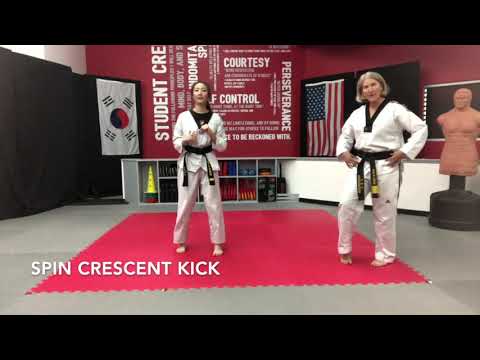
This video is a tutorial of the spin Crescent Kick. Here we breakdown rotation, hip motion, foot placement and flow.
Translation: Spin-back outside crescent kick
The Spin-Back Outside Crescent Kick combines a 180-degree spin with an outside crescent kick, generating tremendous centrifugal force. [1] The spinning outside crescent is one of the most visually dramatic kicks and delivers significant power to the side of the head. [1]
Offers specific tactical advantages over the standard crescent kick in appropriate situations. [1]
Cross-style martial arts kicking tradition; documented in kick compendiums. [1]
High-risk, high-reward technique seen in MMA, kickboxing, and TKD competition. Multiple notable KOs in UFC and GLORY kickboxing. Less common than standard kicks but spectacular when it lands. [1]
No images yet for this technique.
Sign in to suggest an image.
This video is a tutorial of the spin Crescent Kick. Here we breakdown rotation, hip motion, foot placement and flow.
The spin-back outside crescent kick is executed by pivoting on the ball of the supporting foot while initiating the rotation with arm and elbow drive, as emphasized by both Beyond Taekwondo and Fariborz Azhakh. The critical distinguishing feature is hip positioning: the hips must face the target at the moment of strike, differentiating this technique from spin hook or spin heel kicks where hips face lateral or backward directions. Beyond Taekwondo stresses the importance of spotting (fixing gaze on a target point before, during, and after the spin) to prevent dizziness and maintain body control, while emphasizing upright posture and knee height during the chambering phase. Azhakh introduces the "rubber band" principle—that spinning power derives from winding and unwinding the body, with the leg extending past the intended impact point before striking. Both instructors agree on maintaining control through proper hip opening and extension. Azhakh notes two valid approaches to leg configuration: bent-leg execution for close range and straight-leg execution for distance. The instructors align on using the side of the foot for contact and breathing out during the kick for proper force release. Both recommend drilling progressively from stationary positions with targets to develop accuracy and body awareness.
Synthesized from 2 instructors
No instructional courses yet for this technique.
Sign in to suggest a course.
Risk of injury to the person this technique is applied to
Crescent Kick variant with standard striking power
Skill level needed to execute this technique reliably
Whether this technique is allowed under major competition rule sets
Essential Book of Martial Arts Kicks (De Bremaeker & Faige, 2010)
[1] De Bremaeker & Faige, Essential Book of Martial Arts Kicks (2010)
Requires solid crescent kick foundation
Good balance and coordination
Documented in De Bremaeker & Faige, Section 6.3. The spinning outside crescent adds rotational momentum to the vertical arc. The heel swings in a wide vertical circle from outside to inside. (De Bremaeker & Faige, Essential Book of Martial Arts Kicks, 2010)
You need to be on the ball of your foot when you spin, and don't step with your front foot—instead, launch with your back foot. Beyond Taekwondo emphasizes that spotting a fixed point ahead of you as you turn and finish looking at that same spot keeps your body grounded and prevents dizziness.
Use your arms and elbows to start the rotation, then let your hips lift and follow. Make sure your hip opens to the side as you throw the knee across—if your hip doesn't open to the side, you'll end up doing a spin hook kick or spin heel kick instead. Beyond Taekwondo stresses that the hip must drop open during the motion.
Leaning back instead of pushing your hips forward throws off your balance and causes your back leg to hop afterward. Focus on maintaining proper alignment and pushing your hips forward throughout the kick to stay balanced.
You should hit with the side of your foot, not your toes. Fariborz Azhakh notes that you want to aim past the target rather than directly at it to ensure proper technique.
The Spin-Back Outside Crescent Kick combines a 180-degree spin with an outside crescent kick, generating tremendous centrifugal force. The spinning outside crescent is one of the most visually dramatic kicks and delivers significant power to the side of the head.
The Spin-Back Outside Crescent Kick is a specialised variant documented in cross-style kicking methodology. It represents an advanced development of the standard crescent kick.
Unified MMA: legal — Legal striking technique; WBC/Boxing: banned — All kicks prohibited in boxing; WKF: legal — Legal, chudan (body) kick scores 2 points, jodan (head) kick scores 3 points; Kyokushin: legal — Legal at full power to body and head; WT: legal — Legal, body kick 2 points, head kick 3 points, spinning body 4 points, spinni…; WAKO: legal — Legal in Full Contact and Low Kick formats; K: legal — 1/GLORY — Legal; IFMA: legal — Legal — kicks are a core Muay Thai technique
Danger rating 6/10. Crescent Kick variant with standard striking power
The standard setup chain: Feint → Spin-Back Outside Crescent Kick → Follow-up combination.
Standard counters include: Step inside range / Block and counter / Low kick to support leg.
Common variants: High variant; Mid variant; Low variant.
High-risk, high-reward technique seen in MMA, kickboxing, and TKD competition. Multiple notable KOs in UFC and GLORY kickboxing.
Top errors to watch for: Attempting without solid crescent kick foundation / Poor balance / Insufficient power generation.
The Spin-Back Outside Crescent Kick is also known as Supin Bakku Autosaido Kuresento Kikku, Spinning Outside Crescent.