Mounted Rubber Guard - 10th Planet Jiu Jitsu
0
10th Planet Guard·Brandon Mccaghren
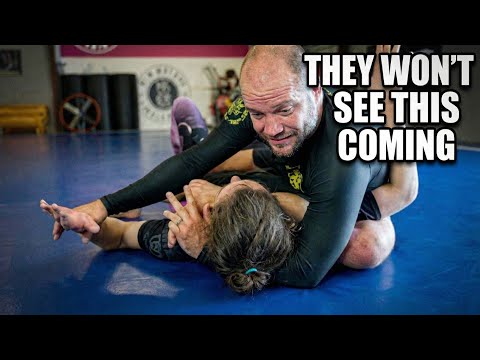
Most people think of Rubber Guard as a bottom game, but when you apply these mechanics from the mount, you unlock an int…
Translation: 10th Planet guard
The 10th Planet Guard family covers guard positions developed within Eddie Bravo's 10th Planet Jiu-Jitsu system, designed exclusively for no-gi grappling and characterised by flexibility-based leg controls that replace traditional gi grips. [1] The signature position is the Rubber Guard — from closed guard, the bottom player uses their flexibility to bring their shin across the opponent's neck and shoulders, controlling posture with the legs alone rather than collar grips. [1],[2] The system uses a unique nomenclature (Mission Control, Chill Dog, New York, Meathook, Zombie, Crackhead Control) and creates pathways to submissions that are inaccessible from traditional closed guard. [2],[3] While requiring above-average hip flexibility, 10th Planet guards have proven effective in both submission grappling (EBI) and MMA competition. [3]
The 10th Planet Guard system was developed by Eddie Bravo after he founded 10th Planet Jiu-Jitsu in 2003. [1] Bravo created the Rubber Guard specifically to address the problem of fighting off your back in MMA without a gi — traditional BJJ guard attacks rely on collar grips unavailable in MMA. [1],[2] The system gained worldwide attention when Bravo used it to submit Royler Gracie at ADCC 2003 and was further popularised through the Eddie Bravo Invitational (EBI) competition series. [2],[3]
10th Planet guard positions have proven effective in both EBI competition and MMA, where the Rubber Guard's ability to control posture without gi grips addresses a critical gap in no-gi grappling. [1] Multiple 10th Planet fighters have used the Rubber Guard successfully in UFC and Bellator competition. [2]
No images yet for this technique.
Sign in to suggest an image.
Most people think of Rubber Guard as a bottom game, but when you apply these mechanics from the mount, you unlock an int…
No instructional courses yet for this technique.
Sign in to suggest a course.
Risk of injury to the person this technique is applied to
Moderate — the primary risk is hip and knee strain from the flexibility demands; forcing Rubber Guard positions without adequate flexibility can cause groin and hip injuries; opponents may attempt to stack or slam from Rubber Guard in some rulesets
Skill level needed to execute this technique reliably
Whether this technique is allowed under major competition rule sets
Mastering the Rubber Guard (Eddie Bravo, 2006)
Description sources — [1] Mastering the Rubber Guard (Bravo, 2006) [2] Eddie Bravo's competition and teaching career [3] EBI competition records
Mastering the Rubber Guard (Eddie Bravo, 2006) || Advanced Rubber Guard (Eddie Bravo, BJJ instructional) || Twister (Eddie Bravo, 2007)
Description sources — [1] Mastering the Rubber Guard (Bravo, 2006) [2] Eddie Bravo's competition and teaching career [3] EBI competition records
hip flexibility (the primary requirement — without it, Rubber Guard is inaccessible), leg dexterity, core strength
flexible/limber body type, long legs, good proprioception
hip flexors and adductors (maintaining leg-on-shoulder position), core (controlling posture from bottom), hamstrings (pulling the leg into position)
Every move, in any martial art, shares a few universal traits. Mix and match below to pinpoint the right tool — or compare equivalents across styles.
The Cocoon is a transitional rubber guard position where both legs wrap the opponent's torso while arm control is maintained, serving as a launching pad for X-guard sweeps and leg attacks. [1]
Mud Dog Control is a rubber guard position maintaining an underhook from bottom while the legs control posture, creating a platform for back takes and sweeps. [1]
New Stomp is Eddie Bravo's updated version of The Stomp Position with refined hand placement and hip angle for better control against wrestlers. [1]
Night of the Living Dead is an advanced rubber guard position combining Zombie control with an additional leg hook, creating an inescapable control platform. [1]
Noogie Control uses the knuckles pressed into the opponent's temple or forehead from guard to create discomfort and force posture changes that open submissions. [1] Eddie Bravo developed this as an MMA-specific tactic. [1]
Super Stomp is an elevated variant of The Stomp Position that creates additional downward pressure and opens transitions to back takes. [1]
The Crocodile is a rubber guard transition position where the leg is threaded across the opponent's back while maintaining head control, resembling a crocodile's death roll setup. [1]
The Exhumer is a rubber guard technique for recovering Mission Control when the opponent has partially escaped, using a digging motion to re-establish the high guard position. [1]
The Stomp Position is entered when the opponent achieves double underhooks from inside guard; the bottom player uses the position to set up stomps, sweeps, and the Godfather series. [1]
Zombie is an advanced rubber guard control position within the 10th Planet Jiu-Jitsu system where the attacker maintains an overhook on the opponent's arm while threading one leg across the opponent's upper back or shoulder, creating an inescapable platform from which triangles, armbars, and the Go-Go Plata can be attacked. [1] The position is entered from Mission Control (the foundational rubber guard position): after establishing the high guard with one foot controlling the opponent's posture from behind their head, the attacker transitions to Zombie by securing an overhook on the opponent's trapped arm while repositioning the controlling leg across the back of the opponent's neck and shoulder. [1] The name 'Zombie' reflects the position's defining characteristic: once fully established, the opponent cannot posture up, cannot strip the grip, and cannot escape laterally — they are held in place by the combined leg-and-arm control like a zombie's victim in its inescapable grasp. [1] Eddie Bravo designed the Zombie as the primary attack position in the rubber guard system: Mission Control is the setup position (creating the broken posture), and the Zombie is the attack position (from which submissions are launched). [1] The position creates immediate threats to the triangle choke (the leg is already across the opponent's neck), the armbar (the overhook isolates the opponent's arm), and the Go-Go Plata (the shin is positioned near the throat). [1] The opponent faces an unresolvable defensive trilemma: defending the triangle opens the armbar, defending the armbar opens the Go-Go Plata, and defending the Go-Go Plata opens the triangle — the attacker simply cycles between the three threats until one connects. [1] This three-way submission chain from a single control position is what makes the Zombie one of the most tactically sophisticated guard positions in modern BJJ. [1]
The 10th Planet Jiu-Jitsu guard system — rubber guard, lockdown half guard, twister side control — appears in 33 passages across 5 books. Eddie Bravo's system was designed specifically for MMA where holding closed guard is dangerous due to ground-and-pound. Uses extreme flexibility to control posture from bottom. (5 books; Bravo, Mastering the Rubber Guard, 2006)
According to Brandon McCaghren, the mounted rubber guard works best on your dominant side—the side where your rubber guard is strongest. He notes this is particularly effective if striking is involved, as you can quickly transition from strikes to control.
Brandon McCaghren demonstrates popping up on your knee or foot while mounted, then using your palm to press your opponent's face to the ground, which forces them into a controlled position.
The 10th Planet Guard family covers guard positions developed within Eddie Bravo's 10th Planet Jiu-Jitsu system, designed exclusively for no-gi grappling and characterised by flexibility-based leg controls that replace traditional gi grips. The signature position is the Rubber Guard — from closed guard, the bottom player uses their flexibility to bring their shin across the opponent's neck and shoulders, controlling posture with the legs alone rather than collar grips.
The 10th Planet Guard system was developed by Eddie Bravo after he founded 10th Planet Jiu-Jitsu in 2003. Bravo created the Rubber Guard specifically to address the problem of fighting off your back in MMA without a gi — traditional BJJ guard attacks rely on collar grips unavailable in MMA.
IBJJF: legal — Legal — guard is fundamental to BJJ, sweeps from guard score 2 points; IJF: restricted — Guard pulling penalized as non-combativity — groundwork from guard permitted …; ADCC: legal — Legal, guard pull penalized -1 point in points portion; Unified MMA: legal — Legal — no penalty for playing guard; FIAS Sport Sambo: legal — Legal
Danger rating 3/10. Low-moderate — the primary risk is hip and knee strain from the flexibility demands; forcing Rubber Guard positions without adequate flexibility can cause groin and hip injuries; opponents may attempt to stack or slam from Rubber Guard in some rulesets
The standard setup chain: Establish Closed Guard → Break Posture → Swim Leg to Shoulder → Establish Mission Control → Transition to Attack → Submit.
Standard counters include: Posture Up — driving upward to break the leg-on-shoulder control / Stack — driving forward to compress the guard player and break the Rubber Guard structure / Strip the Grip — removing the guard player's hand from their own shin breaks Mission Control / Step Over — stepping one leg over the guard player's controlling leg to pass.
Common variants: Mission Control (the base Rubber Guard position with shin across opponent'…); Chill Dog (transitional position with the leg higher on the opponent…); New York (controlling the opponent's arm while maintaining Rubber G…); Meathook (overhooking the opponent's arm with the Rubber Guard leg …); Zombie (releasing the shin to push the arm across for gogoplata o…); Dead Orchid (using the Rubber Guard to set up the triangle choke); Lockdown (half guard variation with figure-four leg control (techni…).
10th Planet guard positions have been used successfully in EBI, ADCC, and MMA competition. Eddie Bravo submitted Royler Gracie using the Rubber Guard system at ADCC 2003.
Top errors to watch for: Forcing Rubber Guard without adequate flexibility — this is the #1 cause of injury; develop hip flexibility gradually… / Not maintaining the Mission Control grip — releasing the shin grip without transitioning to the next position loses t… / Ignoring the opponent's free hand — in Rubber Guard, the opponent's far arm is free and can be used to posture up or … / Playing Rubber Guard in gi without adjustment — the gi provides alternative grips that may be more effective than Rub….
The 10th Planet Guard is also known as Tensu Puranetto Gādo, 10th Planet Jiu-Jitsu Guard, 10P Guard, Eddie Bravo Guard System.