Advanced Jiu-jitsu - Alligator Choke
0
The Crocodile·Gracie Humaita Jiujitsu in Brownsville
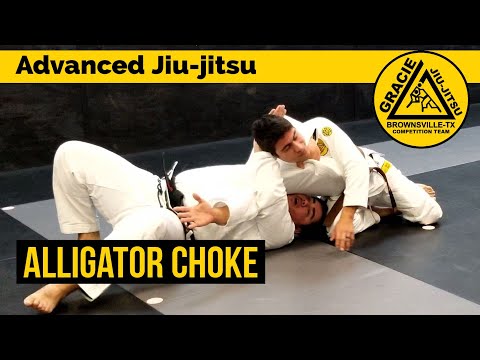
Technique from our advanced class. Alligator Choke from Sprawl Subscribe for more https://www.youtube.com/c/GracieHumai…
Translation: The crocodile
The Crocodile is a rubber guard transition position where the leg is threaded across the opponent's back while maintaining head control, resembling a crocodile's death roll setup. [1]
The Crocodile is part of Eddie Bravo's 10th Planet Jiu-Jitsu system, developed for no-gi and MMA competition. [1]
Proven in professional MMA and no-gi grappling competition by 10th Planet practitioners. [1]
10th Planet Jiu-Jitsu; Eddie Bravo lineage. [1]
Used in professional MMA and EBI competition
No images yet for this technique.
Sign in to suggest an image.
Not yet documented
Technique from our advanced class. Alligator Choke from Sprawl Subscribe for more https://www.youtube.com/c/GracieHumai…
875+ BJJ Tech Demos - https://itunes.apple.com/us/app/875+-bjj-technique-demos/id863770966?ls=1&mt=8 http://www.grapple…
The Crocodile (also called the Alligator) encompasses both a foundational locomotion drill and an advanced submission technique. SundarJiuJitsu presents the movement pattern as a warm-up drill where the practitioner moves in all-fours position using opposite-hand, opposite-foot coordination—when the left hand moves forward, the right foot steps; when the right hand moves, the left foot steps. This pattern lowers the body progressively until full extension is achieved. The four-corners variation involves threading one leg through to face different directions before repeating the locomotion sequence. SundarJiuJitsu emphasizes the real-world application in side control, where the Crocodile movement allows the top player to follow an escaping opponent's hip movement and control their knee placement, preventing guard replacement. Gracie Humaita Jiujitsu in Brownsville describes a distinct submission called the Alligator Choke, performed from a sprawl position after an opponent shoots in. The technique involves opening the collar with one hand placed thumb-up beneath the opponent's armpit, then rolling through with the head underneath the body to feed the hand behind the neck, finishing with a push-pull mechanism on the collar. The name derives from the rolling motion through the opponent's body. Both instructors agree on the importance of limb positioning and weight distribution, though they address different contexts—one defensive scrambling, one offensive submission finishing.
Synthesized from 3 instructors
No instructional courses yet for this technique.
Sign in to suggest a course.
Risk of injury to the person this technique is applied to
Guard control position
Skill level needed to execute this technique reliably
Whether this technique is allowed under major competition rule sets
Mastering the Rubber Guard (Bravo, 2006)
[1] Bravo, Mastering the Rubber Guard (2006) — technique description and application
Requires above-average hip flexibility
Good grip endurance
The Crocodile is a 10th Planet position documented in Mastering the Rubber Guard. Part of the system's approach to controlling and attacking from the bottom in no-gi grappling. (Bravo, Mastering the Rubber Guard, 2006)
Keep your opposite knee and hand engaged close to your opponent's body, and adjust your position as soon as your opponent starts to move away—if you don't change, they will escape. According to SundarJiuJitsu, you can walk forward and block their knee with a sit-through to maintain control.
Open the collar with one hand while threading your other hand underneath the opponent's armpit with your thumb pointing toward their ear, getting as deep and tight as possible on the neck. Gracie Humaita Jiujitsu emphasizes that you must get your hand in deep—they should feel the choke before you even roll through.
Roll through by tucking your head under and driving your arm all the way through with the choke, then once your head clears, you can put your hand behind their head and finish by holding your own arm. Gracie Humaita Jiujitsu explains this is the key adjustment when you're too far away to reach the initial grip.
The Crocodile is a rubber guard transition position where the leg is threaded across the opponent's back while maintaining head control, resembling a crocodile's death roll setup.
The Crocodile is part of Eddie Bravo's 10th Planet Jiu-Jitsu system, developed for no-gi and MMA competition.
IBJJF: legal — Legal — guard is fundamental to BJJ, sweeps from guard score 2 points; IJF: restricted — Guard pulling penalized as non-combativity — groundwork from guard permitted …; ADCC: legal — Legal, guard pull penalized -1 point in points portion; Unified MMA: legal — Legal — no penalty for playing guard; FIAS Sport Sambo: legal — Legal
Danger rating 3/10. Guard control position
The standard setup chain: Closed guard → Break posture → The Crocodile → Submission or sweep.
Standard counters include: Posture up / Stack / Strip the leg control.
Used in professional MMA and EBI competition
Top errors to watch for: Insufficient hip flexibility / Losing head control / Not maintaining posture break.
The The Crocodile is also known as Za Kurokodairu, Croc, Crocodile Control.