Use The Cocoon To Protect Your Guard!
0
Cocoon·The Grappling Academy
SALE SALE SALE OVER 50% OFF – BOX SET – ALL 4 COURSES 50% OFF CLICK HERE – https://bit.ly/2lAOHmp • The Blue Belt Sup…
Translation: Cocoon
The Cocoon is a transitional rubber guard position where both legs wrap the opponent's torso while arm control is maintained, serving as a launching pad for X-guard sweeps and leg attacks. [1]
Cocoon is part of Eddie Bravo's 10th Planet Jiu-Jitsu system, developed for no-gi and MMA competition. [1]
Proven in professional MMA and no-gi grappling competition by 10th Planet practitioners. [1]
10th Planet Jiu-Jitsu; Eddie Bravo lineage. [1]
Used in professional MMA and EBI competition
No images yet for this technique.
Sign in to suggest an image.
Not yet documented
SALE SALE SALE OVER 50% OFF – BOX SET – ALL 4 COURSES 50% OFF CLICK HERE – https://bit.ly/2lAOHmp • The Blue Belt Sup…
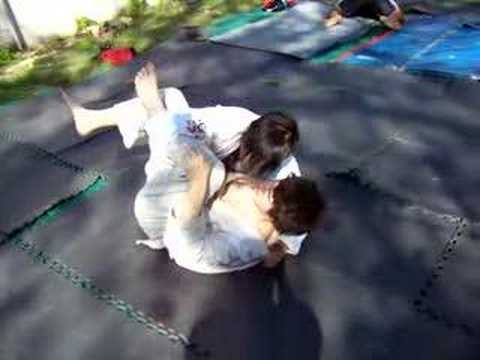
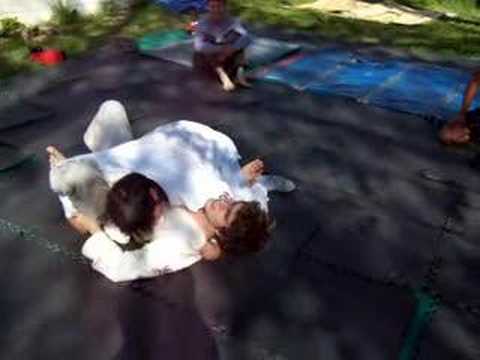
Hedgehogey demonstrates the cocoon guard with Munacra at the April ATX SparBQ.
Hedgehogey and Munacra demonstrate some trouble shooting tips in cocoon guard at the April ATX SparBQ.
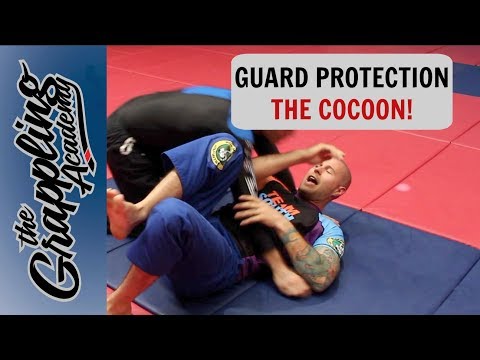
The cocoon is a defensive guard principle focused on protecting critical "real estate" from guard pass attempts and mounted positions. According to The Grappling Academy, the technique involves connecting the elbow to the knee on one or both sides to create a barrier that prevents opponents from accessing the torso, rib cage, and thigh area. By maintaining this elbow-to-knee connection, the defender can frustrate side control transitions, prevent mount positioning, and avoid common injuries to the serratus anterior and intercostal muscles. The Grappling Academy emphasizes drilling this principle by having a partner attempt side control while the defender focuses solely on maintaining the elbow-knee connection. Joe Cheavens approaches the cocoon as part of a broader half-guard and guard-retention system, incorporating wrist grips and bicep control to trap the opponent's arm while threading knees through to create space and transition to spider guard or other attacking positions. Cheavens also addresses troubleshooting scenarios where opponents attempt to pin the defender to the stomach, offering underhook reversals, foot control, and knee-on-stomach escape mechanics as counters. While The Grappling Academy stresses the cocoon's defensive utility for white belts, Cheavens demonstrates how it integrates into more complex offensive guard retention chains from 10th Planet Jiu-Jitsu.
Synthesized from 3 instructors
No instructional courses yet for this technique.
Sign in to suggest a course.
Risk of injury to the person this technique is applied to
Guard control position
Skill level needed to execute this technique reliably
Whether this technique is allowed under major competition rule sets
Mastering the Rubber Guard (Bravo, 2006)
[1] Bravo, Mastering the Rubber Guard (2006) — technique description and application
Requires above-average hip flexibility
Good grip endurance
The cocoon is a 10th Planet half guard position documented in Mastering the Rubber Guard. Part of the half guard progression leading to sweeps and back takes from the lockdown system. (Bravo, Mastering the Rubber Guard, 2006)
According to The Grappling Academy, the cocoon protects the 'real estate' from the top of your knee, down your thigh, up your torso, and up to your elbow—the area you never want an opponent to occupy, whether they're in a low mount on your thighs or under your armpits.
Joe Cheavens recommends playing half guard and shrimping the wrong way while pushing your opponent's arm out and bringing your knee inside as an alternative when you cannot turn toward them.
Joe Cheavens demonstrates that by hooking your opponent's foot and knee with your leg while escaping knee on stomach, you can get them off balance and create an opening.
Joe Cheavens suggests trying to underhook one of your opponent's legs to reverse them, or if that fails, grabbing their foot on the other side and working their hips over using old school techniques.
The Cocoon is a transitional rubber guard position where both legs wrap the opponent's torso while arm control is maintained, serving as a launching pad for X-guard sweeps and leg attacks.
Cocoon is part of Eddie Bravo's 10th Planet Jiu-Jitsu system, developed for no-gi and MMA competition.
IBJJF: legal — Legal — guard is fundamental to BJJ, sweeps from guard score 2 points; IJF: restricted — Guard pulling penalized as non-combativity — groundwork from guard permitted …; ADCC: legal — Legal, guard pull penalized -1 point in points portion; Unified MMA: legal — Legal — no penalty for playing guard; FIAS Sport Sambo: legal — Legal
Danger rating 3/10. Guard control position
The standard setup chain: Closed guard → Break posture → Cocoon → Submission or sweep.
Standard counters include: Posture up / Stack / Strip the leg control.
Used in professional MMA and EBI competition
Top errors to watch for: Insufficient hip flexibility / Losing head control / Not maintaining posture break.
The Cocoon is also known as Kokūn, Cocoon Guard, Wrapped Guard.