The Zombie Pass Principle | The Machado Method | Jiu Jitsu
0
Zombie·Hayabusa
An in-depth look at Jiu Jitsu basics by Carlos Machado (8th Degree Coral Belt). Master Machado explains how swaying you…
Translation: Zombie — named for the relentless, inescapable control the position creates, resembling how a zombie grabs and never releases its victim
Zombie is an advanced rubber guard control position within the 10th Planet Jiu-Jitsu system where the attacker maintains an overhook on the opponent's arm while threading one leg across the opponent's upper back or shoulder, creating an inescapable platform from which triangles, armbars, and the Go-Go Plata can be attacked. [1] The position is entered from Mission Control (the foundational rubber guard position): after establishing the high guard with one foot controlling the opponent's posture from behind their head, the attacker transitions to Zombie by securing an overhook on the opponent's trapped arm while repositioning the controlling leg across the back of the opponent's neck and shoulder. [1] The name 'Zombie' reflects the position's defining characteristic: once fully established, the opponent cannot posture up, cannot strip the grip, and cannot escape laterally — they are held in place by the combined leg-and-arm control like a zombie's victim in its inescapable grasp. [1] Eddie Bravo designed the Zombie as the primary attack position in the rubber guard system: Mission Control is the setup position (creating the broken posture), and the Zombie is the attack position (from which submissions are launched). [1] The position creates immediate threats to the triangle choke (the leg is already across the opponent's neck), the armbar (the overhook isolates the opponent's arm), and the Go-Go Plata (the shin is positioned near the throat). [1] The opponent faces an unresolvable defensive trilemma: defending the triangle opens the armbar, defending the armbar opens the Go-Go Plata, and defending the Go-Go Plata opens the triangle — the attacker simply cycles between the three threats until one connects. [1] This three-way submission chain from a single control position is what makes the Zombie one of the most tactically sophisticated guard positions in modern BJJ. [1]
The Zombie was developed by Eddie Bravo as a core position in the 10th Planet Jiu-Jitsu rubber guard system, documented in Mastering the Rubber Guard (2006). [1] Bravo's naming convention (drawing from horror and pop-culture themes) gave the position its distinctive name — the 'zombie' metaphor captures the position's inescapable, relentless quality. [1] The Zombie represents Bravo's tactical philosophy of 'position before submission': rather than chasing individual submissions from guard (which smart opponents can defend individually), the Zombie establishes a PLATFORM from which multiple submissions are accessible simultaneously, forcing the opponent to defend a tactical system rather than a single technique. [1] This 'submission platform' concept — a single position that threatens multiple finishing techniques — has influenced modern no-gi BJJ broadly, with other grappling systems adopting similar multi-threat positional strategies. [1]
The Zombie is one of the most effective guard positions in no-gi grappling because it creates a submission trilemma: the opponent must simultaneously defend the triangle, armbar, and Go-Go Plata — an impossible task, since defending one opens another. [1] In EBI (Eddie Bravo Invitational) competition, the Zombie and its associated submission chain have produced multiple finishes at the professional level. [1] The position's effectiveness scales with the attacker's ability to flow between submissions: a beginner who holds the Zombie but only attacks one submission is easier to defend than an expert who cycles between all three threats based on the opponent's reactions. [1] In MMA, the Zombie provides the additional benefit of allowing bottom-position striking while maintaining submission threats — a rare combination in guard play. [1]
Eddie Bravo → 10th Planet Jiu-Jitsu rubber guard system → Zombie documented in Mastering the Rubber Guard (2006) → core attack position for 10th Planet guard players worldwide. [1]
Used in EBI (Eddie Bravo Invitational) competition as a primary guard attack position. The Zombie-to-submission chain (triangle/armbar/Go-Go Plata) has produced multiple professional-level finishes. In MMA, the position has been used by fighters with 10th Planet training backgrounds to control and submit opponents from bottom guard.
No images yet for this technique.
Sign in to suggest an image.
An in-depth look at Jiu Jitsu basics by Carlos Machado (8th Degree Coral Belt). Master Machado explains how swaying you…
No instructional courses yet for this technique.
Sign in to suggest a course.
Risk of injury to the person this technique is applied to
Zombie is a CONTROL position, not a submission — it does not directly cause pain or injury. However, the position creates immediate access to three high-danger submissions (triangle choke, armbar, Go-Go Plata), making it a platform for fight-ending attacks. The danger lies in what the position enables, not in the position itself.
Skill level needed to execute this technique reliably
Whether this technique is allowed under major competition rule sets
Mastering the Rubber Guard (Bravo, 2006)
description: [1] Bravo 2006 Zombie section
Standard katakana transliteration of Western martial arts terminology (外来語) — used in Japanese MMA, boxing, and BJJ communities
description: [1] Bravo 2006 Zombie section
Requires above-average hip flexibility (the controlling leg must reach behind the opponent's head from guard)
Good grip endurance for maintaining the overhook
Core strength for keeping the guard structure engaged
Ability to flow between submission positions without releasing base control
Practitioners with rubber guard flexibility adapt fastest
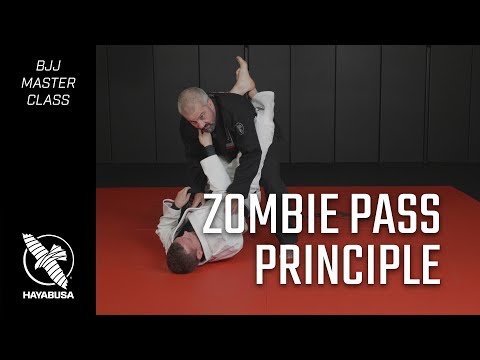
According to Hayabusa's Machado Method instruction, the basic idea is to stay relaxed while approaching, keep both hands level with your hip control, and use a back knee drop with your front leg on your tiptoes to make your leg longer and harder to wrap around.
Hayabusa explains that keeping your knee pointed out prevents your opponent from grapevining your leg, which can cause significant problems during the pass.
Hayabusa emphasizes that you must always keep the arm on the hip low; if both arms go high, your opponent can underhook you, which compromises your stability as you clear the legs. Additionally, failing to put your elbow in leaves you vulnerable to a kimura attack from the bottom.
Zombie is an advanced rubber guard control position within the 10th Planet Jiu-Jitsu system where the attacker maintains an overhook on the opponent's arm while threading one leg across the opponent's upper back or shoulder, creating an inescapable platform from which triangles, armbars, and the Go-Go Plata can be attacked. The position is entered from Mission Control (the foundational rubber guard position): after establishing the high guard with one foot controlling the opponent's posture from behind their head, the attacker transitions to Zombie by securing an overhook on the opponent's trapped arm while repositioning the controlling leg across the back of the opponent's neck and shoulder.
The Zombie was developed by Eddie Bravo as a core position in the 10th Planet Jiu-Jitsu rubber guard system, documented in Mastering the Rubber Guard (2006). Bravo's naming convention (drawing from horror and pop-culture themes) gave the position its distinctive name — the 'zombie' metaphor captures the position's inescapable, relentless quality.
IBJJF: legal — Legal — guard is fundamental to BJJ, sweeps from guard score 2 points; IJF: restricted — Guard pulling penalized as non-combativity — groundwork from guard permitted …; ADCC: legal — Legal, guard pull penalized -1 point in points portion; Unified MMA: legal — Legal — no penalty for playing guard; FIAS Sport Sambo: legal — Legal
Danger rating 3/10. Zombie is a CONTROL position, not a submission — it does not directly cause pain or injury. However, the position creates immediate access to three high-danger submissions (triangle choke, armbar, Go-Go Plata), making it a platform for fight-ending attacks. The danger lies in what the position enables, not in the position itself.
The standard setup chain: Closed guard → Break opponent's posture (pull them down with legs and collar/head control) → Establish Mission Control (one foot behind opponent's head, controlling posture) → Thread the overhook on the opponent's near arm → Reposition the controlling leg across the back of the opponent's neck/shoulder → ZOMBIE ESTABLISHED → Read the opponent's defensive reaction: → If they try to pull arm free → Attack the triangle choke → If they tuck against the triangle → Attack the armbar → If they defend both arm and head → Thread shin across throat for Go-Go Plata → Cycle between all three until one connects.
Standard counters include: Posture up early — before the Zombie is fully established, posturing up prevents the leg from reaching behind the head / Strip the overhook — fighting to extract the trapped arm removes one of the two control points / Stack — driving forward and stacking the attacker compresses their rubber guard structure / Guard pass — lateral movement to pass the guard entirely removes both the leg and arm control.
Common variants: Standard Zombie (leg across the back of the neck with overhook on the near…); Deep Zombie (the leg is threaded further across (shin across the throa…); Zombie to Night of the Living Dead (adding a second leg hook for even tighter control (see Ni…); Modified Zombie (using a wrist grip instead of a full overhook when the ov…); Zombie from half guard (an alternative entry from bottom half guard rather than c…).
Used in EBI (Eddie Bravo Invitational) competition as a primary guard attack position. The Zombie-to-submission chain (triangle/armbar/Go-Go Plata) has produced multiple professional-level finishes.
Top errors to watch for: Insufficient hip flexibility — the most common barrier to the Zombie; if the leg cannot reach behind the opponent's h… / Shallow overhook — a loose or shallow arm wrap allows the opponent to extract their arm, collapsing the dual-control … / Releasing one control to attack a submission — the power of the Zombie is the SIMULTANEOUS dual control; releasing ei… / Not maintaining guard tension — the hips must actively pull the opponent downward; passive hips allow the opponent to….
The Zombie is also known as Zonbi, Zombie Control, Zombie Position, Dead Man's Grip, Zombie Guard.