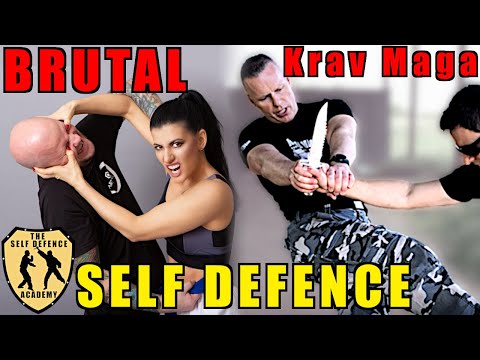
Introduction To Self Defence / Krav Maga
0
Krav Maga Defence·THE SELF DEFENCE ACADEMY
We are presenting a new introduction to self defence. All self defence principals are explained in this video. In The Se…
Translation: Krav Maga defence
The Krav Maga Defence family within the Block group covers Krav Maga's blocking and deflection system for defending against unarmed strikes — designed for real-world self-defence where the defender may have no training, no warning, and no protective equipment. [1] Krav Maga defence emphasises two core principles: the 360-degree defence (outside defence against circular attacks from any angle) and the inside defence (deflecting straight punches inward). [1],[2] Unlike sport-fighting blocking that assumes a squared-off opponent at known range, Krav Maga defences are designed for ambush attacks, surprise punches, and chaotic street violence — they use gross motor movements that function even under the adrenaline dump and fine-motor-skill degradation that occurs during a real attack. [2],[3] Every Krav Maga defence includes an immediate simultaneous counter-attack ('bursting') — the system never separates defence from offence. [3]
Krav Maga's blocking system was developed by Imi Lichtenfeld for the Israeli Defence Forces (IDF) starting in the 1940s, drawing on his background in boxing, wrestling, and street-fighting experience in 1930s Bratislava. [1] The 360-degree defence system was specifically designed to address the reality that street attacks come from any angle and often without warning — traditional martial arts blocks assumed a known attack direction. [1],[2] The simultaneous defence-and-counter-attack principle ('bursting') was developed because Lichtenfeld understood that in real combat, the attacker who maintains initiative wins — waiting to counter after defending wastes critical time. [2],[3]
Krav Maga's blocking system is designed for maximum effectiveness with minimum training — the gross motor movements work even under the adrenaline dump of a real attack. [1] The system has been validated through decades of IDF and Israeli security use in real combat situations. [2] However, against trained fighters in a sport context, Krav Maga blocking is less refined than boxing or Muay Thai defensive systems. [3]
Not applicable — Krav Maga is a self-defence system, not a competitive format. Effectiveness validated through military and security use. [1]
No images yet for this technique.
Sign in to suggest an image.
We are presenting a new introduction to self defence. All self defence principals are explained in this video. In The Se…
No instructional courses yet for this technique.
Sign in to suggest a course.
Risk of injury to the person this technique is applied to
Krav Maga defences are designed to be safe for the defender; the forearm is a durable blocking surface; the primary risk is being overwhelmed by multiple rapid attacks or failing to execute the simultaneous counter-attack
Skill level needed to execute this technique reliably
Whether this technique is allowed under major competition rule sets
Krav Maga: How to Defend Yourself Against Armed Assault (Imi Lichtenfeld & Eyal Yanilov, 2001)
Description sources — [1] Krav Maga: How to Defend Yourself (Lichtenfeld & Yanilov, 2001) [2] Complete Krav Maga (Levine & Whitman, 2007) [3] IDF training methodology
Description sources — [1] Krav Maga: How to Defend Yourself (Lichtenfeld & Yanilov, 2001) [2] Complete Krav Maga (Levine & Whitman, 2007) [3] IDF training methodology
basic coordination, willingness to commit to aggressive counter-attack
the system is explicitly designed for all body types and fitness levels
forearms (blocking), shoulders (driving the defence), legs (bursting forward), core (power transfer for counter-attack)
Every move, in any martial art, shares a few universal traits. Mix and match below to pinpoint the right tool — or compare equivalents across styles.
The Defence Against Hook Punch is the Krav Maga technique for defending against circular hook punches to the head or body, using a raised forearm shield that absorbs and deflects the hook's arc while simultaneously delivering a counter-strike with the opposite hand. [1] The hook punch is one of the most common and dangerous attacks in street violence — a wide, looping punch thrown by untrained attackers (the 'haymaker') and trained fighters alike — and is responsible for a disproportionate number of knockout and injury in real-world altercations. [1,2] The Krav Maga defence addresses the hook by raising the forearm on the attacked side vertically alongside the head (the 'shield' position), creating a barrier that the hook's arc impacts before reaching the jaw or temple. [1] Critically — following the Krav Maga principle of simultaneous defence and attack — the opposite hand delivers a counter-strike to the attacker's face at the same moment the forearm shield absorbs the hook. [1,2] The shield block is structurally different from a boxing shell or parry: the forearm is pressed flat against the side of the head (ear covered by the bicep, fist near the forehead), creating a surface that absorbs the hook through the hard ulnar bone rather than the thin temporal bone of the skull. [1] Yaron Lichtenstein documented this technique in The Book of Krav-Maga: The Bible as a core defence alongside the 360 Defence, Inside Defence, and Outside Defence, noting that the hook punch requires a DIFFERENT defensive mechanism than the straight punch: straight punches can be deflected (Inside/Outside Defence), but hook punches must be ABSORBED by a shield because their circular trajectory cannot be redirected effectively by deflection. [1]
The Defence Against Uppercut is the Krav Maga technique for defending against rising uppercut punches — close-range attacks that drive the fist upward from below into the chin, jaw, or solar plexus. [1] The uppercut is one of the most dangerous punches in combat because it arrives from below the defender's visual field (most awareness is focused on attacks coming from the front, sides, and above) and targets the chin (the body's most vulnerable knockout target) from the direction that produces maximum rotational head acceleration. [1,2] The Krav Maga defence addresses the uppercut by dropping the elbow downward to intercept the rising fist before it reaches the chin — the hard point of the elbow meets the incoming fist, deflecting the uppercut and potentially injuring the attacker's hand on the bony olecranon. [1] Following the fundamental Krav Maga principle of simultaneous defence and attack, the opposite hand delivers a counter-strike to the attacker's face at the same moment the elbow drop intercepts the uppercut. [1] The elbow-drop defence is biomechanically efficient because it uses gravity: the elbow drops downward (assisted by gravity) to meet a fist rising upward (against gravity), creating a collision where the defender has the gravitational advantage. [1] Yaron Lichtenstein documented this technique in The Book of Krav-Maga: The Bible as the defence specifically designed for the uppercut — distinct from the 360 Defence (which covers wide attacks), the Inside/Outside Defence (which covers straight punches), and the Shield Block (which covers hook punches). [1] Together, these four defensive techniques provide coverage against every common unarmed attack angle: straight (Inside/Outside), circular (Shield), descending (360), and RISING (Elbow Drop). [1]
The Inside Defence Against Straight Punch is a core Krav Maga defensive technique where the defender uses the palm of the hand to deflect an incoming straight punch from the inside line — the hand moves from the defender's centreline outward, contacting the inside of the attacker's forearm or wrist and redirecting the punch past the face. [1] The critical principle that separates the Inside Defence from traditional martial arts blocking is SIMULTANEITY: the deflecting hand redirects the punch while the opposite hand delivers a counter-strike to the attacker's face at the same instant — the defender does not block first and then counter, but performs both actions in a single moment. [1,2] This simultaneous defence-and-attack principle is the defining characteristic of Krav Maga and reflects its development as a military combatives system where the first priority is immediate counter-attack rather than sustained defence. [1,2] The Inside Defence is the first technique taught in Krav Maga for defending against straight punches (the most common street attack) and is practised at every training session from white belt through expert levels. [1] Imi Lichtenfeld designed the technique to be as simple as possible: the deflecting hand performs a natural sweeping motion outward (similar to brushing a fly off your face), requiring no special skill or training to execute at a basic level. [1,2] At advanced levels, the Inside Defence is refined to include precise body movement (stepping offline at 15-30°), weight transfer into the counter-strike, and immediate follow-up combinations. [1] Yaron Lichtenstein (9th Dan) documented the technique in The Book of Krav-Maga: The Bible as the foundational defence against the most common unarmed attack. [1]
The Inside Defense is a Krav Maga technique where the defender deflects an incoming straight attack by sweeping the hand or forearm from outside to inside across the body's centerline. [1] The open palm or forearm contacts the attacking arm and redirects it inward (across the attacker's own body), simultaneously stepping to the outside. [1] This creates an angle where the defender is outside the attacker's power line and in position for immediate counter-attacks to the exposed flank. [1] It is the mirror complement to the outside defense and together they form the foundation of Krav Maga's straight-attack defense system. [1]
The Krav Maga 360 Defence is a comprehensive blocking system that uses six forearm blocking positions arranged around the body to intercept strikes coming from any angle — above, below, left, right, front-left, and front-right — providing 360 degrees of defensive coverage with a single unified defensive framework. [1] Developed by Imi Lichtenfeld (Sde-Or) as the foundational defensive technique of Krav Maga, the 360 Defence solves a fundamental self-defence problem: in a real attack, the defender rarely knows from which direction the strike will come, and cannot rely on identifying the specific attack type before responding. [1,2] The system addresses this by dividing the space around the defender's body into six zones, each protected by a specific forearm position: Zone 1 (overhead, defending downward strikes), Zone 2 (upper-right/left, defending hooks and haymakers), Zone 3 (mid-right/left, defending body hooks and rib attacks), Zone 4 (lower-right/left, defending low punches and knee-level attacks), Zone 5 (inside high, defending straight punches to the face), and Zone 6 (inside low, defending body jabs). [1,2] Each defensive position uses the hard outer edge of the forearm (ulna bone) as the blocking surface, and — critically — every block is accompanied by a simultaneous counter-strike with the opposite hand. [1] This principle of simultaneous defence and attack is the defining characteristic that separates Krav Maga from traditional blocking-then-countering martial arts: the defender does not block first and then hit — they block AND hit at the same moment, eliminating the gap between defence and offence. [1,2] The 360 Defence is taught at the very first Krav Maga class to every beginner, and remains a core technique used by Israeli Defence Forces (IDF) soldiers, Shin Bet agents, and civilian Krav Maga practitioners worldwide. [1,3]
The Outside Defence Against Straight Punch is the complementary pair to the Inside Defence, deflecting an incoming straight punch from the OUTSIDE line — the hand moves from the defender's centreline outward, contacting the outside of the attacker's forearm or wrist and redirecting the punch past the face to the defender's outside. [1] While the Inside Defence works from the inside line (deflecting the punch outward past the face), the Outside Defence works from the outside line (deflecting the punch inward past the face while the body angles to the outside), providing complete bilateral coverage when combined: the Inside Defence covers the inside angle, the Outside Defence covers the outside angle. [1,2] The Outside Defence includes a critical body-movement component: as the deflecting hand redirects the punch, the defender steps at approximately 30-45° to the outside of the attacker's punching arm, simultaneously creating a new angle that makes the attacker's follow-up attack difficult while positioning the defender for a devastating counter from the outside flank. [1] This body angle is what distinguishes the Outside Defence from the Inside Defence (which typically stays on the centreline): the Outside Defence actively creates an angular advantage. [1] Following the Krav Maga simultaneous defence-and-attack principle, the deflecting hand redirects the punch while the opposite hand delivers a counter-strike — but in the Outside Defence, the counter often targets the side of the attacker's jaw, the ear, or the temple, because the angled position gives access to targets the frontal Inside Defence cannot reach. [1,2] Yaron Lichtenstein documented this defence alongside the Inside Defence as the two primary responses to straight punches, noting that the choice between Inside and Outside depends on the attacker's angle, the defender's position, and the tactical opportunity: the Inside Defence is faster (less body movement required) while the Outside Defence creates a superior counter-attacking angle. [1]
The Outside Defense is a Krav Maga defensive technique where the defender uses the forearm or open hand to deflect an incoming straight attack (punch, knife thrust) by sweeping the arm from inside to outside, redirecting the attack away from the centerline. [1] Unlike traditional martial arts blocks that stop the attack, Krav Maga's outside defense deflects while simultaneously stepping offline, creating an angle for an immediate counter-attack. [1] It is part of Krav Maga's 360-degree defense system which provides coverage against attacks from all angles. [1]
Krav Maga weapon defenses are the most widely taught civilian self-defense system for weapon threats — knife, gun, and stick. Developed by Imi Lichtenfeld for the IDF and adapted for civilian use. The system prioritizes aggressive counter-attack simultaneous with the defense. (Lichtenfeld system; Krav Maga manuals)
Krav Maga teaches you how to defend yourself against present or current types of threats, attacks, or weapons. The Self Defence Academy emphasizes that it prepares you to defend yourself and your loved ones from anyone in any situation.
The most important rule of Krav Maga is that it is for defense only. This principle guides how the system should be applied and practiced.
Yes. The Self Defence Academy demonstrates that beginners with no prior self-defense experience can progress through their training to become confident, skilled, and fearless self-defense practitioners.
The Krav Maga Defence family within the Block group covers Krav Maga's blocking and deflection system for defending against unarmed strikes — designed for real-world self-defence where the defender may have no training, no warning, and no protective equipment. Krav Maga defence emphasises two core principles: the 360-degree defence (outside defence against circular attacks from any angle) and the inside defence (deflecting straight punches inward).
Krav Maga's blocking system was developed by Imi Lichtenfeld for the Israeli Defence Forces (IDF) starting in the 1940s, drawing on his background in boxing, wrestling, and street-fighting experience in 1930s Bratislava. The 360-degree defence system was specifically designed to address the reality that street attacks come from any angle and often without warning — traditional martial arts blocks assumed a known attack direction.
Unified MMA: legal — Legal defensive technique; IBJJF: legal — Legal; IJF: legal — Legal defensive action; WBC/Boxing: legal — Legal; WKF: legal — Legal; WT: legal — Legal
Danger rating 3/10. Low — Krav Maga defences are designed to be safe for the defender; the forearm is a durable blocking surface; the primary risk is being overwhelmed by multiple rapid attacks or failing to execute the simultaneous counter-attack
The standard setup chain: Recognise Attack → Deploy Defence → Simultaneous Counter → Burst Forward → Continue (Retzev) → Scan and Escape.
Standard counters include: Rapid Combinations — overwhelming the single-block-counter response with multiple rapid attacks / Feinting — drawing the 360 defence then attacking from a different angle / Trained Fighting — a trained fighter's superior timing generally outperforms Krav Maga's gross motor approach / Grappling/Takedowns — closing distance past the blocking range.
Common variants: 360-degree outside defence (forearm block against circular attacks from six zones (hi…); Inside defence (palm-out forearm deflection against straight punches; pus…); Inside defence with body turn (a more advanced version that combines the deflection with…); Cover ('crash helmet') (emergency head protection with both forearms when attacke…); Plucking defence (against chokes) (specific Krav Maga defence against being choked while sta…).
Not applicable — Krav Maga is a self-defence system, not a competitive format. Effectiveness validated through military and security use.
Top errors to watch for: Blocking without counter-attacking — Krav Maga never separates defence from offence; a block without a simultaneous c… / Using sport-fighting range — Krav Maga defences are designed for close-range surprise attacks, not squared-off fighti… / Over-training complex defences instead of mastering the basics — the 360-degree defence and inside defence handle 90%… / Blocking and stepping backward — Krav Maga teaches burst forward into the attacker; retreating gives the attacker ini….
The Krav Maga Defence is also known as Kuravu Maga Difensu, Krav Maga Block, Krav Maga Striking Defence, KM Defence.