How to do Jodan Uke (Up Block)
0
Seiken Jodan Uke·Witney Karate Club Strength & Fitness
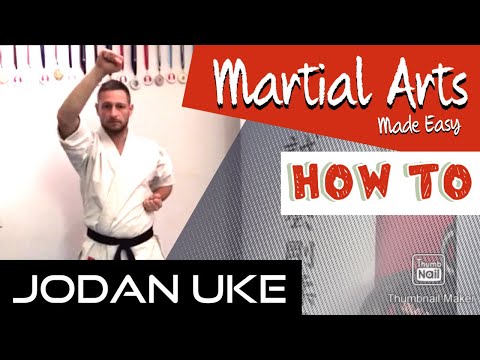
Martial Arts made easy. How to do a Goju Karate Jodan Uke (Up Block) or Age Uke (Rising Block) - this is the first vi…
Translation: Seiken (正拳) = fore-fist, Jodan (上段) = upper level, Uke (受け) = block/receive — a rising forearm block that deflects attacks to the head by sweeping the forearm upward from below to above the head
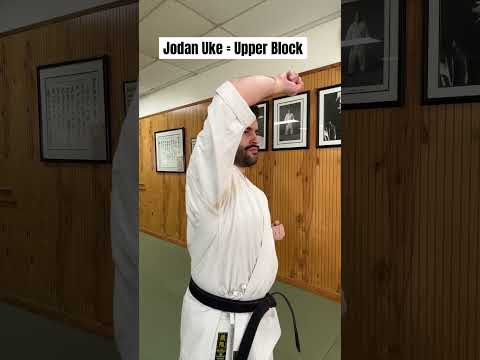
Seiken Jodan Uke (commonly called Age Uke or Rising Block) is the fundamental karate defence against attacks descending toward the head — overhead strikes, hammer fists, downward bottle or stick attacks, and any technique that travels on a downward trajectory toward the skull. [1],[2] The block is executed by sweeping the forearm from a low position (typically starting at the opposite hip) diagonally upward across the body to a position above and slightly forward of the head, where the outer forearm (ulnar surface) meets the descending attack and deflects it upward and over the defender's head. [1],[2] Masutatsu Oyama taught that the rising block must serve a dual purpose: every block must also be an attack — the forearm rising with sufficient force should cause pain and damage to the attacker's arm, discouraging repeated attacks. [1] In this philosophy, the Age Uke is not merely a passive deflection but an active counterforce that punishes the attacker's limb while protecting the defender's head. [1] The technique appears in virtually every karate kata (it is one of the first movements taught in Taikyoku Shodan and Heian Shodan, the most basic kata in Shotokan) and is considered one of the four fundamental blocks alongside Soto Uke (outside block), Uchi Uke (inside block), and Gedan Barai (downward sweep). [2] In Kyokushin full-contact competition, the Age Uke is used to deflect head kicks (mawashi geri, ushiro mawashi geri) and overhead elbow strikes, making it one of the most frequently used defensive techniques. [1] The block's mechanical principle is deflection rather than collision: the forearm sweeps at approximately 45° to the incoming attack's trajectory, redirecting it upward rather than stopping it head-on — this requires far less force than a direct collision and preserves the defender's structural integrity. [1],[2]
The Age Uke (rising block) is one of the four foundational blocks in karate, documented since the earliest Okinawan te manuscripts and present in virtually every karate kata. [2] Gichin Funakoshi included the Age Uke in Karate-Do Kyohan (1935) as one of the basic defensive techniques (kihon waza) that every beginning student must master. [2] The block's placement as the second movement of Taikyoku Shodan (the most basic Shotokan kata) reflects its importance in the karate curriculum — it is literally one of the first movements a karate student learns. [2] Masutatsu Oyama refined the Age Uke for Kyokushin's full-contact environment, emphasising that the block must be powerful enough to damage the attacker's limb — this 'destructive blocking' philosophy transforms the defensive technique into a dual-purpose weapon. [1] In Kyokushin competition, where head kicks are the primary threat to the skull, the Age Uke is the first line of defence and is practiced thousands of times in every fighter's training camp. [1]
The Age Uke is one of the most effective defensive techniques in martial arts against descending attacks because it uses a deflection angle that redirects the attack's force rather than opposing it. [1],[2] The 45° deflection principle means the defender can redirect attacks from significantly stronger opponents — a smaller person can deflect a larger person's overhead strike because they are redirecting rather than stopping the force. [2] In Kyokushin competition, the Age Uke is the primary defence against head kicks and has been validated through decades of full-contact use against world-class kickers. [1] The technique's limitation is that it defends only the upper target — attacks to the midsection or lower body require different blocks (soto uke, gedan barai). A comprehensive defence requires all four fundamental blocks. [1],[2]
The Age Uke is the primary defence against head kicks in Kyokushin full-contact competition. In WKF karate, it is used to defend against upper-level attacks. In MMA, the rising forearm block (functionally equivalent) is used against overhead hammerfists, elbows, and kicks. The technique has been used successfully in competition for over a century across all karate styles.
No images yet for this technique.
Sign in to suggest an image.
Martial Arts made easy. How to do a Goju Karate Jodan Uke (Up Block) or Age Uke (Rising Block) - this is the first vi…
Sattva Karate - Goju Ryu Karate Do Sattva Karate - Jodan Uke / Upper Block http://www.sattvakarate.com These videos a…
#karate #karateblocks #gojuryu #martialarts #karateclass #karatelife #drills #mma
#karate #Block#worldkaratefederation #upperblock
Jodan Uke ist der japanische Begriff für einen Block im Kyokushinkai-Karate.
Check us out at http://www.pathwaysdojo.com We are launching a new program where we do live class sessions through zoom.…
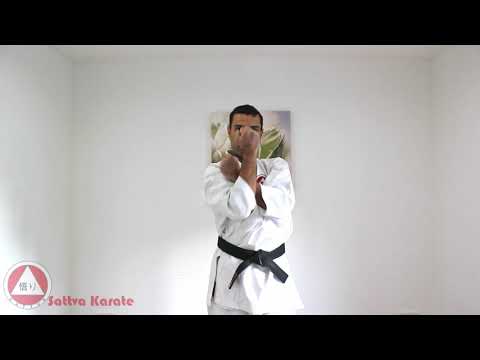
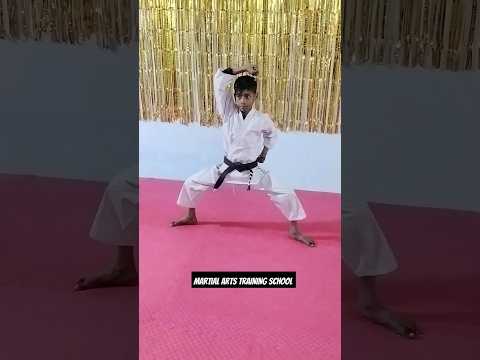
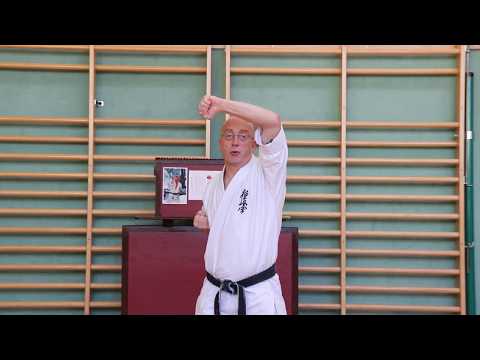
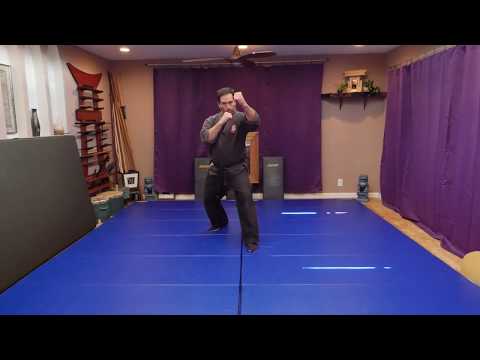
Seiken Jodan Uke, or upper block, is a fundamental defensive technique executed by raising the forearm vertically in front of the face to intercept attacks to the head. Witney Karate Club emphasizes the importance of covering the center line with the initial arm position, keeping it underneath eye level, while the second arm slides underneath to create the chamber before the blocking arm rises above the head. Sattva Karate stresses that the wrist must remain straight and angled to avoid exposure, with the fist maintaining distance approximately one fist-width from the body; crucially, this instructor notes that the blocking motion should involve sliding the arm upward rather than lifting the elbow first, reducing friction and improving responsiveness against incoming strikes. Pathways Dojo introduces a pedagogical variation using a rowing motion concept, where the defender steps back while bringing the arm down before rotating upward, emphasizing the engagement of spinal and hip rotation to generate power and structure. All instructors agree on the fundamental principle: both arms participate in the technique, with one blocking while the other maintains a defensive guard position. The technique culminates in a stable, structured stance capable of parrying or deflecting strikes to the upper level.
Synthesized from 4 instructors
No instructional courses yet for this technique.
Sign in to suggest a course.
Risk of injury to the person this technique is applied to
The Age Uke is primarily a defensive technique, but Oyama's philosophy that 'every block must also be an attack' means the rising forearm should contact the attacker's arm with enough force to cause bruising, temporary nerve compression, or discourage repeated attacks. A powerful Age Uke to the attacker's forearm can cause pain, swelling, and reduced grip strength in the attacking hand. [1]
Skill level needed to execute this technique reliably
Whether this technique is allowed under major competition rule sets
This Is Karate (Oyama, 1965)
description: [1] Oyama 1965, [2] Funakoshi 1973
Official karate technique names (和語/漢語)
Established Japanese martial arts naming convention — native Japanese term (和語/漢語)
description: [1] Oyama 1965, [2] Funakoshi 1973
Minimal physical requirements — the Age Uke is one of the most accessible defensive techniques in martial arts
forearm bone conditioning (developed over time through blocking drills), shoulder mobility for the rising arc, basic coordination
Accessible to ALL body types, ages, and fitness levels
The block can be learned in the first karate class and refined over a lifetime
Jodan uke (upper-level block / age uke) appears in 48 passages. The rising block — the forearm sweeps upward to deflect overhead attacks. One of the four fundamental karate blocks. (48 passages; Nakayama, Dynamic Karate; Funakoshi, Karate-Do Kyohan)
Your backhand should stay up and ready in case you need it for defense or follow-up techniques. Pathways Dojo emphasizes keeping both hands active during the block to maintain structure and readiness.
Yes, you should perform the same blocking motion on both arms. Witney Karate Club notes that you're doing the same technique on both sides, making it important to practice it evenly on the left and right.
Seiken Jodan Uke (commonly called Age Uke or Rising Block) is the fundamental karate defence against attacks descending toward the head — overhead strikes, hammer fists, downward bottle or stick attacks, and any technique that travels on a downward trajectory toward the skull. The block is executed by sweeping the forearm from a low position (typically starting at the opposite hip) diagonally upward across the body to a position above and slightly forward of the head, where the outer forearm (ulnar surface) meets the descending attack and deflects it upward and over the defender's head.
The Age Uke (rising block) is one of the four foundational blocks in karate, documented since the earliest Okinawan te manuscripts and present in virtually every karate kata. Gichin Funakoshi included the Age Uke in Karate-Do Kyohan (1935) as one of the basic defensive techniques (kihon waza) that every beginning student must master.
Unified MMA: legal — Legal defensive technique; WBC/Boxing: legal — Legal — blocking and evasion are core boxing skills; WKF: legal — Legal — blocking is a fundamental karate skill; Kyokushin: legal — Legal; WT: legal — Legal; WAKO: legal — Legal; K: legal — 1/GLORY — Legal; IFMA: legal — Legal
Danger rating 3/10. The Age Uke is primarily a defensive technique, but Oyama's philosophy that 'every block must also be an attack' means the rising forearm should contact the attacker's arm with enough force to cause bruising, temporary nerve compression, or discourage repeated attacks. A powerful Age Uke to the attacker's forearm can cause pain, swelling, and reduced grip strength in the attacking hand.
The standard setup chain: Attacker initiates a descending overhead strike (hammer fist, stick, bottle, or descending punch) → Defender recognises the downward trajectory → Forearm sweeps upward from the opposite hip at approximately 45° across the body → Outer forearm (ulna) contacts the attacker's forearm between the wrist and elbow → Deflection angle redirects the attack upward and over the defender's head → Simultaneously: the block's force damages the attacker's forearm (Oyama's destructive blocking principle) → IMMEDIATELY counter with: Seiken Chudan Tsuki (body punch) or Seiken Jodan Tsuki (face punch) or Mae Geri (front kick) → Reset to fighting stance.
Standard counters include: Feint high, attack low — feinting an overhead attack to draw the Age Uke, then attacking the now-exposed midsection / Double attack — attacking with both hands simultaneously overwhelms a single-arm block / Circular attack — the Age Uke defends linear descending attacks; a circular attack (hook, roundhouse) bypasses the ve… / Attack from below — the Age Uke defends overhead; attacks from below (uppercut, knee) are not covered.
Common variants: Standard Age Uke (rising block) (the basic version rising from opposite hip to above the head); Inside Age Uke (the forearm rises from the same side rather than crossing…); Double Age Uke (Morote Uke) (both forearms rise together for additional protection); Reinforced Age Uke (with back hand support) (the non-blocking hand supports the blocking forearm for e…); Open-hand Age Uke (using the open palm instead of the closed fist for a soft…); Walking Age Uke (executing the block while stepping forward or backward); Jumping Age Uke (executing the block while jumping to meet a very high or …).
The Age Uke is the primary defence against head kicks in Kyokushin full-contact competition. In WKF karate, it is used to defend against upper-level attacks.
Top errors to watch for: Blocking too late — the forearm must be in position BEFORE the attack arrives; blocking at the moment of contact mean… / Arm too extended — a straight arm in the block position lacks structural rigidity and can be driven through by a powe… / Rising directly upward instead of at an angle — the forearm must rise at approximately 45° across the body, creating … / Not clenching the fist — a loose fist reduces the structural rigidity of the forearm-wrist-fist unit, potentially cau….
The Seiken Jodan Uke is also known as Seiken Jodan Uke, Upper Level Forefist Block, Rising Block, Age Uke, Jodan Age Uke.