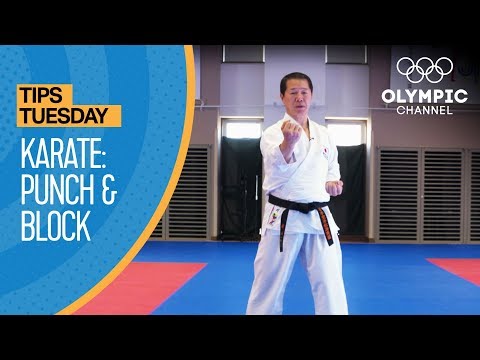
How to punch and block in Karate | Olympians' Tips
0
Karate Block·Olympic Games
📲 Subscribe to @olympics: http://oly.ch/Subscribe Sensei Masao Kagawa shows basic punching and defensive techniques …
Translation: Karate blocking technique
The Karate Block family covers traditional karate blocking techniques (uke waza, 受け技) — the formalised defensive system of Japanese and Okinawan karate that uses powerful, decisive arm movements to intercept and deflect incoming strikes. [1] Karate recognises five fundamental blocks: age uke (rising block against head attacks), gedan barai (downward sweep against low attacks), soto uke (outside-to-inside block against midsection attacks), uchi uke (inside-to-outside block), and shuto uke (knife-hand block). [1],[2] Unlike boxing's passive absorption-style blocking, karate blocks are executed with full power and commitment — the blocking arm meets the attack with force, often damaging the attacker's striking limb (the concept of 'uke' as both receiving and counter-attacking simultaneously). [2],[3] Karate blocks are practiced extensively in kata (formal patterns) and developed through thousands of repetitions until they become reflexive responses to attacks from any angle. [3]
Karate blocking techniques (uke waza) derive from Okinawan te and the Chinese martial arts influences that shaped early karate. [1] Gichin Funakoshi systematised karate's blocking curriculum when he brought karate from Okinawa to mainland Japan in 1922, incorporating blocks into the formal training framework (kihon and kata). [1],[2] Masatoshi Nakayama's 'Dynamic Karate' (1966) provided the definitive technical reference for JKA-style karate blocks. [2],[3] The five fundamental blocks (age uke, gedan barai, soto uke, uchi uke, shuto uke) have remained the core defensive curriculum across all major karate styles (Shotokan, Shito-ryu, Goju-ryu, Wado-ryu). [3]
Karate blocks are highly effective in their designed context — intercepting committed attacks from karate or street-fighting range with powerful, decisive movements. [1] In sport karate (WKF kumite), blocking creates the openings for counter-attacks that score points. [2] However, traditional full-extension karate blocks are less commonly used in MMA and kickboxing due to the speed of modern combination striking — most fighters modify them into tighter, more compact defensive movements. [3]
No images yet for this technique.
Sign in to suggest an image.
📲 Subscribe to @olympics: http://oly.ch/Subscribe Sensei Masao Kagawa shows basic punching and defensive techniques …
No instructional courses yet for this technique.
Sign in to suggest a course.
Risk of injury to the person this technique is applied to
Karate blocks are very safe for the defender; the primary risk is forearm bruising from repeated impact against hard strikes, and the potential for wrist injury if the block is executed with incorrect alignment
Skill level needed to execute this technique reliably
Whether this technique is allowed under major competition rule sets
Dynamic Karate (Masatoshi Nakayama, 1966)
Description sources — [1] Dynamic Karate (Nakayama, 1966) on uke waza classification [2] Karate-Do Kyohan (Funakoshi, 1935) on fundamental blocks [3] Best Karate series (Nakayama, 1977–87)
History sources — [1] Okinawan Karate (Bishop, 1999) [2] Funakoshi's introduction of karate to Japan [3] JKA standardisation
Description sources — [1] Dynamic Karate (Nakayama, 1966) on uke waza classification [2] Karate-Do Kyohan (Funakoshi, 1935) on fundamental blocks [3] Best Karate series (Nakayama, 1977–87)
History sources — [1] Okinawan Karate (Bishop, 1999) [2] Funakoshi's introduction of karate to Japan [3] JKA standardisation
forearm conditioning (blocking surface must be hardened through training), hip rotation (hikite drives blocking power), proper stance (blocks require a rooted base)
strong forearms, good reflexes, fast hip rotation
forearm extensors and flexors (blocking impact), deltoids (driving the blocking arm), obliques and hip flexors (hikite rotation), quadriceps (maintaining stance)
Every move, in any martial art, shares a few universal traits. Mix and match below to pinpoint the right tool — or compare equivalents across styles.
The Double Arm Block (Morote Uke) uses both arms simultaneously to block a powerful incoming attack, with one arm performing the primary block and the other reinforcing it. [1] In karate, it is called morote uke (augmented forearm block), where the back fist of the supporting hand is placed against the inside of the blocking arm's forearm to add structural reinforcement. [1,2] In Taekwon-Do it is doo palmok makgi (double forearm block). This technique is used against powerful attacks where a single-arm block may be insufficient — particularly against strong roundhouse kicks or committed punches. [1]
Seiken Chudan Soto Uke (commonly abbreviated as Soto Uke) is the fundamental outside forearm block in traditional karate, deflecting straight punches and strikes directed at the midsection by sweeping the forearm from the outside of the body inward across the centreline, using the outer forearm (ulnar bone surface) to redirect the incoming attack to the inside. [1,2] The block is one of the four foundational defensive techniques in karate (alongside Age Uke, Uchi Uke, and Gedan Barai), and is considered the primary defence against straight punches to the chest and solar plexus — the most common attacks in both competition and self-defence. [1,2] The mechanical execution starts with the blocking arm raised to the outside of the body (fist near the ear on the blocking side), then the forearm sweeps inward in a horizontal or slightly diagonal arc, with the outer forearm (ulna) contacting the incoming attack's forearm or wrist and deflecting it across the defender's body to the inside. [1,2] Masutatsu Oyama's principle of 'destructive blocking' applies strongly to the Soto Uke: the forearm sweeps with enough force to bruise or numb the attacker's arm, creating a 'dead arm' effect that reduces the attacker's ability to punch with that hand. [1] In Kyokushin competition, the Soto Uke is used primarily to deflect body punches (the main hand attack in Kyokushin's no-face-punch ruleset) and to parry incoming kicks. [1] The block's inward sweeping direction creates an immediate counter-punching opportunity: as the block sweeps the attack to the inside, the opposite hand (which retracted to the hip as hikite) is already loaded for a reverse punch (gyaku-zuki) to the now-exposed target. [1,2] This block-counter integration is one of karate's most fundamental tactical principles: the defence and the counter-attack are designed as a single integrated movement, not two separate actions. [1,2]
Seiken Chudan Uchi Uke (commonly called Uchi Uke or Inside Block) is the inside forearm block in traditional karate, deflecting straight punches and strikes directed at the midsection by sweeping the forearm from the inside of the body outward across the centreline, using the inner forearm (radial bone surface or the ulnar surface, depending on the style) to redirect the incoming attack to the outside. [1,2] The Uchi Uke is the complementary opposite of the Soto Uke (outside block): where the Soto Uke sweeps from outside-to-inside, the Uchi Uke sweeps from inside-to-outside — together, they provide complete lateral coverage of the midsection against straight-line attacks. [1,2] The block starts with the blocking arm chambered across the body at the opposite hip (fist near the non-blocking hip), then sweeps outward in a horizontal arc to the blocking side, with the forearm contacting the incoming attack and deflecting it to the outside of the defender's body. [1,2] Oyama emphasised that the Uchi Uke's outward sweep should carry enough force to damage the attacker's arm, following the Kyokushin principle that every block must also be an attack. [1] The outward deflection direction creates a specific counter-punching opportunity: as the block sweeps the attack to the outside, the attacker's centreline opens — the defender can immediately fire a reverse punch (gyaku-zuki) straight down the now-open centreline. [1,2] This block-counter integration is a mirror image of the Soto Uke's counter: where the Soto Uke deflects inward and counters to the outside, the Uchi Uke deflects outward and counters down the centre — understanding both blocks and their corresponding counters provides a complete defensive-offensive framework for midsection attacks. [1,2]
Seiken Gedan Barai (commonly called Gedan Barai or Low Block) is the fundamental downward sweeping block in traditional karate, deflecting attacks directed at the lower body — low punches, front kicks to the groin, knee strikes, and grabbing attempts — by sweeping the forearm downward and outward across the body to brush the attack away from its target. [1,2] The block is one of the four foundational defensive techniques in karate and is the VERY FIRST movement taught in the most basic kata (Taikyoku Shodan / Heian Shodan), making it literally the first technique many karate students ever learn. [2] The mechanical execution starts with the blocking arm chambered at the opposite shoulder (fist near the ear on the non-blocking side), then sweeps diagonally downward across the body to finish with the forearm extended below the waist at approximately 45° from vertical, with the outer forearm (ulna) having swept through the path of the incoming low attack. [1,2] Oyama taught the Gedan Barai as both a defensive and offensive tool: the downward sweep carries sufficient force to not only deflect a low kick but to damage the kicker's shin on contact — a Kyokushin-conditioned forearm sweeping into an incoming front kick's shin produces a collision that punishes the attacker for kicking. [1] The Gedan Barai is the most frequently occurring technique across all karate kata: it appears in every kata from the most basic to the most advanced, reflecting its universal importance as the foundational response to low-line attacks. [2] In practical application, the Gedan Barai also functions as a clearing technique: when an opponent grabs your wrist or lapel at low level, the downward sweep breaks the grip through its powerful diagonal motion. [1,2]
Seiken Jodan Uke (commonly called Age Uke or Rising Block) is the fundamental karate defence against attacks descending toward the head — overhead strikes, hammer fists, downward bottle or stick attacks, and any technique that travels on a downward trajectory toward the skull. [1,2] The block is executed by sweeping the forearm from a low position (typically starting at the opposite hip) diagonally upward across the body to a position above and slightly forward of the head, where the outer forearm (ulnar surface) meets the descending attack and deflects it upward and over the defender's head. [1,2] Masutatsu Oyama taught that the rising block must serve a dual purpose: every block must also be an attack — the forearm rising with sufficient force should cause pain and damage to the attacker's arm, discouraging repeated attacks. [1] In this philosophy, the Age Uke is not merely a passive deflection but an active counterforce that punishes the attacker's limb while protecting the defender's head. [1] The technique appears in virtually every karate kata (it is one of the first movements taught in Taikyoku Shodan and Heian Shodan, the most basic kata in Shotokan) and is considered one of the four fundamental blocks alongside Soto Uke (outside block), Uchi Uke (inside block), and Gedan Barai (downward sweep). [2] In Kyokushin full-contact competition, the Age Uke is used to deflect head kicks (mawashi geri, ushiro mawashi geri) and overhead elbow strikes, making it one of the most frequently used defensive techniques. [1] The block's mechanical principle is deflection rather than collision: the forearm sweeps at approximately 45° to the incoming attack's trajectory, redirecting it upward rather than stopping it head-on — this requires far less force than a direct collision and preserves the defender's structural integrity. [1,2]
Shotei Chudan Uke (Middle Palm Heel Block) is a Kyokushin Karate palm heel block to the midsection, using the base of the palm to redirect incoming attacks. [1] Mas Oyama taught that every block must also be an attack — the blocking motion itself should cause pain and damage to the attacker's limb. [1] The technique requires proper body rotation and timing. [1]
Shuto Chudan Uke (Middle Knife-Hand Block) is a Kyokushin Karate knife-hand block to the midsection, deflecting punches and strikes with the blade of the hand. [1] Mas Oyama taught that every block must also be an attack — the blocking motion itself should cause pain and damage to the attacker's limb. [1] The technique requires proper body rotation and timing. [1]
Shuto Gedan Barai (Lower Knife-Hand Sweep) is a Kyokushin Karate knife-hand sweeping block to the lower level. [1] Mas Oyama taught that every block must also be an attack — the blocking motion itself should cause pain and damage to the attacker's limb. [1] The technique requires proper body rotation and timing. [1]
Shuto Jodan Uke (Upper Knife-Hand Block) is a Kyokushin Karate knife-hand rising block using the outer edge of the hand to deflect high attacks. [1] Mas Oyama taught that every block must also be an attack — the blocking motion itself should cause pain and damage to the attacker's limb. [1] The technique requires proper body rotation and timing. [1]
The Single Arm Block is a defensive technique using one forearm to deflect or stop an incoming strike. [1] In Korean martial arts, it is called han palmok makgi (one forearm block) and serves as the foundation for most blocking techniques. [1] The blocking arm intercepts the incoming attack while the other hand remains in a guard position or prepares for a counter-strike. The technique can be executed as an upward block (rising block), inward block, outward block, or downward block depending on the direction of the incoming attack. [1]
Karate blocks (uke-waza) are the foundational defensive techniques — age-uke (rising block), soto-uke (outside block), uchi-uke (inside block), and gedan-barai (downward sweep). Every karate kata contains blocking sequences. Nakayama's Dynamic Karate documents all standard blocking forms. (Nakayama, Dynamic Karate; Funakoshi, Karate-Do Kyohan)
The Karate Block family covers traditional karate blocking techniques (uke waza, 受け技) — the formalised defensive system of Japanese and Okinawan karate that uses powerful, decisive arm movements to intercept and deflect incoming strikes. Karate recognises five fundamental blocks: age uke (rising block against head attacks), gedan barai (downward sweep against low attacks), soto uke (outside-to-inside block against midsection attacks), uchi uke (inside-to-outside block), and shuto uke (knife-hand block).
Karate blocking techniques (uke waza) derive from Okinawan te and the Chinese martial arts influences that shaped early karate. Gichin Funakoshi systematised karate's blocking curriculum when he brought karate from Okinawa to mainland Japan in 1922, incorporating blocks into the formal training framework (kihon and kata).
Unified MMA: legal — Legal defensive technique; WBC/Boxing: legal — Legal — blocking and evasion are core boxing skills; WKF: legal — Legal — blocking is a fundamental karate skill; Kyokushin: legal — Legal; WT: legal — Legal; WAKO: legal — Legal; K: legal — 1/GLORY — Legal; IFMA: legal — Legal
Danger rating 2/10. Low — karate blocks are very safe for the defender; the primary risk is forearm bruising from repeated impact against hard strikes, and the potential for wrist injury if the block is executed with incorrect alignment
The standard setup chain: Maintain Ready Position → Recognise Attack → Select Block → Execute Block → Counter → Reset.
Standard counters include: Feinting then attacking a different target — the block commits the defender's arm to one direction; attack the opening / Combination attacks — rapid combinations overwhelm single-block defences / Low attacks after high block — blocks commit to a specific level; change levels to exploit / Trapping the blocking arm — catching the blocking arm and attacking the exposed target.
Common variants: Age uke (rising block/jodan uke) (upward sweeping block against head attacks; the most powe…); Gedan barai (downward sweep) (downward diagonal block against low attacks; the first bl…); Soto uke (outside block) (outside-to-inside horizontal block against midsection att…); Uchi uke (inside block) (inside-to-outside horizontal block); Shuto uke (knife-hand block) (knife-edge-of-hand block in cat stance; the most technica…); Juji uke (X-block) (crossed-arm block against powerful overhead or low attacks); Morote uke (augmented block) (reinforced block using both arms for maximum stopping power); Osae uke (pressing block) (pressing/sweeping the attack downward; a softer, more def…).
Karate blocks are the foundation of defence in WKF kumite competition and are practiced in every karate kata. In sport karate, effective blocking creates the openings that lead to scored counter-attacks.
Top errors to watch for: Over-extending the block — the blocking arm should not swing past the body's centre line (for soto uke) or too far ov… / Not using hikite — neglecting the pulling hand removes 50% of the block's power and hip rotation / Blocking with the hand instead of the forearm — the hand is fragile; the forearm is the designed blocking surface / Blocking without stance — karate blocks require a rooted stance to be effective; blocking while off-balance is weak.
The Karate Block is also known as Karate Uke Waza, Uke Waza, Karate Blocking Technique, Karate Defence.