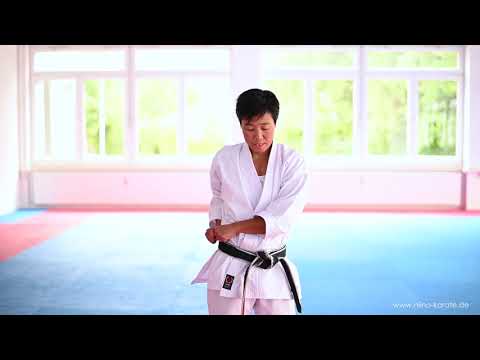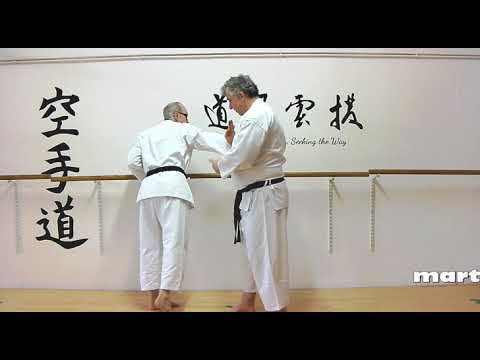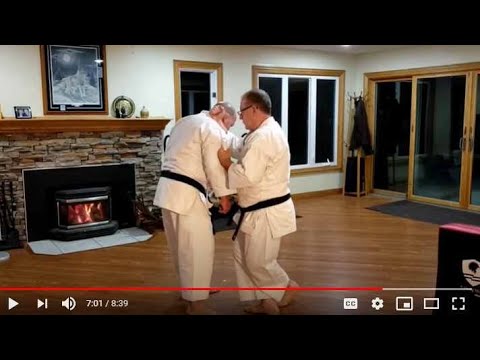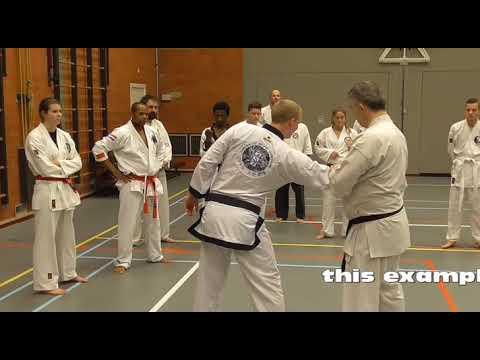
Morote uke Examples
0
Double Arm Block·Kata For Self Defense Shotoryu Goshinjutsu
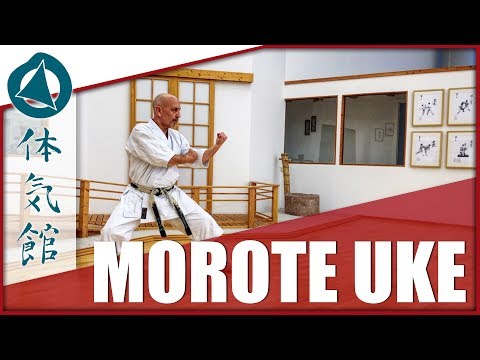
Just some samples of possible uses of the Morote uke, both-hand block/augmented block. Please 'like' & subscribe to my …
Translation: double arm block / augmented block
The Double Arm Block (Morote Uke) uses both arms simultaneously to block a powerful incoming attack, with one arm performing the primary block and the other reinforcing it. [1] In karate, it is called morote uke (augmented forearm block), where the back fist of the supporting hand is placed against the inside of the blocking arm's forearm to add structural reinforcement. [1],[2] In Taekwon-Do it is doo palmok makgi (double forearm block). This technique is used against powerful attacks where a single-arm block may be insufficient — particularly against strong roundhouse kicks or committed punches. [1]
The Double Arm Block (Morote Uke) is documented in Gichin Funakoshi's Karate-Do Kyohan as an augmented forearm block for defending against powerful attacks. [1] In Taekwon-Do it is doo palmok makgi. The technique appears in kata/forms across nearly all traditional martial arts as a response to committed power attacks. [1],[2]
Essential against powerful attacks where a single arm block would be insufficient. [1] Particularly effective against roundhouse kicks to the body — the double forearm barrier absorbs the shin impact. However, it commits both hands to defense, so it must be followed immediately by a counter-attack. [1]
Okinawan karate lineage: Chinese martial arts (Fujian White Crane, Southern Shaolin) → Okinawan te (Shuri-te, Naha-te, Tomari-te) → systematized by Anko Itosu and Kanryo Higaonna → transmitted to mainland Japan by Gichin Funakoshi (Shotokan), Chojun Miyagi (Goju-Ryu), and Kenwa Mabuni (Shito-Ryu) in the 1920s–30s. [1]
Fundamental defensive technique in WKF karate kumite competition. Used in every competitive karate match. Also foundational in TKD, kickboxing, and MMA striking defense. [1]
No images yet for this technique.
Sign in to suggest an image.
Just some samples of possible uses of the Morote uke, both-hand block/augmented block. Please 'like' & subscribe to my …
Es gibt viele verschiedene Varianten einer Technikausführung. Warum ist das so? Beherrsche das Kihon Basic Prinzip und v…
http://www.bunkai.co.uk for the free Bunkai Strategies Newsletter and our range of DVDs, Books, and Downloads. In this …
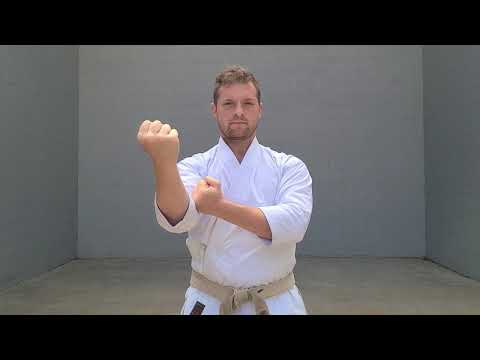
This is an orientation for the use of the augmented block / morote uke as a block and strike, either simultaneously, or …
http://www.bunkai.co.uk for the free Bunkai Strategies Newsletter and our range of DVDs, Books, and Downloads. In this …
🔊 Turn on subtitles 🇺🇸 Video description: MOROTE UKE | Shōtōkan Karate Technique --- If you like the video, feel fr…
☯️ BIO: Kyoshi Colton Woodard, USA National Team Athlete, Entrepreneur, Ramen Noodle Connoisseur & Operator of the Natio…
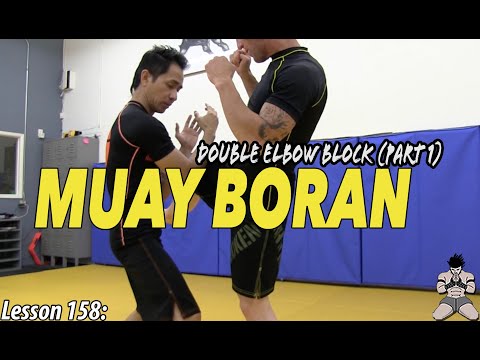
This ancient Muay Thai method of blocking uses 2 arms to block as you step inward to close the gap. In this instance, we…
The double arm block (morote uke) functions as a simultaneous defensive and offensive technique in which both arms work together to intercept and neutralize incoming attacks while creating immediate striking opportunities. According to Kata For Self Defense Shotoryu Goshinjutsu, the fundamental application involves raising both hands to protect the body when an opponent throws a punch, with one arm blocking while the other generates a counter-strike, particularly targeting the torso or neck. The technique's effectiveness increases when the defender breaks the attacker's structural integrity through the block itself. John Burke emphasizes alternative bunkai applications involving grab scenarios, where the defender uses the double arm block mechanics to control an aggressor's wrist or grip, roll their arm position, and transition into striking from a position of control. Both instructors agree the timing of interception is critical—ideally catching the attacker's arm before it passes the shoulder. Kata For Self Defense details multiple striking targets including the floating ribs, thoracic nerve, femoral nerve, and jaw, with variations in stance (front or back) and follow-up sequences depending on kata context. The technique appears extensively in Heian Nidan and Heian Sandan, where it manifests as block-strike combinations or multi-strike sequences. Burke stresses the importance of controlling the opponent's weapons and managing positioning advantage before committing to strikes.
Synthesized from 4 instructors
No instructional courses yet for this technique.
Sign in to suggest a course.
Risk of injury to the person this technique is applied to
Minimal — defensive technique.
Skill level needed to execute this technique reliably
Whether this technique is allowed under major competition rule sets
Funakoshi, G. Karate-Do Kyohan. Kodansha.
[1] Funakoshi, Karate-Do Kyohan, Blocking chapter
[2] Choi, Condensed Encyclopedia of Taekwon-Do (1999)
Official karate technique names (和語/漢語)
Established Japanese martial arts naming convention — native Japanese term (和語/漢語)
[1] Funakoshi, Karate-Do Kyohan, Blocking chapter
[2] Choi, Condensed Encyclopedia of Taekwon-Do (1999)
forearm conditioning (absorbing powerful impacts), structural alignment
both deltoids, both forearm complexes, core (absorbing impact through the body)
A double arm block is preferable when moving away would allow your opponent to continue their attack. By moving in and up while executing the block, you can simultaneously defend and strike across their head in one motion, controlling the distance and neutralizing the threat.
After executing the double arm block and striking, you can continue with a double tap combination—such as a kick followed by an elbow strike—which bends your opponent over and creates an excellent target for follow-up techniques.
The Double Arm Block (Morote Uke) uses both arms simultaneously to block a powerful incoming attack, with one arm performing the primary block and the other reinforcing it. In karate, it is called morote uke (augmented forearm block), where the back fist of the supporting hand is placed against the inside of the blocking arm's forearm to add structural reinforcement.
The Double Arm Block (Morote Uke) is documented in Gichin Funakoshi's Karate-Do Kyohan as an augmented forearm block for defending against powerful attacks. In Taekwon-Do it is doo palmok makgi.
WKF Karate: Legal: legal — fundamental defensive technique; WT Taekwondo: Legal: legal — blocking is a core skill; WAKO Kickboxing: Legal {src:WAKO Full Contact Rules|/sources/WAKO: legal — Full-Contact-Rules.pdf}; Unified MMA: Legal {src:Unified Rules of MMA, August 2025|/sources/Unified: legal — MMA-Rules-August-2025.pdf}
Danger rating 1/10. Minimal — defensive technique.
The standard setup chain: Double block a roundhouse kick → immediate counter knee to the body → X-block a downward strike → push attacker away and counter → Double low block a leg kick → rising counter-kick to the head.
Standard counters include: N/A — this IS a defensive technique. Can be exploited by feinting a power attack then striking elsewhere while both a….
Common variants: Augmented block (morote uke) (one arm blocks, the other reinforces from behind); X-block (juji uke) (both forearms cross to create an X-shaped barrier); Double rising block (both arms sweep upward against an overhead attack); Double low block (both arms sweep downward against a low kick).
Fundamental defensive technique in WKF karate kumite competition. Used in every competitive karate match.
Top errors to watch for: Using the double block against weak attacks — wastes both hands unnecessarily / Reaching too far — both arms extended leaves the body exposed / Not countering immediately after the block — you're defensively committed / Poor alignment between the two arms — reduces structural reinforcement.
The Double Arm Block is also known as Morote Uke, Doo Palmok Makgi, Augmented Block, Reinforced Block, Two Arm Block.