Dealing with Double Collar Ties
0
Double Collar Tie-Thai Plum·Aaron Jannetti
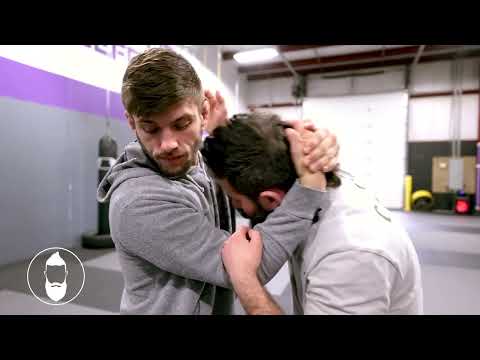
Here's a look at a few concepts/approaches that have served me well over the years for dealing with a double collar tie.…
Translation: double collar tie / Thai plum
The Double Collar Tie (Thai Plum) subfamily covers the clinch position where both hands grip behind the opponent's neck, creating maximum head control with bilateral grip. [1] The Thai plum is the signature position of Muay Thai clinch fighting — both hands interlocked behind the neck with elbows tight against the opponent's collarbones, allowing the attacker to pull the head down for devastating knee strikes. [1],[2] The double collar tie creates a powerful frame that controls the opponent's posture, movement, and ability to generate offence, making it one of the most dominant standing clinch positions in combat sports. [2],[3]
The Thai plum (double collar tie) is the most iconic clinch position in Muay Thai, refined over centuries of competition in Thailand where clinch fighting is considered the art's most sophisticated tactical arena. [1] Thai fighters spend thousands of hours drilling clinch work, with the plum position serving as the primary offensive platform for the devastating knee strikes that characterise Muay Thai. [2] The position entered mainstream MMA through fighters like Anderson Silva and Wanderlei Silva, who demonstrated its effectiveness in cage fighting. [2],[3]
The Thai plum is widely regarded as the single most dominant standing clinch position in Muay Thai, providing near-total head control and a direct platform for devastating knee strikes. [1] Kraitus and Kraitus describe the plum as the position from which 'the most powerful knee strikes in Muay Thai are delivered,' noting that a fighter who secures the full plum against an untrained opponent has an overwhelming advantage. [1] Delp rates it among the highest-percentage clinch positions in combat sports, emphasising that even experienced fighters struggle to escape once the lock is fully engaged. [2]
The Thai plum evolved within the Muay Thai tradition in Thailand, transmitted through stadium training camps (kai muay) where clinch fighting is considered the highest expression of technical mastery. [1] The position is taught as a core technique across all major Muay Thai lineages, from the Lumpinee and Rajadamnern stadium systems to modern international Muay Thai programmes. [2] Notable lineage holders include the fighters and trainers of the Sityodtong, Sor Thanikul, and Jocky Gym camps, all of which emphasise clinch dominance. [3]
Anderson Silva used the Thai plum to deliver the knee that finished Rich Franklin at UFC 64 (October 2006) and again in their rematch at UFC 77 (October 2007), both times securing the plum and landing devastating knees. [1] Wanderlei Silva relied heavily on the plum clinch throughout his PRIDE career, using it to deliver knees in victories over Quinton Jackson (PRIDE 28, 2004), Kazushi Sakuraba, and others. [2] In Muay Thai, Dieselnoi Chor Thanasukarn (1980s) was considered the greatest plum clinch fighter in history, using his height and clinch skills to dominate the Lumpinee stadium scene with knees from the plum. [3]
No images yet for this technique.
Sign in to suggest an image.
Here's a look at a few concepts/approaches that have served me well over the years for dealing with a double collar tie.…
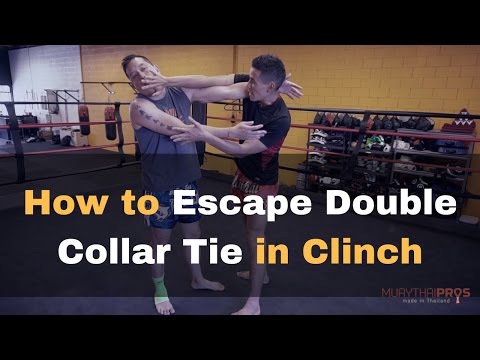
Learn how to escape from the clinch when your opponent has two hands wrapped around your neck. This video showcases 3 di…
The double collar tie (also called Thai plum) is a dominant head-control clinch position where the opponent controls the back of the head with both hands, creating significant postural breakdown and vulnerability to strikes or further clinch work. The strategic context for escaping this position centers on timing and immediate resistance: Muay Thai PROS emphasizes that escape attempts must occur in the early stages of the lock, before the opponent establishes a deep, tight grip—allowing only a narrow window for intervention. Aaron Jannetti frames escapes as space-creation strategies, categorizing them into progressively more forceful options depending on the opponent's size, arm positioning (elbow flare vs. tight control), and grip quality. Both instructors agree that initial postural resistance—keeping the neck straight and head upright—is fundamental to prevent the clinch from becoming inescapable. Jannetti details multiple escape progressions: swimming the arm to the inside toward a half-collar-tie position, face/head pushing with hand or forearm bone, and ear-pull techniques that collapse the opponent's elbow via forward hip walk and downward elbow drive. Muay Thai PROS presents three primary escapes: shoulder-to-shoulder compression to fold the opponent's grip, cross-face stiff-arm pressure, and lower-body repositioning for a body lock. Both instructors stress that escape methodology should serve a larger strategic objective—whether transitioning to offensive clinch control, striking position, or disengagement—rather than escape as an isolated goal.
Synthesized from 2 instructors
No instructional courses yet for this technique.
Sign in to suggest a course.
Risk of injury to the person this technique is applied to
Head/neck control positions create cervical strain; Muay Thai plum is primary striking platform
Skill level needed to execute this technique reliably
Whether this technique is allowed under major competition rule sets
Muay Thai: The Art of Fighting (Yod Ruerngsa, Khun Kao Charuad & James Cartmell, 2002)
Alias sources — [1] Muay Thai: The Art of Fighting (Kraitus & Kraitus, 1988) [2] Wrestling Physical Conditioning Encyclopedia (Welker, 2010) [3] Muay Thai Unleashed (Delp, 2006) [4] Muay Thai Unleashed (Delp, 2006)
Effectiveness sources — [1] Muay Thai: The Art of Fighting (Kraitus & Kraitus, 1988) [2] Muay Thai Unleashed (Delp, 2006)
Established Japanese martial arts naming convention — native Japanese term (和語/漢語)
Alias sources — [1] Muay Thai: The Art of Fighting (Kraitus & Kraitus, 1988) [2] Wrestling Physical Conditioning Encyclopedia (Welker, 2010) [3] Muay Thai Unleashed (Delp, 2006) [4] Muay Thai Unleashed (Delp, 2006)
Effectiveness sources — [1] Muay Thai: The Art of Fighting (Kraitus & Kraitus, 1988) [2] Muay Thai Unleashed (Delp, 2006)
neck and bicep strength for head control, endurance for sustained clinch
longer forearms for deeper collar tie, strong neck
biceps, forearms, neck muscles, core
Every move, in any martial art, shares a few universal traits. Mix and match below to pinpoint the right tool — or compare equivalents across styles.
The Long Guard Plum is a variation of the Thai plum where the attacker extends the arms to create distance before snapping the head down, using the extended position to manage range and timing. [1] Unlike the tight plum where the elbows are pressed against the opponent's collarbones, the long guard plum maintains some extension in the arms, creating a frame that keeps the opponent at the optimal distance for pull-in knee strikes. [1,2] The long guard plum allows the attacker to see incoming strikes better and react defensively while maintaining head control. [2,3]
The Standard Plum is the classical Thai plum position with both hands interlocked behind the opponent's neck, elbows pressed tight against the opponent's collarbones, and the attacker's forehead pressed into the opponent's forehead or crown. [1] The tight elbow position creates a frame that prevents the opponent from posturing up or creating distance, while the interlocked hands provide a secure grip for pulling the head down into knee strikes. [1,2] The standard plum is considered the most dominant clinch position in Muay Thai because it provides complete head control and an ideal platform for the sport's most powerful weapon — the straight knee. [2,3]
The Wrestling Collar Tie is the double collar tie variant adapted for wrestling contexts, where both hands grip behind the neck with the emphasis on snap-downs, takedown entries, and positional control rather than knee strikes. [1] The wrestling version typically uses a wider elbow position than the tight Muay Thai plum, allowing more push-pull dynamics for off-balancing and creating takedown openings. [1,2] From the wrestling double collar tie, the attacker can snap the opponent down for front headlock entries, circle for angles and go-behinds, or drive the opponent backward for body lock or double-leg entries. [2,3]
The double collar tie (Muay Thai clinch or 'plum') is the dominant clinch position in Muay Thai — both hands clasp behind the opponent's head to control posture and deliver knees. Countering the Muay Thai clinch is a dedicated chapter in most MMA training guides. (The Ultimate Mixed Martial Arts Training Guide; Muay Thai Unleashed, Delp)
Resist immediately when your opponent's hands first go around your neck and keep your head tight and neck straight. According to Muay Thai PROS, the first escape involves reaching your arm around the outside of their lock—this escape works right away before they establish a dominant position.
The primary goal is to create space and separation so you can either strike or fight for control. Aaron Jannetti emphasizes that you never want to let someone hang on the back of your head, and creating space allows you to get your head and torso back up into a postured position.
Aaron Jannetti outlines multiple follow-up options depending on your goal: you can fight to establish a tie clinch, work for overhooks or underhooks, go around the back, or set up strikes. The key is having a clear objective and chaining your next movements accordingly.
The Double Collar Tie (Thai Plum) subfamily covers the clinch position where both hands grip behind the opponent's neck, creating maximum head control with bilateral grip. The Thai plum is the signature position of Muay Thai clinch fighting — both hands interlocked behind the neck with elbows tight against the opponent's collarbones, allowing the attacker to pull the head down for devastating knee strikes.
The Thai plum (double collar tie) is the most iconic clinch position in Muay Thai, refined over centuries of competition in Thailand where clinch fighting is considered the art's most sophisticated tactical arena. Thai fighters spend thousands of hours drilling clinch work, with the plum position serving as the primary offensive platform for the devastating knee strikes that characterise Muay Thai.
Unified MMA: legal — Legal — clinching is integral to MMA; IJF: legal — Legal — kumi-kata (grip fighting) is fundamental to judo; IBJJF: legal — Legal — standing grip fighting and clinch work permitted; IFMA: legal — Legal — the clinch is a core element of Muay Thai, clinch dominance is highly…; WBC/Boxing: restricted — Holding is technically a foul — referee breaks clinch, excessive holding resu…; K: restricted — 1/GLORY — One attack from clinch allowed, then referee breaks; WAKO: restricted — Clinch generally broken by referee — limited or no clinch fighting in most fo…; UWW: legal — Legal — clinch is fundamental to wrestling, the primary position in Greco-Roman
Danger rating 5/10. High — head/neck control positions create cervical strain; Muay Thai plum is primary striking platform
The standard setup chain: Close Distance → Cup the Neck → Pull Down → Off-Balance.
Standard counters include: Pummeling — fight for inside position by swimming arms under opponent's grips / Frame and Push — create distance using forearm frames against the chest or neck / Hand Fight — strip grips by peeling fingers or pushing the wrist away / Level Change — change levels to break the collar tie angle and attack the legs.
Common variants: Single collar tie (one hand on the nape controlling the head); Double collar tie (plum) (both hands behind the head for maximum control); Collar tie with wrist control (one hand on the nape, other controlling the wrist).
Anderson Silva used the Thai plum to deliver the knee that finished Rich Franklin at UFC 64 (October 2006) and again in their rematch at UFC 77 (October 2007), both times securing the plum and landing devastating knees. Wanderlei Silva relied heavily on the plum clinch throughout his PRIDE career, using it to deliver knees in victories over Quinton Jackson (PRIDE 28, 2004), Kazushi Sakuraba, and others.
Top errors to watch for: Clasping hands behind the head with elbows wide — wide elbows let the opponent swim inside and break the plum / Not pulling the head down — the plum's power is the downward control that enables knees and elbows / Holding the plum without attacking — the position is only valuable when you're throwing knees or breaking posture / Interlacing fingers behind the head — use a Gable grip or butterfly grip; interlaced fingers break.
The Double Collar Tie-Thai Plum is also known as Kubi-zumo, Thai Plum, Double Neck Tie, Chap Kho, Muay Thai Plum Clinch.