Master the Collar Tie for BJJ in 5 Minutes
0
Wrestling Collar Tie·Chesapeake Grappling Academy·Added by Admin
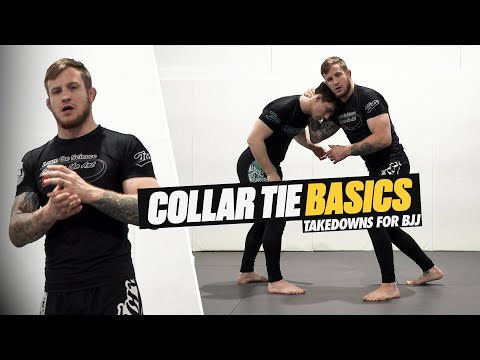
Welcome to Greg Walker Jiu Jitsu! In this video, 3rd degree black belt Greg Walker takes you through the fundamentals …
Translation: wrestling collar tie
The Wrestling Collar Tie is the double collar tie variant adapted for wrestling contexts, where both hands grip behind the neck with the emphasis on snap-downs, takedown entries, and positional control rather than knee strikes. [1] The wrestling version typically uses a wider elbow position than the tight Muay Thai plum, allowing more push-pull dynamics for off-balancing and creating takedown openings. [1],[2] From the wrestling double collar tie, the attacker can snap the opponent down for front headlock entries, circle for angles and go-behinds, or drive the opponent backward for body lock or double-leg entries. [2],[3]
The wrestling collar tie (double collar tie variant used in wrestling) is highly effective for snap-down attacks and front headlock transitions. [1] Welker describes it as a fundamental control position from which wrestlers can generate downward force on the opponent's head and neck to break posture and create takedown opportunities. [1] Petrov notes it is particularly effective when combined with level changes, as the snap-down motion disrupts the opponent's base. [2]
The wrestling collar tie is a universal position in folkstyle, freestyle, and Greco-Roman wrestling, taught at every level from youth wrestling through the Olympic programme. [1] It is a foundational technique in the American collegiate wrestling tradition, where snap-downs from the collar tie are among the first offensive techniques taught. [2]
The wrestling collar tie is one of the most fundamental positions in folkstyle and freestyle wrestling competition at all levels. [1]
No images yet for this technique.
Sign in to suggest an image.
Welcome to Greg Walker Jiu Jitsu! In this video, 3rd degree black belt Greg Walker takes you through the fundamentals …
PLEASE Click this link to SUPPORT the TeachMeGrappling Channel!!! https://www.patreon.com/TeachMeGrappling or https:/…
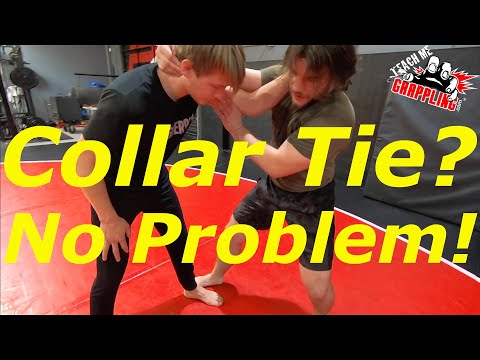
The wrestling collar tie is a fundamental head-control grip established from the clinch that enables multiple takedown setups and positional dominance. Both Chesapeake Grappling Academy and TeachMeGrappling Coach Brian emphasize that the collar tie combines control of the opponent's neck with management of their inside arm (bicep or elbow). Chesapeake Grappling Academy stresses the methodical approach to establishing the grip: first controlling the opponent's wrist by collapsing the four knuckles with the thumb, then climbing progressively to the elbow before securing the collar. They emphasize keeping the controlling elbow tight to the body ("T-Rex arm" position) to maximize tension through the chest, shoulders, and lats, and maintaining inside control of the wrist while following the opponent's arm during pummeling exchanges. TeachMeGrappling Coach Brian, featuring wrestler Anton Kalista, demonstrates the collar tie as a setup for the throw-by technique, where the grip facilitates a quarter-cartwheel hip rotation to displace the opponent. Brian stresses that effective throw-by execution relies on hip movement and body positioning rather than muscular pulling, with the guide arm functioning primarily to direct rather than drive the opponent. Both instructors agree that the collar tie serves as a hub for directional movement and leg manipulation, allowing practitioners to create angles for single-leg takedowns or throws depending on which direction they step.
Synthesized from 2 instructors
No instructional courses yet for this technique.
Sign in to suggest a course.
Risk of injury to the person this technique is applied to
Head/neck control positions create cervical strain; Muay Thai plum is primary striking platform
Skill level needed to execute this technique reliably
Whether this technique is allowed under major competition rule sets
Muay Thai: The Art of Fighting (Yod Ruerngsa, Khun Kao Charuad & James Cartmell, 2002)
Alias sources — [1] Wrestling Physical Conditioning Encyclopedia (Welker, 2010) [2] NCAA Wrestling Rules and Interpretations (NCAA, 2020) [3] Freestyle Wrestling: A Complete Guide (Petrov, 2005)
Effectiveness sources — [1] Wrestling Physical Conditioning Encyclopedia (Welker, 2010) [2] Freestyle Wrestling: A Complete Guide (Petrov, 2005)
Standard katakana transliteration of Western martial arts terminology (外来語) — used in Japanese MMA, boxing, and BJJ communities
Alias sources — [1] Wrestling Physical Conditioning Encyclopedia (Welker, 2010) [2] NCAA Wrestling Rules and Interpretations (NCAA, 2020) [3] Freestyle Wrestling: A Complete Guide (Petrov, 2005)
Effectiveness sources — [1] Wrestling Physical Conditioning Encyclopedia (Welker, 2010) [2] Freestyle Wrestling: A Complete Guide (Petrov, 2005)
neck and bicep strength for head control, endurance for sustained clinch
longer forearms for deeper collar tie, strong neck
biceps, forearms, neck muscles, core
The collar tie is control of the neck combined with control of your opponent's inside bicep/elbow. From this position, you can set up multiple takedowns and techniques, making it a hub for finding openings.
Reaching directly for the neck leaves you open to counters and makes it likely your opponent will elbow block. Instead, you should control the hands first as your initial checkpoint before progressing up to the neck.
Aim for the four knuckles and try to get your thumb in between to collapse them—this is surprisingly strong and makes it harder for your opponent to escape.
Keep your elbow close to your body (like a 'T-Rex arm') with your wrist pointed down; the closer your elbow stays to your body, the stronger your control will be.
Step in the direction of the leg you want to take, create space by moving out of the way, and pull your opponent into that space using the collar tie. When they get tired and pop up high, that's when you can enter your shot.
The Wrestling Collar Tie is the double collar tie variant adapted for wrestling contexts, where both hands grip behind the neck with the emphasis on snap-downs, takedown entries, and positional control rather than knee strikes. The wrestling version typically uses a wider elbow position than the tight Muay Thai plum, allowing more push-pull dynamics for off-balancing and creating takedown openings.
The wrestling double collar tie has been a fundamental clinch position in both freestyle and Greco-Roman wrestling for over a century. While Muay Thai optimised the double collar tie for striking, wrestling traditions developed it as a platform for takedowns and positional dominance.
Unified MMA: legal — Legal — clinching is integral to MMA; IJF: legal — Legal — kumi-kata (grip fighting) is fundamental to judo; IBJJF: legal — Legal — standing grip fighting and clinch work permitted; IFMA: legal — Legal — the clinch is a core element of Muay Thai, clinch dominance is highly…; WBC/Boxing: restricted — Holding is technically a foul — referee breaks clinch, excessive holding resu…; K: restricted — 1/GLORY — One attack from clinch allowed, then referee breaks; WAKO: restricted — Clinch generally broken by referee — limited or no clinch fighting in most fo…; UWW: legal — Legal — clinch is fundamental to wrestling, the primary position in Greco-Roman
Danger rating 5/10. High — head/neck control positions create cervical strain; Muay Thai plum is primary striking platform
The standard setup chain: Close Distance → Cup the Neck → Pull Down → Off-Balance.
Standard counters include: Pummeling — fight for inside position by swimming arms under opponent's grips / Frame and Push — create distance using forearm frames against the chest or neck / Hand Fight — strip grips by peeling fingers or pushing the wrist away / Level Change — change levels to break the collar tie angle and attack the legs.
Common variants: Single collar tie (one hand on the nape controlling the head); Double collar tie (plum) (both hands behind the head for maximum control); Collar tie with wrist control (one hand on the nape, other controlling the wrist).
The wrestling collar tie is one of the most fundamental positions in folkstyle and freestyle wrestling competition at all levels.
Top errors to watch for: Snapping without shooting — the snap creates the opening, but you must exploit it with a level change or drag / Using the collar tie to hold the opponent's head down indefinitely — the referee penalises stalling; attack quickly / Not controlling the other arm — without bicep or wrist control, the opponent can freely counter / Snapping straight down instead of diagonally — the diagonal snap creates better off-balance and exposes the side.
The Wrestling Collar Tie is also known as Resuringu Karā Tai, Double Collar Tie, Snap Down Clinch, Wrestling Neck Tie.