How to Deal with a Collar Tie
0
Collar Tie·Stay Safe Martial Arts
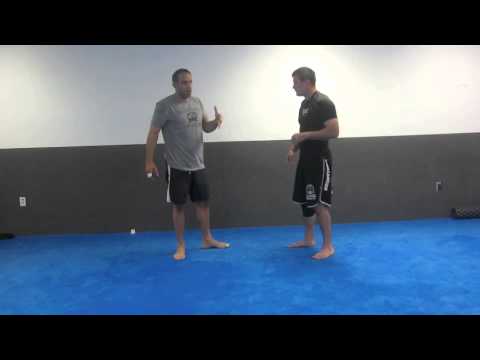
A few different approaches to dealing with a collar tie and how you can tie these approaches together. Future videos we…
Translation: collar tie
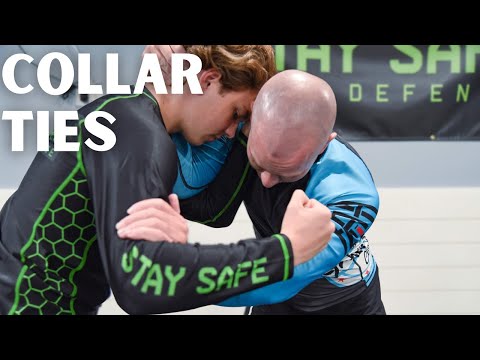
The Collar Tie family covers clinch positions where the attacker places one or both hands behind the opponent's neck, gripping the back of the neck or base of the skull to control the head and posture. [1] The collar tie provides direct head control — the attacker can pull the opponent's head down to break posture, push it to the side to create angles, or snap it forward to initiate takedown entries. [1],[2] Single collar ties allow one free hand for strikes or secondary grips, while the double collar tie (Thai plum) provides maximum head control for knee strikes and clinch throwing techniques. [2],[3]
The collar tie has been a fundamental clinch grip in wrestling for centuries, with the hand-behind-the-neck position appearing in the earliest wrestling instruction. [1] Muay Thai developed the collar tie into its most sophisticated form — the plum clinch — where head control is the foundation of the entire clinch fighting system. [2],[3]
The collar tie is one of the most commonly used clinch positions in MMA. [1]
No images yet for this technique.
Sign in to suggest an image.
A few different approaches to dealing with a collar tie and how you can tie these approaches together. Future videos we…
Go to http://www.bjjimmersion.com for more
No instructional courses yet for this technique.
Sign in to suggest a course.
Risk of injury to the person this technique is applied to
Head/neck control positions create cervical strain; Muay Thai plum is primary striking platform
Skill level needed to execute this technique reliably
Whether this technique is allowed under major competition rule sets
Muay Thai: The Art of Fighting (Yod Ruerngsa, Khun Kao Charuad & James Cartmell, 2002)
Alias sources — [1] Wrestling Physical Conditioning Encyclopedia (Welker, 2010) [2] Muay Thai: The Art of Fighting (Kraitus & Kraitus, 1988) [3] Muay Thai: The Art of Fighting (Kraitus & Kraitus, 1988) [4] Wrestling for Fighting (Couture, 2007)
Effectiveness sources — [1] Wrestling Physical Conditioning Encyclopedia (Petrov, 1977) [2] Muay Thai Unleashed (Delp, 2006)
Standard katakana transliteration of Western martial arts terminology (外来語) — used in Japanese MMA, boxing, and BJJ communities
Alias sources — [1] Wrestling Physical Conditioning Encyclopedia (Welker, 2010) [2] Muay Thai: The Art of Fighting (Kraitus & Kraitus, 1988) [3] Muay Thai: The Art of Fighting (Kraitus & Kraitus, 1988) [4] Wrestling for Fighting (Couture, 2007)
Effectiveness sources — [1] Wrestling Physical Conditioning Encyclopedia (Petrov, 1977) [2] Muay Thai Unleashed (Delp, 2006)
neck and bicep strength for head control, endurance for sustained clinch
longer forearms for deeper collar tie, strong neck
biceps, forearms, neck muscles, core
Every move, in any martial art, shares a few universal traits. Mix and match below to pinpoint the right tool — or compare equivalents across styles.
The Double Collar Tie (Thai Plum) subfamily covers the clinch position where both hands grip behind the opponent's neck, creating maximum head control with bilateral grip. [1] The Thai plum is the signature position of Muay Thai clinch fighting — both hands interlocked behind the neck with elbows tight against the opponent's collarbones, allowing the attacker to pull the head down for devastating knee strikes. [1,2] The double collar tie creates a powerful frame that controls the opponent's posture, movement, and ability to generate offence, making it one of the most dominant standing clinch positions in combat sports. [2,3]
The Irish Collar Tie is a clinch position where one hand controls the back of the opponent's neck (collar tie) while the other hand controls their wrist on the same side — creating a diagonal control configuration used in wrestling and MMA for snap-downs, level changes, and arm drag setups. [1] The 'Irish' variation specifically refers to the wrist control addition to the standard collar tie. [1,2]
The Single Collar Tie subfamily covers clinch positions where one hand grips behind the opponent's neck while the other hand is free to work — gripping the arm, controlling the wrist, or preparing for strikes or takedowns. [1] The single collar tie is the most common initial clinch position in both wrestling and MMA because it is easily established from striking range and provides meaningful head control with one hand while keeping the other available for offence. [1,2] The free hand's versatility makes the single collar tie an extremely adaptable position from which numerous techniques can be initiated. [2,3]
The collar tie appears in 32 passages across 4 books. The most fundamental standing clinch control in wrestling and MMA — one hand grips behind the opponent's neck. Sets up snap-downs, arm drags, and level changes for takedowns. (4 books; The Ultimate MMA Training Guide)
Don't just release the grip and step away, as your opponent may immediately follow with punches or elbows. Instead, maintain control of their arm by converting it into a two-on-one grip, which keeps you safe while you set up a takedown or strike (Stay Safe Martial Arts).
Turn your head and duck slightly while pushing at your opponent's elbow, then push your arm across to create separation. This simple grip break requires maintaining eye contact and awareness so you know if they try to tie up again (Stay Safe Martial Arts).
If you try to throw the collar tie up or lift while ducking, your opponent can keep it tight and maintain control. Instead, come underneath it and duck it properly, then get your angle and penetrate to escape (kenprimo).
After securing control—either through a breakaway, two-on-one grip, or by ducking under—drop your level and penetrate forward. You can also use footwork and circling to create an angle rather than relying solely on upper body strength (kenprimo, Stay Safe Martial Arts).
The Collar Tie family covers clinch positions where the attacker places one or both hands behind the opponent's neck, gripping the back of the neck or base of the skull to control the head and posture. The collar tie provides direct head control — the attacker can pull the opponent's head down to break posture, push it to the side to create angles, or snap it forward to initiate takedown entries.
The collar tie has been a fundamental clinch grip in wrestling for centuries, with the hand-behind-the-neck position appearing in the earliest wrestling instruction. Muay Thai developed the collar tie into its most sophisticated form — the plum clinch — where head control is the foundation of the entire clinch fighting system.
Unified MMA: legal — Legal — clinching is integral to MMA; IJF: legal — Legal — kumi-kata (grip fighting) is fundamental to judo; IBJJF: legal — Legal — standing grip fighting and clinch work permitted; IFMA: legal — Legal — the clinch is a core element of Muay Thai, clinch dominance is highly…; WBC/Boxing: restricted — Holding is technically a foul — referee breaks clinch, excessive holding resu…; K: restricted — 1/GLORY — One attack from clinch allowed, then referee breaks; WAKO: restricted — Clinch generally broken by referee — limited or no clinch fighting in most fo…; UWW: legal — Legal — clinch is fundamental to wrestling, the primary position in Greco-Roman
Danger rating 5/10. High — head/neck control positions create cervical strain; Muay Thai plum is primary striking platform
The standard setup chain: Close Distance → Cup the Neck → Pull Down → Off-Balance.
Standard counters include: Pummeling — fight for inside position by swimming arms under opponent's grips / Frame and Push — create distance using forearm frames against the chest or neck / Hand Fight — strip grips by peeling fingers or pushing the wrist away / Level Change — change levels to break the collar tie angle and attack the legs.
Common variants: Single collar tie (one hand on the nape controlling the head); Double collar tie (plum) (both hands behind the head for maximum control); Collar tie with wrist control (one hand on the nape, other controlling the wrist).
The collar tie is one of the most commonly used clinch positions in MMA.
Top errors to watch for: Grabbing the back of the head instead of cupping the neck — the neck cup gives better directional control / Pulling straight down without an angle — always pull diagonally to create rotational off-balance / Using the collar tie passively without attacking — snap, drag, or strike within 2-3 seconds / Reaching for the collar tie with a straight arm — the arm should be bent with the elbow close to the body.
The Collar Tie is also known as Karā Tai, Neck Tie, Thai Clinch, Muay Thai Plum, Collar Control.