Hand Formation and Grip
The knife hand block begins with proper hand positioning. Both hands are fully opened with fingers pressed tightly together and thumbs pressed firmly against the sides of the hands. The wrist must remain straight throughout the entire technique to maintain proper structure and blocking power.
Basic Two-Hand Drill
The instructor begins with hands positioned in front of the body, elbows forward but slightly away from the ribs. Both hands move upward and inward toward the face with a twisting motion, then extend outward in front while maintaining elbow position close to the body. This in-and-out pattern is repeated rhythmically to develop muscle memory and proper hand coordination.
Alternating Single-Hand Execution
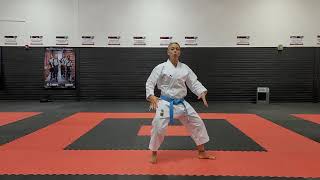
Practitioners progress to alternating hands, with one hand moving inward while the other extends outward to the blocking position. As one hand returns to chamber at the stomach, the opposite hand executes the block. The palms face outward, with the edge of the hand serving as the striking surface for blocking contact.
Footwork Integration: Lateral Steps
The block is combined with lateral stepping while maintaining proper stance alignment. The practitioner drops the body vertically while extending the leg sideways, keeping the torso on the same vertical line. As the body rises, the blocking hand executes the technique in conjunction with the completed step.
Forward and Backward Stepping
The knife hand block transitions to forward and backward movement patterns. Practitioners execute half-steps with chamber positions, followed by full steps with the block. The technique maintains its structure regardless of direction, with proper weight distribution and timing coordinated with hand execution.
Chamber Hand Extension
As practitioners advance, the non-blocking hand extends straight forward during execution rather than remaining passively chambered. The hand at the stomach rises to face height while the opposite hand extends fully forward. This coordinated motion demonstrates proper advanced form and prepares students for combat applications.
Continuous Execution at Speed
The complete technique is performed fluidly at full speed with multiple repetitions in both forward and backward directions. Proper preparation and execution remain critical elements regardless of tempo. Students demonstrate the knife hand block as an integrated movement combining footwork, body rotation, and hand techniques simultaneously.
Beginning Karate: Knife Hand Block (Shuto Uke)
Key Takeaways
- •Hand Formation and Grip
- •Basic Two-Hand Drill
- •Alternating Single-Hand Execution
- •Footwork Integration: Lateral Steps
For new students to karate: How to learn to do a basic knife hand block (shuto-uke).
Frequently Asked Questions
What does this video teach about shuto chudan uke?
This video covers hand formation and grip, basic two-hand drill, alternating single-hand execution. It provides detailed instruction from Seamus O'Dowd.
How long does it take to learn shuto chudan uke?
The basic mechanics can be understood in a single session, but developing reliable execution requires consistent drilling over weeks of practice. This 7-part breakdown helps structure your training by isolating each phase of the technique.
What are the key details for finishing shuto chudan uke?
As practitioners advance, the non-blocking hand extends straight forward during execution rather than remaining passively chambered. The hand at the stomach rises to face height while the opposite hand extends fully forward. This coordinated motion demonstrates proper advanced form and prepares students for combat applications.
Related videos
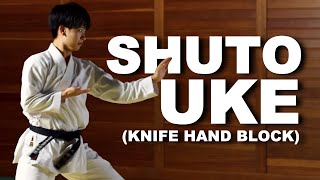
Japanese Karate Sensei's Tips On Shuto Uke (Knife Hand Block)
Karate Dojo waKu
Tip for Shuto Uke. #karate #tutorial #shorts #ytshorts #trending #viral
Kempo by Feike
Shorts075 - Chudan Shuto Uke 👊🏻 #shorts
Honam @ White Belt Dojo
Shuto uke tutorial - 5 Ways to apply shuto uke
The Kata Coach
Shuto Uke
Jennifer Allman