High Guard as Positional Trap
The high vom tog (high guard) serves as a psychological and mechanical trap in HEMA longsword. By adopting this position with the sword held above the head, the fencer signals to their opponent that only downward cuts are possible, forcing a decision: either move to a high guard to match, or commit to a low-line attack from their current position.
Textual Foundation and Intent
According to the Lipton glosses and historical HEMA texts, the high vom tog is specifically designed to counter fool (low-line guards). The mechanical advantage arises when an opponent attempting a low thrust commits their forward momentum, leaving them vulnerable to a descending cut to the head.
Momentum and Distance Management
An attacking thrust generates maximum forward momentum in the initial step and arm extension. Once the attacker reaches full extension, forward momentum diminishes significantly. The high guard fencer exploits this by retreating at matched speed, evading the threatening initial phase and then delivering a cut during the slower extension phase.
Opponent's Defensive Adaptation
When a low-line thrust fails to land, most fencers abandon the attack and raise their hands into a hanging parry or ox guard for protection. This defensive repositioning occurs mid-movement and with minimal distance, severely limiting the fencer's ability to block effectively or mount a counter-thrust.
Positional Advantage and Pressure
Once the opponent commits to a purely defensive block, the high guard fencer achieves a position of control where the opponent has only one option: block, rather than attack. This eliminates the threat of simultaneous afterblows and ensures the descending cut lands with safety.
Post-Miss Dynamics
If the opponent's thrust misses and they fail to raise an adequate hanging parry, their forward momentum leaves them too committed to recover. They are forced either to grapple at close range or accept the descending cut. Either outcome favors the high guard fencer, particularly if they possess strong grappling skills.
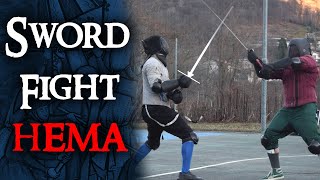
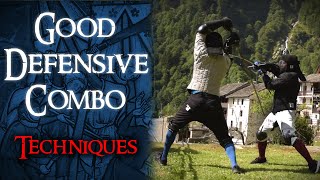
HEMA Fight Breakdown: High vs Low Guards
Key Takeaways
- •High Guard as Positional Trap
- •Textual Foundation and Intent
- •Momentum and Distance Management
- •Opponent's Defensive Adaptation
A common situation with an overlooked solution Feel free to submit your own footage to be featured on the channel. Please send footage either as a video file or a youtube link to [email protected] #hema #longsword
Related Techniques
Frequently Asked Questions
What does this video teach about hema strike?
This video covers high guard as positional trap, textual foundation and intent, momentum and distance management. It provides detailed instruction from HEMA Fight Breakdowns.
How long does it take to learn hema strike?
The basic mechanics can be understood in a single session, but developing reliable execution requires consistent drilling over weeks of practice. This 6-part breakdown helps structure your training by isolating each phase of the technique.
What are the key details for finishing hema strike?
Once the opponent commits to a purely defensive block, the high guard fencer achieves a position of control where the opponent has only one option: block, rather than attack. This eliminates the threat of simultaneous afterblows and ensures the descending cut lands with safety.