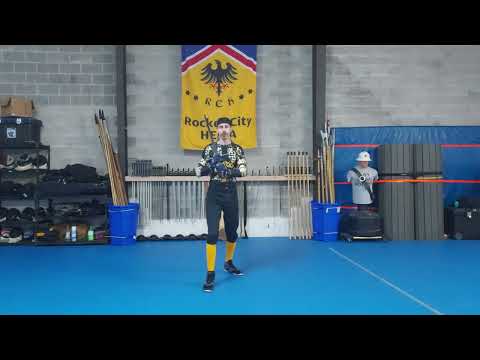
HEMA's 'Sport' Guard
0
HEMA Guard·Rocket City HEMA
Discussing the modern posture often seen in HEMA tournaments and some common actions you can make from it.
Translation: Historical European Martial Arts sword guard positions
The HEMA Guard family encompasses the named sword guard positions (Huten or Leger) of the German and Italian longsword traditions. [1] Guards are specific positions in which the sword is held relative to the body, each offering a distinct combination of defensive coverage and offensive threat. [1] The Liechtenauer German tradition identifies four principal guards: Vom Tag (from the roof — sword held high), Ochs (ox — sword at shoulder with point forward), Pflug (plow — sword at hip with point forward), and Alber (fool — sword held low with point toward the ground). [1],[2] Italian traditions add additional guards such as Posta di Donna (woman's guard) and Posta Longa (long guard). [2] Guards are not static — they are transitional positions from which attacks and counters are launched, and through which the sword passes between actions. [1],[2]
HEMA guards originate in the medieval German Fechtbücher (fight books) of the 14th–16th centuries. [1] The four principal guards of the Liechtenauer tradition (Vom Tag, Ochs, Pflug, Alber) are described in the Zettel and elaborated in the glosses of Sigmund Ringeck, Peter von Danzig, and Pseudo-Peter von Danzig. [1],[2] Italian fencing master Fiore dei Liberi documented additional guards in his Fior di Battaglia (1409), and the Italian and German traditions share many guard concepts under different names. [2] Modern HEMA practitioners reconstruct these guards from the manuscript illustrations and descriptions, adapting them for tournament competition. [1],[2]
Guards provide the structural framework for all longsword combat — without proper guards, attacks lack power and defense lacks coverage. [1] The strategic choice of guard communicates intention and invites specific responses, allowing skilled fencers to manipulate the opponent's actions. A deep understanding of guards and their transitions is considered the foundation of HEMA competence. [1],[2]
German longsword lineage: Johannes Liechtenauer (14th century) → transmitted through the Gesellschaft Liechtenauers (Society of Liechtenauer) → documented in Fechtbücher by Sigmund Ringeck (c. 1440), Peter von Danzig (1452), Hans Talhoffer (1459), and Paulus Kal (1470). Reconstructed in modern HEMA from manuscript study beginning in the 1990s–2000s. [1]
Used in modern HEMA longsword tournaments sanctioned by HEMAA, HEMA Alliance, and regional federations. Scoring varies by ruleset (afterblow, first-touch, or exchange-based). [1]
No images yet for this technique.
Sign in to suggest an image.
Discussing the modern posture often seen in HEMA tournaments and some common actions you can make from it.
No instructional courses yet for this technique.
Sign in to suggest a course.
Risk of injury to the person this technique is applied to
Guards are positions, not attacks. Risk of fatigue from holding heavy swords in extended guards.
Skill level needed to execute this technique reliably
Whether this technique is allowed under major competition rule sets
Clements, J. (1998). Medieval Swordsmanship. Paladin Press.
[1] Clements, Medieval Swordsmanship (1998), chapters on the four principal guards and their applications
[2] Tobler, Secrets of German Medieval Swordsmanship (2004), guard descriptions from Ringeck and von Danzig glosses
[1] Clements, Medieval Swordsmanship (1998), chapters on the four principal guards and their applications
[2] Tobler, Secrets of German Medieval Swordsmanship (2004), guard descriptions from Ringeck and von Danzig glosses
shoulder endurance for holding heavy swords, core stability, understanding of attack lines
practitioners with sword handling experience
deltoids (sword support), forearms (grip), core (posture), legs (stance stability)
Every move, in any martial art, shares a few universal traits. Mix and match below to pinpoint the right tool — or compare equivalents across styles.
The Hanging Guard (Hangetort) is a HEMA longsword guard position where the sword is held with the point hanging downward, typically with the hands above the head or at shoulder height and the blade angled toward the ground. [1] It provides protection for the upper body while threatening with a rising cut or thrust. The hanging guard appears in multiple German and Italian fencing treatises as a transitional or defensive position that can quickly convert to an attack. [1] It is particularly effective against overhead cuts, as the angled blade deflects downward strikes while positioning for an immediate counter-thrust. [1]
Schrankhut (Barrier Guard) is a HEMA longsword guard where the sword is held low with the blade crossed in front of the body, creating a barrier between the fighter and the opponent. [1] The sword is typically held with the point directed to one side and the blade angled across the body at hip or knee level. It is a defensive guard that invites the opponent to attack high while positioning the blade for a rising counter-cut. [1] The guard appears in the German longsword tradition of Johannes Liechtenauer. [1]
The modern HEMA sport guard is characterized by a dominant foot forward stance (typically right foot), the sword held extended in front of the body, and a linear posture. According to Rocket City HEMA, the thumb position can vary—sometimes prominent on the blade, sometimes with the edge on—but the key feature is the dominant leg decidedly in front with the back leg equally engaged underneath.
Rocket City HEMA identifies several primary attacks: thrusting with the point forward, cutting from the left side (since both fighters typically have right foot forward with equally extended right arms), sweeping across the hands as a deflection or threat, and attacking the exposed hands with a quick turn. Strikes can also go low to the hands or body with a slight hip turn.
According to Rocket City HEMA, fighters typically fold into a left shoulder guard when they run out of options during an exchange. From this position, attacks and covers come across the body at a harsher angle, starting from the middle line rather than extended out, which gives them more application to the opponent's side.
Rocket City HEMA emphasizes that if the sport guard stance wasn't effective, practitioners wouldn't achieve success with it, and it's a position you will likely encounter and probably already take when fighting pressure is applied. The instructor treats it as a legitimate fighting position regardless of its historical presence in old manuals.
The HEMA Guard family encompasses the named sword guard positions (Huten or Leger) of the German and Italian longsword traditions. Guards are specific positions in which the sword is held relative to the body, each offering a distinct combination of defensive coverage and offensive threat.
HEMA guards originate in the medieval German Fechtbücher (fight books) of the 14th–16th centuries. The four principal guards of the Liechtenauer tradition (Vom Tag, Ochs, Pflug, Alber) are described in the Zettel and elaborated in the glosses of Sigmund Ringeck, Peter von Danzig, and Pseudo-Peter von Danzig.
HEMA tournaments: Legal: legal — guards are the foundation of all technique; HEMAA/HEMA Alliance: Legal: legal — standard in all longsword competition; SCA Heavy Combat: Legal: legal — permitted in armored combat formats
Danger rating 2/10. Low — guards are positions, not attacks. Risk of fatigue from holding heavy swords in extended guards.
The standard setup chain: Choose guard based on distance and opponent's stance → threaten with the guard's attack line → opponent reacts → launch attack or counter → Vom Tag → opponent sees high threat → covers high → switch to Pflug → attack low.
Standard counters include: Provoking — use feints to draw the opponent out of a strong guard / Attacking the guard — some guards leave specific openings that can be exploited / Pressing — apply forward pressure to collapse a defensive guard.
Common variants: Vom Tag (high guard (sword above head or at shoulder)); Ochs (ox guard (sword at shoulder, point forward toward opponen…); Pflug (plow guard (sword at hip, point forward toward opponent's…); Alber (fool's guard (sword held low, point toward ground)); Nebenhut (side guard (sword held to the side)); Schrankhut (barrier guard (see child entry)); Hanging Guard (sword held with point downward (see child entry)).
Used in modern HEMA longsword tournaments sanctioned by HEMAA, HEMA Alliance, and regional federations. Scoring varies by ruleset (afterblow, first-touch, or exchange-based).
Top errors to watch for: Holding guards statically — they must be transitional / Choosing guards randomly — each guard is a tactical decision / Neglecting Alber (fool's guard) — it appears weak but invites attacks that can be countered / Poor posture — fatigue from holding heavy swords leads to collapsed guards.
The HEMA Guard is also known as HEMA Gādo, Huten, Leger, Guard Position, Ward.