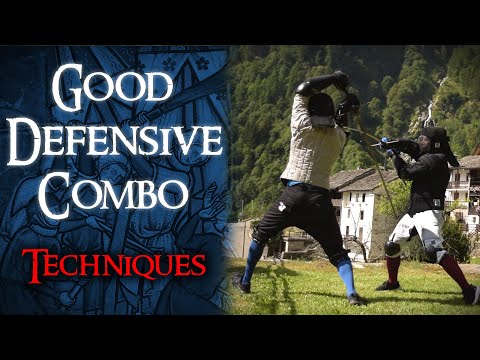
HEMA: Counter the Attack - Thrust and Cut Combination
0
HEMA Counter·Federico Malagutti HEMA
If you want to support me and this channel, check my Patreon page. Lots of exclusive contents awaits you there! PATREON…
Translation: Historical European Martial Arts counter-techniques
The HEMA Counter family encompasses the defensive-offensive techniques of the German longsword tradition — actions that simultaneously defend against an incoming attack and deliver a counter-attack. [1] In the Liechtenauer system, countering is not a passive act of blocking followed by a separate attack; instead, the core principle of Indes ('meanwhile') teaches the fighter to defend and attack in the same tempo. [1] Counter-techniques include Absetzen (setting aside with a thrust), Nachreisen (traveling after an opponent's movement), and various Versetzen (displacements) that redirect the opponent's blade while creating an opening. [1],[2] The family is distinct from the HEMA Guard family (static positions) and the HEMA Strike family (offensive cuts) because counter-techniques are reactive — they require the opponent to initiate an action. [2]
HEMA counter-techniques originate in the Kunst des Fechtens (Art of Fighting) tradition attributed to Johannes Liechtenauer (14th century). [1] The Zettel (epitome) of Liechtenauer's teachings describes fighting as fundamentally organized around Vor (before — initiative) and Nach (after — reaction), with the most skilled fighters using counter-techniques to turn the opponent's attacks into their own offensive opportunities. [1],[2] Multiple medieval Fechtbücher (fight books) — including those of Sigmund Ringeck, Peter von Danzig, and Hans Talhoffer — elaborate on counter-techniques as the highest level of swordsmanship. [2]
Counter-techniques are the most efficient actions in longsword combat because they combine defense and offense into a single tempo. [1] A fighter who must block first and then attack is always one tempo behind a fighter who deflects and strikes simultaneously. The Liechtenauer tradition considers mastery of counter-timing (Indes) to be the hallmark of the expert fencer. [1],[2]
German longsword lineage: Johannes Liechtenauer (14th century) → transmitted through the Gesellschaft Liechtenauers (Society of Liechtenauer) → documented in Fechtbücher by Sigmund Ringeck (c. 1440), Peter von Danzig (1452), Hans Talhoffer (1459), and Paulus Kal (1470). Reconstructed in modern HEMA from manuscript study beginning in the 1990s–2000s. [1]
Used in modern HEMA longsword tournaments sanctioned by HEMAA, HEMA Alliance, and regional federations. Scoring varies by ruleset (afterblow, first-touch, or exchange-based). [1]
No images yet for this technique.
Sign in to suggest an image.
If you want to support me and this channel, check my Patreon page. Lots of exclusive contents awaits you there! PATREON…
No instructional courses yet for this technique.
Sign in to suggest a course.
Risk of injury to the person this technique is applied to
Counter-techniques deliver strikes while the opponent is committed to their own attack and unable to defend.
Skill level needed to execute this technique reliably
Whether this technique is allowed under major competition rule sets
Clements, J. (1998). Medieval Swordsmanship. Paladin Press.
[1] Clements, Medieval Swordsmanship (1998), chapters on counter-techniques and Indes principle
[2] Tobler, Secrets of German Medieval Swordsmanship (2004), translations of Ringeck and von Danzig glosses on counter-play
[1] Clements, Medieval Swordsmanship (1998), chapters on counter-techniques and Indes principle
[2] Tobler, Secrets of German Medieval Swordsmanship (2004), translations of Ringeck and von Danzig glosses on counter-play
excellent timing, blade sensitivity (Fühlen), ability to read opponent's intention
experienced fencers with strong fundamentals
forearms (blade control), wrists (angling), core (stepping offline), legs (footwork)
Every move, in any martial art, shares a few universal traits. Mix and match below to pinpoint the right tool — or compare equivalents across styles.
Attack their arms from below with a manduito sotano (undercut) to their forearm. Federico Malagutti notes this is effective because raising the hands is a common defensive response, especially under pressure from beginners and intermediate fencers.
Move sideways—toward your left (the opponent's right)—while landing your manduito sotano, as this positioning increases your chances of defending from any follow-up action, especially a reverse cut.
After landing your cut, immediately retreat your hands into posto di donna while continuing to move sideways, which will help you defend from your opponent's next action.
The HEMA Counter family encompasses the defensive-offensive techniques of the German longsword tradition — actions that simultaneously defend against an incoming attack and deliver a counter-attack. In the Liechtenauer system, countering is not a passive act of blocking followed by a separate attack; instead, the core principle of Indes ('meanwhile') teaches the fighter to defend and attack in the same tempo.
HEMA counter-techniques originate in the Kunst des Fechtens (Art of Fighting) tradition attributed to Johannes Liechtenauer (14th century). The Zettel (epitome) of Liechtenauer's teachings describes fighting as fundamentally organized around Vor (before — initiative) and Nach (after — reaction), with the most skilled fighters using counter-techniques to turn the opponent's attacks into their own offensive opportunities.
HEMA tournaments: Legal: legal — core techniques in longsword competition; HEMAA/HEMA Alliance: Legal: legal — recognized in all affiliated tournaments; SCA Heavy Combat: Legal: legal — permitted in armored combat formats
Danger rating 8/10. Very High — counter-techniques deliver strikes while the opponent is committed to their own attack and unable to defend.
The standard setup chain: Hold a guard → opponent attacks → counter with Absetzen (deflect and thrust) → Provoke an attack with a feint → opponent commits → Nachreisen into their opening → Bind blades → feel opponent's pressure (Fühlen) → wind (Winden) to counter-thrust.
Standard counters include: Feint — draw out a counter-technique then attack the real opening / Compound attack — chain multiple attacks to overwhelm the counter-fighter / Angreifen (constraining) — apply pressure to prevent the opponent from setting up counters.
Common variants: Absetzen (setting aside (simultaneous parry and thrust)); Nachreisen (traveling after (attacking into the opponent's preparation)); Versetzen (displacement (redirecting the opponent's blade)); Durchwechseln (changing through (withdrawing the blade under the opponen…); Schnappen (snapping (quick counter-cut after a parry)).
Used in modern HEMA longsword tournaments sanctioned by HEMAA, HEMA Alliance, and regional federations. Scoring varies by ruleset (afterblow, first-touch, or exchange-based).
Top errors to watch for: Separating defense and offense into two motions — must be simultaneous / Waiting for the attack rather than anticipating it — counters require reading intention / Using the weak of the blade to deflect — insufficient structure / Not stepping offline — partial deflections still land if you stay on the line.
The HEMA Counter is also known as HEMA Kauntā, Gegenfechten, Counter-Technique, Nachschlagen, HEMA Defensive Technique.