Introduction and Equipment Requirements
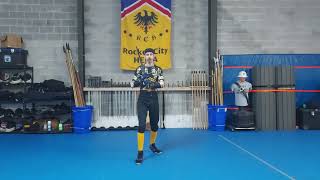
Jonathan, known as the medieval genie, presents British military sabre fundamentals using the Roworth and Angelo's system. The basket hilt or similarly protective guard is essential for hand safety, as unprotected hilts will result in severe laceration to hands, fingers, and forearms. The system applies to military sabres, broadswords, backswords, and similar weapons with straight or curved blades.
Stance and Off-Hand Positioning
The dominant foot leads the stance; a right-handed fencer positions the right foot forward and left foot back, holding the sabre with the right hand. The off-hand should remain protected behind the back or hip rather than extended, preserving it for occasional specialized actions such as disarms or grappling. Maintaining safe hand positioning prevents exposure to cuts while keeping the weapon ready for engagement.
Medium Guard: Theory and Limitations
The medium guard positions the hilt directly forward with the point threatening the opponent's center line. While this stance allows the opponent to run onto the blade if charging carelessly, it provides no actual protection of the head, flanks, or lower body. Due to these significant defensive deficiencies, the medium guard is considered impractical against a competent opponent and is not recommended as a primary position.
Outside Guard: Passive Configuration
The outside guard is achieved through a simple hand rotation, positioning the basket hilt to the sword-side (right for right-handed fencers) with the point directed toward the opponent. In the passive configuration, the point remains level, creating an immediate threat while simultaneously preparing a hard parry against attacks from the sword-side. This position provides inherent protection without requiring movement, allowing immediate execution of cuts, thrusts, and defensive actions.
Outside Guard: Raised Point Variant
The point can be raised higher while maintaining the outside guard, keeping the blade on-line for immediate exploitation of openings. When an opponent's thrust is averted, raising the point allows a simple forward step to complete the riposte with minimal effort. This variant provides enhanced reach and can withstand powerful blade-beats by bracing the sword closer to the body, reducing the likelihood of the opponent's strike breaking through the parry.
Inside Guard: Passive Configuration
The inside guard is achieved through an inward hand rotation while maintaining the point directed at the opponent, mirroring the advantages of the outside guard. The blade remains positioned along the body's centerline without extreme positioning, protecting the vital areas while avoiding unnecessary exposure of the flanks. Like the outside guard, this position requires only hand manipulation to establish and maintains constant offensive threat through point control.
British Military Sabre Basics: Guards
Key Takeaways
- •Introduction and Equipment Requirements
- •Stance and Off-Hand Positioning
- •Medium Guard: Theory and Limitations
- •Outside Guard: Passive Configuration
I show the artful swordfighting positions one must take when staving off one's quarry smartly with a basket hilted sword in one hand, the most incontestably British style! My background is in Historical European Martial Arts (HEMA), including studying sabre treatises and practicing with steel sabres that are of correct weight but blunt. I do not claim to be a master or expert in any particular style or overall, however these basics should help get the aspiring sabreur started. See my channel for more videos: https://www.youtube.com/user/PcGenie2 Help support my channel via Patreon: https://www.patreon.com/Pc_Genie
Related Techniques
Frequently Asked Questions
What does this video teach about sabre — military?
This video covers introduction and equipment requirements, stance and off-hand positioning, medium guard: theory and limitations. It provides detailed instruction from Medieval Genie.
How long does it take to learn sabre — military?
The basic mechanics can be understood in a single session, but developing reliable execution requires consistent drilling over weeks of practice. This 6-part breakdown helps structure your training by isolating each phase of the technique.
What are the key details for finishing sabre — military?
The point can be raised higher while maintaining the outside guard, keeping the blade on-line for immediate exploitation of openings. When an opponent's thrust is averted, raising the point allows a simple forward step to complete the riposte with minimal effort. This variant provides enhanced reach and can withstand powerful blade-beats by bracing the sword closer to the body, reducing the likelihood of the opponent's strike breaking through the parry.