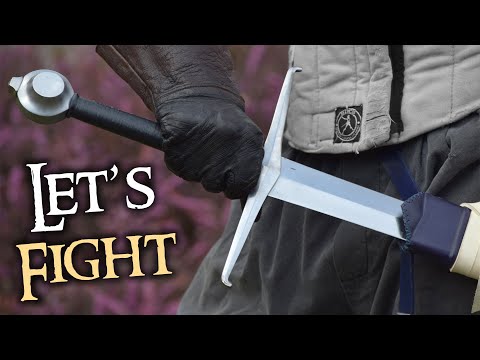
HEMA Longsword Fighting
0
HEMA Longsword·Federico Malagutti HEMA
If you want to support me and this channel, check my Patreon page. Lots of exclusive contents awaits you there! PATREON…
Translation: HEMA longsword
The HEMA Longsword family covers the two-handed sword techniques of the German Kunst des Fechtens and the Italian school of Fiore dei Liberi, the most widely studied and competitively practised weapon in Historical European Martial Arts. [1] The longsword — a cruciform-hilted, double-edged blade with a grip long enough for two hands, typically 100–130 cm in total length — was the quintessential weapon of the European knight from the fourteenth to sixteenth centuries. [1],[2] German longsword technique is organised around Liechtenauer's system of five master cuts (Meisterhäue), four principal guards (Vier Leger), and the concept of Vor and Nach (before and after) that governs initiative. [2],[3] Italian longsword technique, following Fiore, emphasises twelve guards (poste), flowing plays, and the integration of wrestling (abrazare) into sword combat. [3],[4]
The longsword emerged as a primary military weapon in the fourteenth century and was the subject of the most extensive body of European martial arts literature. [1] Johannes Liechtenauer's system, recorded in the Zettel and interpreted by Ringeck (c. 1440s) and Peter von Danzig (1452), became the dominant German school. [2],[3] Fiore dei Liberi's independent Italian system (1409) provides a complementary tradition with different tactical emphases. [3],[4]
The longsword is one of the most versatile medieval weapons, capable of cutting, thrusting, half-swording (gripping the blade for close-range thrusts against armour), and using the pommel and cross-guard as striking implements. [1] Its two-handed grip provides superior leverage for powerful cuts while maintaining enough point control for precise thrusts. [2] The German Kunst des Fechtens tradition and the Italian school of Fiore dei Liberi both developed comprehensive fighting systems demonstrating the longsword's adaptability across all combat ranges. [3]
The German longsword tradition traces its lineage to Johannes Liechtenauer (14th century), whose Zettel (mnemonic verse) encoded the core principles of the Kunst des Fechtens. [1] Liechtenauer's teachings were transmitted through a Society of masters including Sigmund Ringeck, Peter von Danzig, and Jud Lew, whose glosses (commentaries on the Zettel) survive in manuscripts from the 15th century. [2] The Italian tradition is anchored by Fiore dei Liberi's Fior di Battaglia (1409), which systematises longsword alongside dagger, wrestling, and polearm combat. [3] Hans Talhoffer produced multiple fight books (1443–1467) documenting German combat across all weapon categories. [4]
HEMA longsword competition has grown rapidly since the 2000s, with major tournaments including Swordfish (Gothenburg, est. 2007), Longpoint (USA, est. 2011), and the HEMA World Championship organised by the HEMAC. [1] Competitive scoring typically awards points for clean cuts and thrusts to the head and torso, with deductions for simultaneous exchanges (afterblows), reflecting the historical emphasis on striking without being struck. [2]
No images yet for this technique.
Sign in to suggest an image.
If you want to support me and this channel, check my Patreon page. Lots of exclusive contents awaits you there! PATREON…
No instructional courses yet for this technique.
Sign in to suggest a course.
Risk of injury to the person this technique is applied to
Edged weapons cause fatal lacerations; historical battlefield mortality rates >30% (Amberger 1999)
Skill level needed to execute this technique reliably
Whether this technique is allowed under major competition rule sets
The Art of Combat (Joachim Meyer, 1570)
Alias sources — [1] MMA Instruction Manual (UFC, 2008) [2] MMA Instruction Manual (UFC, 2008) [3] MMA Instruction Manual (UFC, 2008)
Effectiveness sources — [1] Tobler, C., In Saint George's Name: An Anthology of Medieval German Fighting Arts (Freelance Academy Press, 2010) [2] Forgeng, J., The Art of Combat: A German Martial Arts Treatise of 1570 (Palgrave Macmillan, 2003) [3] Mondschein, K., The Knightly Art of Battle (Getty Publications, 2011)
Standard katakana transliteration of Western martial arts terminology (外来語) — used in Japanese MMA, boxing, and BJJ communities
Alias sources — [1] MMA Instruction Manual (UFC, 2008) [2] MMA Instruction Manual (UFC, 2008) [3] MMA Instruction Manual (UFC, 2008)
Effectiveness sources — [1] Tobler, C., In Saint George's Name: An Anthology of Medieval German Fighting Arts (Freelance Academy Press, 2010) [2] Forgeng, J., The Art of Combat: A German Martial Arts Treatise of 1570 (Palgrave Macmillan, 2003) [3] Mondschein, K., The Knightly Art of Battle (Getty Publications, 2011)
wrist control for edge alignment, grip endurance, footwork precision
quick wrists, strong forearms, good posture
forearm extensors/flexors, deltoids, core, calves
Every move, in any martial art, shares a few universal traits. Mix and match below to pinpoint the right tool — or compare equivalents across styles.
The Grappling at the Sword (Ringen am Schwert) subfamily covers the close-quarters wrestling techniques performed while both combatants retain their longswords, a distinctive feature of German HEMA that integrates swordsmanship with grappling. [1] When the distance closes beyond cutting or thrusting range, the fight transitions to Ringen am Schwert, where fighters use their crossguards, pommels, and half-swording grips to throw, disarm, or lock the opponent. [1,2] These techniques include pommel strikes to the face, crossguard hooks to the neck, arm locks using the blade as a lever, and takedowns that use the sword as a wrestling aid. [2,3]
The Guard (Huten) subfamily covers the four principal guards (Vier Leger) of the German longsword tradition — Vom Tag, Ochs, Pflug, and Alber — which form the positional framework from which all attacks and defences originate. [1] Each guard protects specific lines while threatening others: Vom Tag threatens from above, Ochs guards the upper openings while threatening a thrust, Pflug guards the lower openings while threatening a thrust, and Alber invites the opponent's attack while preparing rising cuts. [1,2] Liechtenauer's system teaches that guards are not static positions but transitional states through which the sword passes during continuous combat flow. [2,3]
The Liechtenauer Cut subfamily covers the primary cutting techniques of HEMA longsword fencing, anchored in the German tradition's five master cuts (Fünf Meisterhäue) — Zornhau, Krumphau, Zwerchhau, Schielhau, and Scheitelhau — along with the fundamental Oberhau (descending cut) and Unterhau (rising cut). [1] Each master cut is not merely a strike but a complete tactical concept that simultaneously attacks and defends by displacing the opponent's blade while cutting to an opening. [1,2] The principle of Indes (meanwhile) teaches that cuts must flow without pause from one action to the next, maintaining constant pressure. [2,3]
The Winding (Winden) subfamily covers the blade manipulation techniques performed when two longswords are crossed in the bind (Binden), one of the most distinctive and sophisticated aspects of the German tradition. [1] Winding involves rotating the sword around the axis of the bind — by turning the hands and hips — to change the angle of threat from a cut-line to a thrust-line or vice versa, without breaking contact with the opponent's blade. [1,2] Winding is governed by the principle of Fühlen (feeling) — sensing the opponent's pressure through the crossed blades to determine whether they are hard or soft in the bind, and responding accordingly. [2,3]
The longsword (Langes Schwert) is the primary weapon of the Liechtenauer German tradition and the most popular HEMA discipline. Modern HEMA longsword competition uses steel or synthetic simulators with protective gear. The weapon requires two hands and combines cuts, thrusts, and pommel strikes. (Clements, Medieval Swordsmanship; Tobler, Secrets of German Medieval Swordsmanship)
Federico Malagutti suggests that during sparring, you should focus on finding out what your opponent will do and then counter it technically while playing the same game, which helps increase your technical adaptability over time.
The HEMA Longsword family covers the two-handed sword techniques of the German Kunst des Fechtens and the Italian school of Fiore dei Liberi, the most widely studied and competitively practised weapon in Historical European Martial Arts. The longsword — a cruciform-hilted, double-edged blade with a grip long enough for two hands, typically 100–130 cm in total length — was the quintessential weapon of the European knight from the fourteenth to sixteenth centuries.
The longsword emerged as a primary military weapon in the fourteenth century and was the subject of the most extensive body of European martial arts literature. Johannes Liechtenauer's system, recorded in the Zettel and interpreted by Ringeck (c.
Traditional martial arts: legal — Practiced in traditional kata/forms and weapon-specific competition under var…; IWUF: legal — Legal in wushu taolu if applicable; HEMA: legal — Legal in applicable historical weapon categories
Danger rating 9/10. Extreme — edged weapons cause fatal lacerations; historical battlefield mortality rates >30% (Amberger 1999)
The standard setup chain: Assume Guard (Kamae/Hut) → Measure Distance (Ma-ai) → Initiate Cut/Thrust → Follow Through (Zanshin).
Standard counters include: Parry (Absetzen) — deflect the incoming blade with a counter-displacement / Void (Step Back) — withdraw from measure to avoid the cutting arc / Counter-Cut (Nachreisen) — strike into the opponent's opening during their attack.
Common variants: Standard cut (primary cutting angle from the ready stance); Thrust (tsuki) (straight thrust targeting the throat, chest, or face); Rising cut (kiri-age) (upward diagonal cut from low to high); Diagonal cut (kesa-giri) (downward diagonal cut following the kimono line).
HEMA longsword competition has grown rapidly since the 2000s, with major tournaments including Swordfish (Gothenburg, est. 2007), Longpoint (USA, est.
Top errors to watch for: Swinging the longsword like a baseball bat — cuts must use proper mechanics with edge alignment and body rotation / Ignoring the historical sources — the treatises provide the technical foundation; modern interpretation must be groun… / Fighting only at long measure — the longsword system includes close-range grappling and half-swording techniques / Not learning the bind (Krieg) — the bind is where most longsword technique occurs; both fighters' swords in contact.
The HEMA Longsword is also known as HEMA Rongu Sōdo, European Longsword, German Longsword, Langes Schwert.