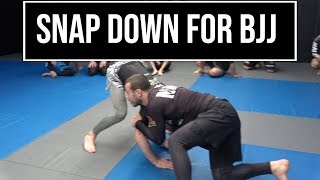
Collar Drag Overview
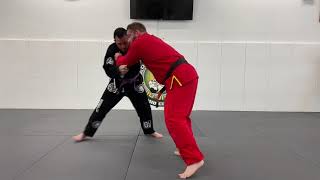
The collar drag is a high-percentage takedown applicable from standing and ground positions, functioning with similar mechanics to the arm drag. The technique is established by securing two grips: a sleeve grip and a collar grip, with the collar grip obtained by either intercepting the opponent's incoming hand or breaking their initial grip.
Execution from Standing
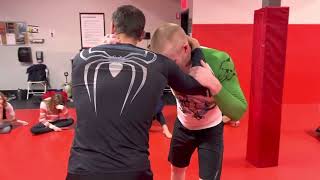
From standing, the practitioner assumes a squat position before executing the throw. The arm nearest the collar is pulled back to the hip in a karate reverse-punch motion while the other arm is thrown over the head, designed to force the opponent face-first into the floor.
Landing Position Control
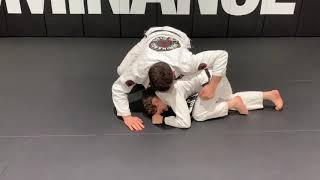
After the opponent lands flat, the practitioner collapses the opponent's legs, faces inside, and establishes top side control. If the opponent lands in a turtle position instead, the practitioner can immediately hunt for back control or scissor the legs to prevent guard replacement.
Countering the Leg Step Over
If the opponent steps over the practitioner's leg during the throw, the practitioner maintains the collar grip, pivots on their knee, and hugs the opponent's leg while placing their head into the ribs. From this position, the practitioner picks the leg and hopping turns to achieve the takedown and establish a passing position.
Ground Application
From butterfly guard, the practitioner secures collar and sleeve grips and removes their foot from the center before pulling past and sweeping. The practitioner should land on their elbow while hooking inside the opponent's leg to maintain position for establishing back control.
Common Mistakes and Timing
The most common error is falling to the shoulder after the sweep, allowing the opponent easier top position. Proper timing of the grip, sleeve control, and counter-prevention are essential for executing the collar drag as a high-percentage, difficult-to-defend takedown.
Super Simple Takedown - The Collar Drag
Key Takeaways
- •Collar Drag Overview
- •Execution from Standing
- •Landing Position Control
- •Countering the Leg Step Over
For a long time now, the collar drag takedown has been a favorite of mine in the gi. Once you understand the grips, entry and execution of this throw, it is pretty simple to pull off if the timing is there. In this video, I show how I like to set it up and how to deal with what I feel are the most common responses the opponent has to it. I hope you enjoy it. • Please like, subscribe and share! ----------------------------------------------------------------------------------------------------------- I'm now on Rokfin! Get access to premium content of mine and get access to everyone else's content when you join. Check it out! https://rokfin.com/knightjiujitsu ----------------------------------------------------------------------------------------------------------- Thanks for watching! • If you haven’t checked out my Jiu-Jitsu Deep Dive yet, go to www.martialartsdigitalseminars.com/Jiu-Jitsu-Deep-Dive to get it. • Please support my content creation and get lots of extra content at Patreon.com/KnightJiuJitsu • Follow me on Instagram @knight_jiu_jitsu_ • Multiple titles of mine available at BJJ Fanatics here: https://bjjfanatics.com/search?q=eli+... • Knight Jiu-Jitsu T-Shirts available here: https://tinyurl.com/wzu6ufb • Knight Jiu-Jitsu on Instagram @knight_jiu_jitsu_ • Follow me on DTube: https://d.tube/#!/c/knightbjj • Follow me on Steemit: https://steempeak.com/@knightbjj
Related Techniques
Frequently Asked Questions
What does this video teach about drag takedown?
This video covers collar drag overview, execution from standing, landing position control. It provides detailed instruction from Knight Jiu-Jitsu.
How long does it take to learn drag takedown?
The basic mechanics can be understood in a single session, but developing reliable execution requires consistent drilling over weeks of practice. This 6-part breakdown helps structure your training by isolating each phase of the technique.
What are the key details for finishing drag takedown?
From butterfly guard, the practitioner secures collar and sleeve grips and removes their foot from the center before pulling past and sweeping. The practitioner should land on their elbow while hooking inside the opponent's leg to maintain position for establishing back control.