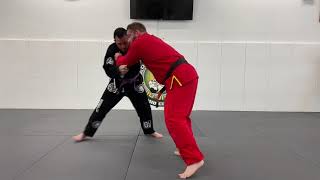
Warm-Up Drill: Head-and-Shoulder Contact
The instructor begins with a foundational drill where both participants maintain head-to-shoulder contact while attempting to touch the opponent's legs or back of the knee. Defenders can employ three layers of protection: using the head to block, hand-fighting to intercept, or stepping the legs back to create distance.
One-for-One Drill with Leg Threats
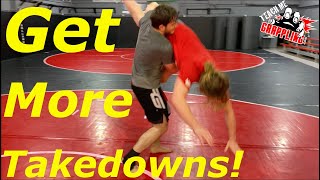
In the second progression, one participant attacks the legs while the other defends. As the defender steps back to avoid leg attacks, their posture becomes vulnerable to the snap down. The attacker places one hand on the back of the head and the other on the shoulder, then steps back with the lead leg as the defender's hands contact the mat.
Grip Mechanics and Hand Placement
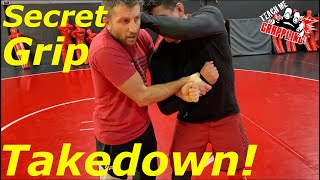
The snap down requires gripping the back of the head with one hand and the upper tricep or shoulder with the other, with both hands pulling simultaneously. The most effective snap down occurs when the opponent's head is positioned in front of their feet rather than directly above, which requires first breaking their upright posture.
Creating Vulnerability Through Posture Manipulation
An upright stance makes the snap down ineffective, so the attacker must first force the defender into a forward-leaning position. This can be achieved by either threatening leg attacks, forcing the defender to lower their level defensively, or by pushing and allowing the defender to push back, which naturally brings their head forward.
Preventing Counter-Control with Inside Position
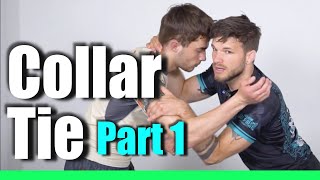
If the defender establishes a collar tie or gripping position on the attacker's body, it can prevent the snap down from working effectively. The attacker should prioritize obtaining inside position—where the attacking hand is positioned on the inside of the defender's arm—which prevents the defender from securing a strong grip.
Timing and Deception in Execution
Rather than reaching directly for the head, which telegraphs intent, the attacker should use pushing and blocking motions with the hands positioned in front of the body. Once the defender reacts to this pressure, the attacker quickly transitions to gripping the head and executing the snap down.
Lower Body Initiation and Momentum
The snap down is primarily driven by backward momentum generated from the legs rather than pure arm strength. The attacker pushes backward off their lead leg—typically the same side as the collar tie—which initiates the movement and generates the momentum needed for an effective snap.
Post-Snap Control with Chin Grip
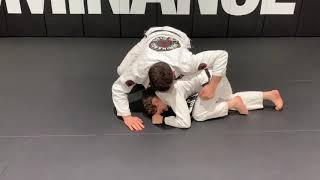
Once the opponent's hands reach the mat, the attacker should establish a chin grip and pull their own shoulder in front of the opponent's shoulder. This positioning prevents the opponent from escaping backward via the chin grip and prevents them from driving forward into the attacker's legs.
Snap down for BJJ (Lachlan Giles)
Key Takeaways
- •Warm-Up Drill: Head-and-Shoulder Contact
- •One-for-One Drill with Leg Threats
- •Grip Mechanics and Hand Placement
- •Creating Vulnerability Through Posture Manipulation
Thank you to my wrestling coaches at Absolute MMA, who teach this much better than I do. SAVE on my highly reviewed instructionals with the codes below * BJJ Fanatics instructionals (save 10%) with LACHLAN10 http://lachlangiles.net/lachlan-giles-bjjfanatics * Grapplers Guide site membership (save 30%) with LACHLAN http://lachlangiles.net/grapplers-guide-deal The Leg Lock Anthology: 50/50 http://lachlangiles.net/the-leg-lock-anthology The Body Lock Pass: http://lachlangiles.net/the-body-lock-pass The Guard Passing Anthology: Half Guard can be found here: http://lachlangiles.net/the-guard-passing-anthology-half-guard-deal Check out my half guard DVD "The Half Guard Anthology" here. Which covers all things half guard http://lachlangiles.net/the-half-guard-anthology-deal My No Gi Chokes DVD here: Focusing on the guillotine, arm in guillotine, anaconda, darce, Japanese necktie, North South choke, and how to link these chokes together. http://lachlangiles.net/high-percentage-chokes-deal You can check out a detailed instructional on my butterfly, shin to shin, single X, X guard game on through the Grapplers Guide. There is also heaps of content from other world class instructors! Use the Coupon code LACHLAN to save 30% and also to help me out :) Follow this link for Grapplers Guide http://lachlangiles.net/grapplers-guide-deal I have a GI half guard seminar available for just $17.50. Get that here: https://gdf.thinkific.com/courses/lachlan-giles-half-guard-seminar Lachlan is a second degree BJJ black belt. He is the 2017 IBJJF No-Gi World Championship Bronze Medallist, 2014 Australian Jiu-Jitsu Grand Prix Champion, multiple time Pan Pacific and Victorian Jiu Jitsu Champion. He has represented Australia twice at ADCC, the most prestigious submission grappling competition in the world, represented Australia three times at the World Pro Championships and competed at the Eddie Bravo Invitational where he submitted former ADCC Champion Rani Yahya. In 2014 and 2017 he completed a clean sweep of the black belt division at Australia's most prestigious competition, the Pan Pacific Championships, winning 4 gold medals. In 2016 Lachlan was ranked as the number 12 lightweight BJJ competitor in the world. He is also the 2016 Australian Freestyle Wrestling Champion. He also works as a physiotherapist and in 2016 completed his PhD.
Related Techniques
Frequently Asked Questions
What does this video teach about two-on-one snap down?
This video covers warm-up drill: head-and-shoulder contact, one-for-one drill with leg threats, grip mechanics and hand placement. It provides detailed instruction from Absolute MMA St Kilda - Melbourne.
How long does it take to learn two-on-one snap down?
The basic mechanics can be understood in a single session, but developing reliable execution requires consistent drilling over weeks of practice. This 8-part breakdown helps structure your training by isolating each phase of the technique.
What are the key details for finishing two-on-one snap down?
The snap down is primarily driven by backward momentum generated from the legs rather than pure arm strength. The attacker pushes backward off their lead leg—typically the same side as the collar tie—which initiates the movement and generates the momentum needed for an effective snap.