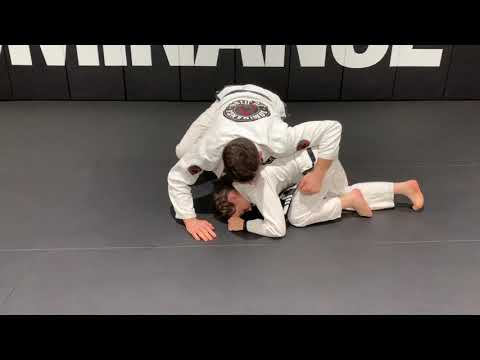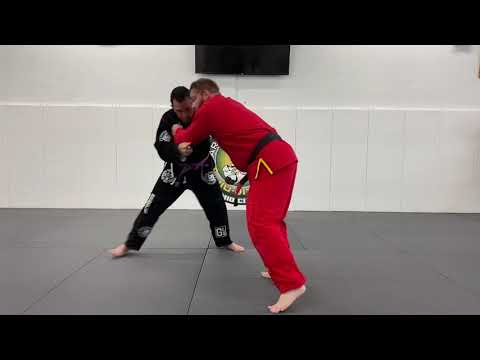
Snap Down using the Gi
0
Snap Down Takedown·Coach Travis Clark
Utilizing the Gi to execute a Snap Down
Translation: snap down takedown (katakana)
The Snap Down Takedown family covers takedowns initiated by snapping the opponent's head and upper body downward using a sharp pulling action on the head, neck, or collar tie, causing the opponent to stumble forward and lose posture. [1] The snap down exploits the opponent's forward weight distribution or creates it through a pull-and-release action — pulling the opponent forward then snapping their posture down. [1],[2] The resulting postural collapse creates openings for front headlock entries, go-behinds, and various takedown finishes. [2] Snap downs are among the most commonly used offensive tools in wrestling, serving as both primary attacks and setups for other techniques. [2],[3]
Snap downs are frequently used in both wrestling and MMA competition, particularly as setups for front headlock attacks. [1]
No images yet for this technique.
Sign in to suggest an image.
Utilizing the Gi to execute a Snap Down
A simple snap down we use in our kids class. And them some drills to show you how to incorporate it into the back contor…
No instructional courses yet for this technique.
Sign in to suggest a course.
Risk of injury to the person this technique is applied to
Snap down forces opponent to mat; neck strain risk
Skill level needed to execute this technique reliably
Whether this technique is allowed under major competition rule sets
Japanese amateur wrestling terminology
Japanese amateur wrestling terminology
Standard katakana transliteration of Western martial arts terminology (外来語) — used in Japanese MMA, boxing, and BJJ communities
Standard katakana transliteration used in Japanese wrestling (レスリング)
grip strength, explosive downward pull, core stability
strong neck and traps for controlling the clinch
latissimus dorsi, biceps, forearms, core
Every move, in any martial art, shares a few universal traits. Mix and match below to pinpoint the right tool — or compare equivalents across styles.
The Collar Tie Snap Down subfamily uses a collar tie grip — one hand behind the opponent's neck — to snap the opponent's posture down, driving their head toward the mat and creating a takedown opportunity. [1] The collar tie provides direct access to the back of the neck, allowing the attacker to apply a sharp downward force that breaks the opponent's posture instantly. [1,2] The snap can be used to set up front headlocks, go-behinds, or direct takedown entries when the opponent stumbles forward. [2,3]
The Two-On-One Snap Down subfamily uses a two-on-one arm control (both hands gripping one of the opponent's arms) to snap the opponent's posture down, using the controlled arm as a lever to break posture. [1] The two-on-one grip gives the attacker dominant control of one side of the opponent's body, and snapping down on this controlled arm forces the opponent's upper body forward and down. [1,2] The two-on-one snap is particularly effective because it simultaneously controls the opponent's arm (preventing defensive framing) and breaks their posture. [2,3]
The snap down appears in 21 passages across 13 books — documented in the 1943 US Navy H2H manual as 'neck snap: grasp his hair and snap down sharply.' In modern wrestling and MMA, the collar tie snap-down is a fundamental setup for front headlock attacks. (13 books in corpus; 1943 US Navy H2H Combat manual)
Coach Travis Clark emphasizes keeping your knuckles right in the back of the head rather than going for a front choke, as this position gives you access to a series of follow-up techniques and maintains control even if your opponent tries to pull guard.
Keep your forearm in their chest with elbows in tight—this prevents them from shooting or escaping, and causes them to panic. Coach Travis Clark notes that you should stay up and move reactively based on what your opponent does, adjusting your technique accordingly.
Coach Travis Clark advises that sometimes opponents don't fall on the first attempt, and if they pull their guard back due to insufficient pressure, you can simply adjust and move based on their reaction.
Coach Travis Clark recommends pulling the collar grip out before engaging, and once you have it, turning your elbow down to make it harder for your opponent to break the grip—this also gives you the option to go head-low and finish from behind the head if needed.
The Snap Down Takedown family covers takedowns initiated by snapping the opponent's head and upper body downward using a sharp pulling action on the head, neck, or collar tie, causing the opponent to stumble forward and lose posture. The snap down exploits the opponent's forward weight distribution or creates it through a pull-and-release action — pulling the opponent forward then snapping their posture down.
Snap downs have been fundamental to wrestling technique across all styles, with the collar tie snap being one of the first offensive techniques taught to developing wrestlers. The technique's simplicity and effectiveness ensure its prominence in wrestling, judo, and MMA curricula.
IJF: legal — Legal takedown technique; IBJJF: legal — Legal at all belt levels, scored as takedown (2 points); UWW: legal — Legal in both freestyle and Greco-Roman; Unified MMA: legal — Legal takedown technique; ADCC: legal — Legal, scored 2-4 points in second half of match; FIAS Sport Sambo: legal — Legal — all takedowns permitted; FIAS Combat Sambo: legal — Legal; NCAA Folkstyle: legal — Legal, scored as takedown (2 points)
Danger rating 4/10. Moderate — snap down forces opponent to mat; neck strain risk
The standard setup chain: Establish Contact → Create Off-Balance → Execute the Takedown → Follow to Ground.
Standard counters include: Sprawl — drop hips back and drive weight down to stuff the takedown attempt / Underhook — establish inside position to control distance and prevent the takedown entry / Post and Circle — post on the attacker's head and circle away to break their angle / Level Change Defence — recognize the shot early and react with appropriate hip defence.
Common variants: Collar tie snap-down (snapping with hand on the nape of the neck); Two-on-one snap (using two-on-one grip to snap the posture down); Snap-down to front headlock (following the snap with a front headlock for further attacks).
Snap downs are frequently used in both wrestling and MMA competition, particularly as setups for front headlock attacks.
Top errors to watch for: Snapping gradually instead of explosively — the snap must be sudden to break posture / Pulling straight down into your chest, where the opponent's head hits your body and they recover / Following the opponent down after the snap, ending up with your own posture broken / Snapping without a follow-up plan — the broken posture lasts 1-2 seconds at most.
The Snap Down Takedown is also known as Sunappu Daun Teikudaun, Snap Down, Snap, Front Headlock Setup.