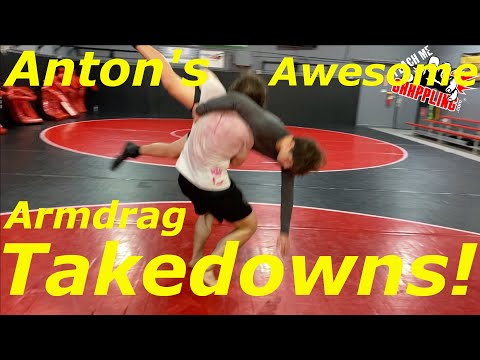
MORE Arm Drag Takedown FUN!!
0
Arm Drag Takedown·TeachMeGrappling Coach Brian
This video Anton demos more takedown finishes when using an armdrag as an entry/setup! Check out the details and you ar…
Translation: arm drag takedown (katakana)
The Arm Drag Takedown family covers takedowns initiated by an arm drag — a technique where the attacker grabs the opponent's arm at the wrist or tricep and pulls it across the body, creating an angle behind the opponent. [1] The arm drag redirects the opponent's arm and rotates their body, exposing their back or side and creating a clear path to attack from an advantageous angle. [1],[2] Arm drags can be executed from standing and seated positions, and they typically chain into back takes, single legs, or body lock takedowns once the angle is achieved. [2] The arm drag is one of the most versatile offensive tools in grappling because it works in both gi and no-gi contexts and creates opportunities across multiple takedown families. [2],[3]
Arm drags have been fundamental wrestling and grappling techniques for centuries, with refined modern versions developed in both American wrestling and Brazilian Jiu-Jitsu. [1] Marcelo Garcia's systematic use of the arm drag in no-gi competition during the 2000s elevated it to one of the most studied techniques in modern grappling. [2],[3]
No images yet for this technique.
Sign in to suggest an image.
This video Anton demos more takedown finishes when using an armdrag as an entry/setup! Check out the details and you ar…
No instructional courses yet for this technique.
Sign in to suggest a course.
Risk of injury to the person this technique is applied to
Arm drag creates angle for safe takedown entry
Skill level needed to execute this technique reliably
Whether this technique is allowed under major competition rule sets
Japanese BJJ community standard terminology; Japanese amateur wrestling terminology
Japanese BJJ community standard terminology; Japanese amateur wrestling terminology
Standard katakana transliteration of Western martial arts terminology (外来語) — used in Japanese MMA, boxing, and BJJ communities
Katakana transliteration used in Japanese BJJ community
penetration step speed, upper body endurance for finishing, balance
longer arms for reach, quick hips for level change
quadriceps, hip flexors, shoulders, grip/forearms
Every move, in any martial art, shares a few universal traits. Mix and match below to pinpoint the right tool — or compare equivalents across styles.
The Seated Arm Drag subfamily covers arm drag takedowns initiated from a seated position, commonly from butterfly guard or seated guard in BJJ and submission grappling. [1] The seated attacker grabs the opponent's wrist or tricep and pulls the arm across their body while simultaneously scooting the hips behind the opponent, achieving a back-take or angle that enables a takedown or sweep. [1,2] Seated arm drags are a cornerstone of modern no-gi grappling and are frequently used as the primary offensive tool from seated guard positions. [2,3]
The Standing Arm Drag subfamily covers arm drag takedowns from a standing position, where the attacker grabs the opponent's arm and pulls it across to create an angle for attack. [1] From standing, the arm drag typically chains into a single leg, double leg, or back take depending on the angle achieved and the opponent's reaction. [1,2] Standing arm drags are fundamental in both wrestling and no-gi grappling, serving as a primary method for breaking through the opponent's defensive shell to access takedown entries. [2,3]
The arm drag takedown uses the arm drag entry to clear the opponent's defensive frames and access the back or legs. Documented in the 1943 US Navy H2H manual as a fundamental grappling entry. In modern MMA and BJJ, the arm drag is the highest-percentage back-take setup from standing. (1943 US Navy H2H; BJJ competition records)
Reset your position and chain into a different takedown like a high crotch or single leg. Coach Brian emphasizes that the arm drag works best as a setup for multiple techniques rather than relying on it as your only first move.
You need to break the glass by driving forward so your chest gets in front of your hips and you maintain momentum. If your foot stops you on the mat, it actually pushes you backward and causes you to lose balance, according to Coach Brian.
The finish is all hips, not arms—just like any trip. Once your leg comes through, you drive with your hips to complete the takedown. Coach Brian stresses that relying on arm pressure instead of hip drive weakens the technique.
Block his leg with your hand to prevent him from extending, then immediately wrap around and capture the leg so he can't escape. Coach Brian notes that once you block, you must quickly secure the grip before your opponent can stretch out and create space.
The Arm Drag Takedown family covers takedowns initiated by an arm drag — a technique where the attacker grabs the opponent's arm at the wrist or tricep and pulls it across the body, creating an angle behind the opponent. The arm drag redirects the opponent's arm and rotates their body, exposing their back or side and creating a clear path to attack from an advantageous angle.
Arm drags have been fundamental wrestling and grappling techniques for centuries, with refined modern versions developed in both American wrestling and Brazilian Jiu-Jitsu. Marcelo Garcia's systematic use of the arm drag in no-gi competition during the 2000s elevated it to one of the most studied techniques in modern grappling.
IJF: legal — Legal takedown technique; IBJJF: legal — Legal at all belt levels, scored as takedown (2 points); UWW: legal — Legal in both freestyle and Greco-Roman; Unified MMA: legal — Legal takedown technique; ADCC: legal — Legal, scored 2-4 points in second half of match; FIAS Sport Sambo: legal — Legal — all takedowns permitted; FIAS Combat Sambo: legal — Legal; NCAA Folkstyle: legal — Legal, scored as takedown (2 points)
Danger rating 3/10. Moderate — arm drag creates angle for safe takedown entry
The standard setup chain: Establish Contact → Create Off-Balance → Execute the Takedown → Follow to Ground.
Standard counters include: Sprawl — drop hips back and drive weight down to stuff the takedown attempt / Underhook — establish inside position to control distance and prevent the takedown entry / Post and Circle — post on the attacker's head and circle away to break their angle / Level Change Defence — recognize the shot early and react with appropriate hip defence.
Common variants: Inside single (shooting to the inside of the lead leg, head inside position); Outside single (attacking from the outside of the lead leg); High crotch (securing the thigh above the knee with head in the hip); Low single (attacking the ankle from outside range without deep penet…).
Arm drags are one of the most commonly used setups in NCAA wrestling. Marcelo Garcia used arm drags from seated guard to win multiple ADCC titles (2003, 2005, 2007, 2009).
Top errors to watch for: Pulling the arm without stepping to the outside — you need both the drag and the angle step / Dragging too slowly, giving the opponent time to pull back and re-square / Gripping only the wrist without the tricep control — the arm slips out / Successfully completing the drag but freezing without following up with a takedown.
The Arm Drag Takedown is also known as Āmu Doraggu Teikudaun, Arm Drag, Drag, Arm Pull.