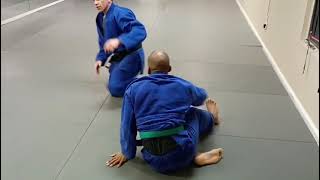
Referee Position Setup
In referee's position, the top wrestler places their bottom-side knee down with the top-side knee up, positioning the top foot behind the opponent's tailbone. The bottom-side hand forms a C-grip above the opponent's elbow, while the top-side hand contacts the opponent's midsection near the belly button. The wrestler's ear should connect with the opponent's back on the same side as the bottom knee and elbow.
Hand and Arm Placement Rules
The C-grip must be positioned precisely above the elbow—placement too high or too low results in a referee stoppage. The midsection hand placement must contact near the belly button; placement too far outward on the love handles or too far inward (tightwisting) is penalized. Proper hand positioning is essential for legal and effective technique.
Breaking Down the Opponent
Upon the referee's whistle, the top wrestler initiates the breakdown by turning the opponent's elbow downward. The technique applies the concept of removing one leg of a 'table'—destabilizing the opponent's base makes the breakdown easier to execute. Turning the elbow away from oneself creates proper leverage rather than pulling the opponent into the wrestler's own body.
Pressure and Positioning Requirements
Maintaining constant forward pressure is critical; without it, the opponent can escape in seconds. The wrestler's trajectory must be directed over the opponent's shoulder, ensuring pressure drives through the opponent rather than allowing space. If the wrestler remains upright and detached, the opponent retains freedom of movement regardless of other technique elements.
Integration of Upper and Lower Body
The back knee must drive through the opponent's tailbone while the wrestler maintains an ear-down position and turns the elbow inward. The chopping motion with the pinky-side hand, combined with driving pressure over the shoulder, uses the back foot as the primary power source. Properly integrated upper and lower body movement is necessary for effective flattening of the opponent.
Execution and Follow-up
The complete breakdown sequence involves turning the elbow, executing a chopping motion, and driving through with maximum effort using coordinated body pressure. Successfully flattening the opponent positions them for potential pinning maneuvers if the wrestler continues driving over the shoulder. The technique requires synchronization of all body segments to achieve the desired result of putting the opponent on their back.
Wrestling Basics: Referee's Position to the Breakdown
Key Takeaways
- •Referee Position Setup
- •Hand and Arm Placement Rules
- •Breaking Down the Opponent
- •Pressure and Positioning Requirements
A great video for every new and experienced wrestler coming into season. " I fear not the man who practices a thousand kicks once. Fear the man that practices one kick one thousand times."-Bruce Lee. Everyone needs a great breakdown and the basics always work. #wrestlingmoves #wrestlingbasics #newwrestlers #refereeposition #breakdown #wrestlingtechniques #wrestlingchop #top #mma #wrestling #highschoolwrestling #collegewrestling #collegiatewrestling #trojanwrestling #brucelee #bruceleequotes
Related Techniques
Frequently Asked Questions
What does this video teach about referee position?
This video covers referee position setup, hand and arm placement rules, breaking down the opponent. It provides detailed instruction from Sign&Sub.
How long does it take to learn referee position?
The basic mechanics can be understood in a single session, but developing reliable execution requires consistent drilling over weeks of practice. This 6-part breakdown helps structure your training by isolating each phase of the technique.
What are the key details for finishing referee position?
The back knee must drive through the opponent's tailbone while the wrestler maintains an ear-down position and turns the elbow inward. The chopping motion with the pinky-side hand, combined with driving pressure over the shoulder, uses the back foot as the primary power source. Properly integrated upper and lower body movement is necessary for effective flattening of the opponent.