ATTACKING TURTLE IN GI - JIU JITSU TIPS
0
Attacking Turtle·Will Brooks Official
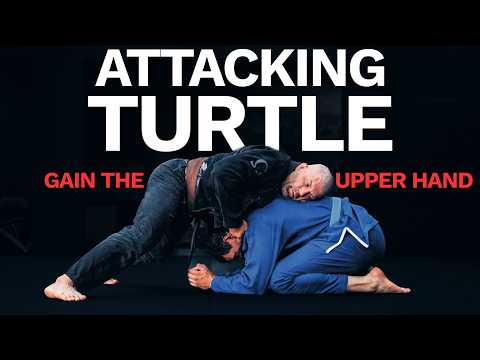
Last week we covered attacking turtle in nogi. This week I’m covering some gi variations that I like. I love how Jiu Jit…
Translation: attacking turtle
The Attacking Turtle family covers positions where one fighter is on top of or behind a turtled opponent, seeking to break down the turtle, take the back, or execute submissions. [1] Attacking the turtle is a critical skill in grappling because the turtle occurs frequently and the attacking fighter must capitalise on the positional advantage before the turtled fighter escapes. [1],[2] Primary attacking positions include the front headlock (controlling from the head side) and seatbelt (controlling from behind). [2],[3]
Attacking the turtle is a fundamental skill in judo ne-waza and BJJ. [1]
Turtle attacks are a critical skill set in judo and BJJ competition. [1]
No images yet for this technique.
Sign in to suggest an image.
Last week we covered attacking turtle in nogi. This week I’m covering some gi variations that I like. I love how Jiu Jit…
No instructional courses yet for this technique.
Sign in to suggest a course.
Risk of injury to the person this technique is applied to
Turtle is a defensive shell position; vulnerable to back takes and chokes
Skill level needed to execute this technique reliably
Whether this technique is allowed under major competition rule sets
Brazilian Jiu-Jitsu: Theory and Technique (Renzo Gracie & Royler Gracie, 2001)
Alias sources — [1] Wrestling Physical Conditioning Encyclopedia (Welker, 2010) [2] Wrestling Physical Conditioning Encyclopedia (Welker, 2010) [3] NCAA Wrestling Rules and Interpretations
Effectiveness sources — [1] Jiu-Jitsu University (Ribeiro, 2008) [2] Kodokan Judo (Kano, 1986)
Official Kodokan ground technique classification system
Standard Japanese martial arts terminology (kanji/hiragana)
Established Japanese martial arts naming convention — native Japanese term (和語/漢語)
Alias sources — [1] Wrestling Physical Conditioning Encyclopedia (Welker, 2010) [2] Wrestling Physical Conditioning Encyclopedia (Welker, 2010) [3] NCAA Wrestling Rules and Interpretations
Effectiveness sources — [1] Jiu-Jitsu University (Ribeiro, 2008) [2] Kodokan Judo (Kano, 1986)
hook control, seatbelt grip endurance, hip connection
long legs for deep hooks, strong grip for seatbelt
hip adductors, biceps, forearms, core
Every move, in any martial art, shares a few universal traits. Mix and match below to pinpoint the right tool — or compare equivalents across styles.
The Front Headlock Turtle subfamily covers the attacking position where the top fighter controls the turtled opponent from the head side, using a front headlock (head-and-arm control) to break down the turtle and set up submissions or back takes. [1] The front headlock provides powerful head control that can be used for guillotines, d'arce chokes, anaconda chokes, and snap-downs to break the turtle. [1,2] It is one of the most versatile attacking positions against the turtle. [2,3]
The Seatbelt Turtle subfamily covers the attacking position where the top fighter controls the turtled opponent from behind using the seatbelt grip (over-under arm configuration from behind). [1] The seatbelt provides strong upper body control that facilitates hook insertion for full back control. [1,2] From seatbelt turtle, the attacking fighter works to insert hooks, establish a body triangle, or flatten the opponent to achieve full rear mount. [2,3]
Attacking the turtle appears referenced extensively — turtle defense is documented in 362 passages across 80 books. The primary attacks from turtle are: clock choke, crucifix, back take via seat belt, and various turnovers. In wrestling, the referee's position is essentially attacking turtle. (80 books; multiple sources)
Will Brooks emphasizes that you want to make your opponent carry your weight as much as possible by staying on your feet. Dropping your knees takes away pressure and makes it harder to finish the submission effectively.
Will Brooks describes it as probably the most powerful choke he can think of because you're essentially dead lifting fabric—a rope of fabric—through your opponent's neck, which creates significant power. However, you should be careful with it during training due to its intensity.
Will Brooks stresses the importance of pressing your opponent's head down to the mat so they don't feel like they can sit up at any time, as allowing them to posture up makes finishing the choke much harder.
Will Brooks emphasizes that the attacking turtle choke relies on leverage and body weight rather than athleticism or strength, making it accessible to practitioners of various physical abilities.
The Attacking Turtle family covers positions where one fighter is on top of or behind a turtled opponent, seeking to break down the turtle, take the back, or execute submissions. Attacking the turtle is a critical skill in grappling because the turtle occurs frequently and the attacking fighter must capitalise on the positional advantage before the turtled fighter escapes.
Attacking the turtle has been a core skill in wrestling (from the referee's position) and judo (breaking down turtle for turnovers and pins) since those arts' inception. BJJ added back-taking and submission attacks to the wrestling and judo frameworks for attacking the turtle.
IBJJF: legal — Legal — common transitional position; IJF: restricted — Legal position but extended turtle without attacking penalized for non-combat…; ADCC: legal — Legal; Unified MMA: legal — Legal; UWW: legal — Legal — bottom position, opponent works to turn/pin; FIAS Sport Sambo: legal — Legal
Danger rating 3/10. Moderate — turtle is a defensive shell position; vulnerable to back takes and chokes
The standard setup chain: Achieve Position → Stabilize → Maintain → Attack.
Standard counters include: Hand Fight — grip-fight the choking hand to prevent the rear naked choke / Shoulder Walk — walk shoulders to the mat to escape back control / Turn into Guard — rotate to face the attacker and recover guard position.
Common variants: Back control with hooks (both feet hooked inside the opponent's thighs); Body triangle back control (legs locked in a figure-four around the torso); Rear mount (mounted on the back with both hooks, opponent face-down); Chair sit back control (sitting behind the opponent with hooks, upright position).
Turtle attacks are a critical skill set in judo and BJJ competition.
Top errors to watch for: Attacking too slowly — the turtle is transitional; the opponent will escape or recover guard if given time / Not maintaining chest-to-back contact — space between you and the turtled opponent allows them to turn or stand / Reaching for the back without controlling the hips — the hips are the anchor; control them first / Attacking only the neck without threatening the back take — the opponent can defend one attack; threaten multiple.
The Attacking Turtle is also known as Kōgeki Kame, Turtle Top, Turtle Attack Position, Riding Turtle.