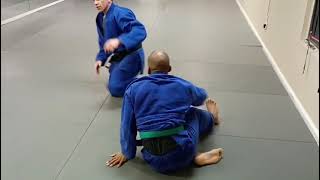
Establishing the Seatbelt Control
When an opponent assumes the turtle position, the defender must secure a seatbelt grip by placing both hands around the opponent's torso. If the opponent's elbows are positioned tightly against their body, the defender can create a distraction by feinting toward the neck or face, allowing hand placement inside the guard. The shoulder should be positioned on the back of the opponent's neck to maximize control.
Breaking Down to the Side
From the seatbelt position, the defender walks laterally while maintaining pressure, then falls off to the side onto their elbow rather than jumping forward aggressively. The defender's foot position helps them rise to a knee as they pull the opponent onto their side, transitioning from the stable turtle defense to a more vulnerable lateral position.
Basic Kimura Finish from Seatbelt
Once the opponent is broken to their side, the defender cups the far shoulder and steps over the opponent's head to establish the kimura position. If the opponent locks their hands to defend, the defender uses a push-pull system with the knee on the biceps, driving downward and backward. The submission can be finished by pulling the elbow toward the chest and applying rotational pressure.
Advanced Finish Mechanics
Against stronger opponents, the most effective kimura finish involves dropping the hips low so that weight distribution comes primarily from the legs rather than upper body leverage. The defender pulls the opponent's elbow toward their chin while maintaining torque through hip position and body alignment.
Scissor Choke Setup from Kimura Position
When the opponent defends tightly against the kimura, the defender can feint the biceps control while actually driving their knee into the opponent's chest as a distraction. Once the opponent tucks their chin in response, the defender scrapes the knee upward to the neck and locks a scissor choke by crossing the legs with the top leg positioned over the bottom leg.
Scissor Choke Mechanics and Advantages
The scissor choke is most effective when set up from the side control position rather than from a headlock, as the traditional headlock entry allows the opponent to defend by tucking their chin. When applied from the kimura position, the opponent's attention is divided between defending the arm and the sudden leg positioning, making the choke more difficult to counter. The defender must straighten their legs rather than curling to maximize choke pressure.
Maintaining Control Posture
To prevent the opponent from escaping the side position, the defender must maintain a tight chest-to-chest posture while cupping the opponent's far shoulder. This positioning prevents the opponent from turning toward the defender or reversing the position, keeping them controlled and vulnerable to submission attempts.
Turtle Position... What to do!
Key Takeaways
- •Establishing the Seatbelt Control
- •Breaking Down to the Side
- •Basic Kimura Finish from Seatbelt
- •Advanced Finish Mechanics
This video I work with my students on a basic system of what to do with your turtled opponent. Enjoy! If you have any questions, comments, or suggestions, please comment below. More videos to come! Please like, share, and subscribe!! PLEASE Click this link to SUPPORT the TeachMeGrappling Channel!!! https://www.patreon.com/TeachMeGrappling or https://www.paypal.me/CoachBrianPeterson To purchase TMG or PG Merchandise go to... https://www.petersongrapplers.com/shop Your contribution is much appreciated and will help me continue to bring you content! 🙏 www.NextLevelGuy.com The NextLevelGuy Podcast with Coach Brian Peterson has been released!! Check it out!
Related Techniques
Frequently Asked Questions
What does this video teach about defensive turtle?
This video covers establishing the seatbelt control, breaking down to the side, basic kimura finish from seatbelt. It provides detailed instruction from TeachMeGrappling Coach Brian.
How long does it take to learn defensive turtle?
The basic mechanics can be understood in a single session, but developing reliable execution requires consistent drilling over weeks of practice. This 7-part breakdown helps structure your training by isolating each phase of the technique.
What are the key details for finishing defensive turtle?
The scissor choke is most effective when set up from the side control position rather than from a headlock, as the traditional headlock entry allows the opponent to defend by tucking their chin. When applied from the kimura position, the opponent's attention is divided between defending the arm and the sudden leg positioning, making the choke more difficult to counter. The defender must straighten their legs rather than curling to maximize choke pressure.