Foundation: Arm Control and Side Positioning
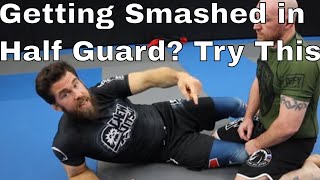
The practitioner must maintain side positioning while blocking the opponent's arm to prevent head control and flattening. This foundational posture creates opportunities for offensive attacks and defensive stability in the half guard.
The Underhook Setup and Leg Swipe
From regular half guard, the practitioner secures an underhook while simultaneously swiping the opponent's leg open with the outside leg. This progression creates off-balance opportunities and additional attacking angles while maintaining arm control.
Defensive Priority: Protecting Against Flattening
The practitioner must continuously track the opponent's arm position to prevent cross-face control and flattening, regardless of hand placement—whether on the knee, body, or elsewhere. Maintaining arm control is critical to maintaining positional advantage.
Preventing Counter Underhooks
The practitioner protects the inside space by keeping elbows tight and pummeling the arms to deny the opponent underhooks. Preventing opponent underhooks disrupts their offensive sequence and allows the bottom player to identify attacking opportunities.
Transition to Closed and Open Guard
From the underhook position, the practitioner can rotate the body downward while controlling the opponent's arm to clear the middle leg and transition to closed or open guard. This movement creates continuity in offensive positioning and additional attack options.
Back Take: Underhook to Shuck
The practitioner secures an underhook, shucks the opponent laterally, and controls the tricep with a stiff-arm to push the opponent away. This sequence exposes the back and enables the practitioner to climb up and secure back control.
Ankle Grab Sweep
After securing the underhook and swiping the leg open, the practitioner builds up and grabs underneath the opponent's ankle with both the outside arm and the back arm grip. The practitioner then collapses the opponent by pulling the leg inward while walking around.
Knee Pick Sweep
Using the same underhook and leg swipe setup, the practitioner builds up and uses the bottom arm to pick the opponent's knee outward while driving forward. This energy-efficient sweep capitalizes on the opponent's compromised base.
Rollback Counter to Overhook Defense
When the opponent counters the ankle grab or knee pick with an overhook and pushback, the practitioner uses the opponent's momentum to roll backward in the opposite direction. This reversal allows the practitioner to convert the opponent's force into a sweep.
Wrestling Up: Single Leg Finish
The practitioner swipes the leg open, builds up, and captures the opponent's leg with a single-leg wrestling grip to complete the sweep or takedown. If the opponent stands, the practitioner can follow into a wrestling sequence to achieve top position.
Gi-Specific Enhancement: Lapel and Belt Leverage
When training in the gi, the practitioner feeds the opponent's lapel or belt between their legs during the buildup phase. This additional grip creates leverage that magnifies the effectiveness of subsequent knee picks and other offensive techniques.
29 Regular Half Guard Techniques In Less Than 12 Minutes (Part 1) by Jason Scully
Key Takeaways
- •Foundation: Arm Control and Side Positioning
- •The Underhook Setup and Leg Swipe
- •Defensive Priority: Protecting Against Flattening
- •Preventing Counter Underhooks
This videos covers "Part 1" of the half guard series. You will learn about the "Regular half guard" position. Understanding the regular half guard is important for building a complete arsenal. Our other videos cover z-half, butterfly half, deep half, and more half guard options. Stay tuned for our other parts of the half guard series which will included z half guard, deep half guard, butterfly half guard, and more! 0:00 - Introduction 0:06 - Positional Concepts 2:35 - Move to Closed or Open Guard 3:24 - Sweeps and Back Takes 9:02 - Submissions JOIN THE GRAPPLERS GUIDE: https://grapplersguide.com JOIN THE GRAPPLERS GUIDE FB GROUP: https://www.facebook.com/groups/grapplersguidemembers GRAPPLERS GUIDE CHANNEL: https://www.youtube.com/jasculs SUPPORT OUR OTHER GUIDE SITES Strikers Guide: https://thestrikersguide.com Weapons Guide: https://theweapsongudie.com Combat Business Guide: https://combatbusinessguide.com FOLLOW OUR SOCIALS: GRAPPLERS GUIDE IG: https://instagram.com/the_grapplers_guide FB Group: https://www.facebook.com/groups/grapplersguidemembers FB Page: https://www.facebook.com/thegrapplersguide STRIKERS GUIDE IG: https://instagram.com/the_strikers_guide FB Group: https://www.facebook.com/groups/strikersguide FB Page: https://www.facebook.com/strikersguide WEAPONS GUIDE IG: https://instagram.com/the_weapons_guide FB Group: https://www.facebook.com/groups/weaponsguide FB Page: https://www.facebook.com/theweaponsguide Combat Business Guide IG: https://www.instagram.com/combat_business_guide FB Group: https://www.facebook.com/groups/combatbusinessguide FB Page: https://www.facebook.com/combatbusinessguide/
Related Techniques
Frequently Asked Questions
What does this video teach about underhook half guard?
This video covers foundation: arm control and side positioning, the underhook setup and leg swipe, defensive priority: protecting against flattening. It provides detailed instruction from Jiu Jitsu In Minutes by Jason Scully.
How long does it take to learn underhook half guard?
The basic mechanics can be understood in a single session, but developing reliable execution requires consistent drilling over weeks of practice. This 11-part breakdown helps structure your training by isolating each phase of the technique.
What are the key details for finishing underhook half guard?
The practitioner swipes the leg open, builds up, and captures the opponent's leg with a single-leg wrestling grip to complete the sweep or takedown. If the opponent stands, the practitioner can follow into a wrestling sequence to achieve top position.
Related videos
The main sweep to know from half guard (Lachlan Giles)
Absolute MMA St Kilda - Melbourne
60 Dog Fight Under-Hook Half Guard Techniques In Just 18 Minutes by Jason Scully - BJJ Grappling
Jiu Jitsu In Minutes by Jason Scully
How To Easily Break The Lock Down Half Guard
Matt Arroyo Jiu Jitsu
Half Guard: The Lockdown becomes even more effective with these tips!
Wim Deputter BJJ
How To Use Lockdown to Escape a Tight Half Guard Smasher in BJJ
Chewjitsu