Knee Shield Half Guard Basics
0
Knee Shield Half Guard·MMA Leech·Added by Admin
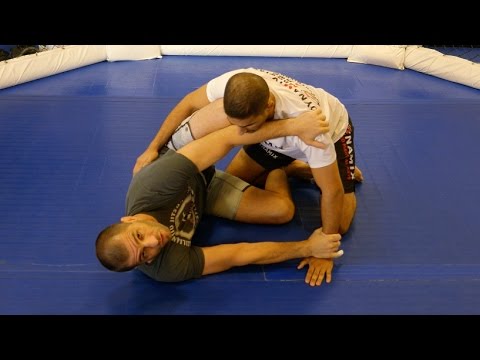
Professor Gustavo Gasperin teaches how to set up your Knee Shield Half Guard and how to position yourself in relation to…
Translation: knee shield half guard
The Knee Shield Half Guard positions the guard player's top knee across the opponent's chest or midsection as a frame while maintaining half guard leg control on the bottom. [1] The knee shield creates powerful distance management, keeping the top fighter from closing distance and applying pressure. [1],[2] The knee shield half guard is one of the most versatile half guard configurations, allowing transitions to X-guard, De La Riva guard, and full guard while providing a stable defensive frame. [2],[3]
Knee shield half guard (also called Z-guard) was developed in modern BJJ as a proactive half guard variant. [1]
Knee shield half guard is one of the most commonly used half guard variants in BJJ competition. [1]
No images yet for this technique.
Sign in to suggest an image.
Professor Gustavo Gasperin teaches how to set up your Knee Shield Half Guard and how to position yourself in relation to…
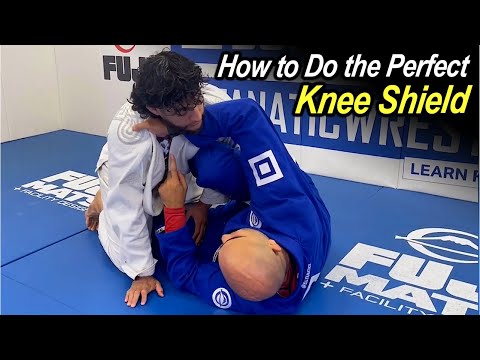
How to Do the Perfect Knee Shield - Bernardo Faria teaches How to Do the Perfect Knee Shield, in this Jiu Jitsu training…
The knee shield half guard is a fundamental defensive position within half guard that prioritizes distance management and weight distribution through intelligent framing. Both Bernardo Faria (BJJ Fanatics) and Professor Gustavo (MMA Leech) emphasize positioning the knee as a structural barrier—Faria uses the metaphor of a seatbelt placed at optimal height and width, neither too low nor too open—while Gustavo stresses channeling an opponent's pressure directly into the mat rather than absorbing it into the body. Both instructors agree that grip work is essential: Faria advocates for a tight collar grip with the forearm opened against the opponent's neck to create a self-choking effect when pressure is applied, while Gustavo emphasizes controlling one shoulder with the knee-shield elbow and the other shoulder with the opposite hand to prevent base switches and arm strikes. Gustavo provides additional structural detail by specifying foot placement on the opponent's hip and ankle hook positioning, noting that following the opponent's movement maintains the critical angle. The instructors diverge slightly in attack sequencing: Faria references deep half, single-leg half, and John Wayne sweeps as follow-up options, while Gustavo describes attacks emerging primarily from the elbow or hand positions, including back takes, leg drags, and arm drags. Both present the position as a foundational headquarters from which all offensive sequences develop.
Synthesized from 2 instructors
No instructional courses yet for this technique.
Sign in to suggest a course.
Risk of injury to the person this technique is applied to
Guard positions are defensive; injury risk comes from transitions, not the position itself
Skill level needed to execute this technique reliably
Whether this technique is allowed under major competition rule sets
Advanced Brazilian Jiu-Jitsu Techniques (Marcelo Garcia, 2011)
Alias sources — [1] Jiu-Jitsu University (Ribeiro, 2008) [2] The Guard (Moreira & Beneville, 2003) [3] Mastering Jujitsu (Gracie & Danaher, 2003)
Effectiveness sources — [1] Jiu-Jitsu University (Ribeiro, 2008) [2] Mastering Jujitsu (Gracie & Danaher, 2003)
Standard katakana transliteration of Western martial arts terminology (外来語) — used in Japanese MMA, boxing, and BJJ communities
Alias sources — [1] Jiu-Jitsu University (Ribeiro, 2008) [2] The Guard (Moreira & Beneville, 2003) [3] Mastering Jujitsu (Gracie & Danaher, 2003)
Effectiveness sources — [1] Jiu-Jitsu University (Ribeiro, 2008) [2] Mastering Jujitsu (Gracie & Danaher, 2003)
hip flexibility, active legs, grip management
long legs for distance control and guard retention
hip flexors, adductors, quadriceps, core, grip
According to MMA Leech, control your opponent's arm by keeping your elbow on the inside of their shoulder—this prevents them from switching their base and smashing you. Bernardo Faria adds that you should frame tightly on their collar and neck while framing their biceps, which stops them from collapsing your leg.
MMA Leech emphasizes finding an angle where your opponent's weight leans straight into your knee with no pressure on your body, and you should accommodate your position as they move around so you bear their weight with minimal effort.
MMA Leech explains that knee shield is primarily a defensive position for setting up attacks, with most offensive techniques (like taking the back) coming when you're on your elbow or hand rather than upright.
Bernardo Faria notes that from knee shield you can transition to deep half guard or set up a single leg half guard by stretching your opponent's leg and securing an underhook.
The Knee Shield Half Guard positions the guard player's top knee across the opponent's chest or midsection as a frame while maintaining half guard leg control on the bottom. The knee shield creates powerful distance management, keeping the top fighter from closing distance and applying pressure.
The knee shield half guard became one of the most popular half guard variations in modern BJJ due to its excellent distance management and transitional versatility. It is widely used at all levels of competition as both a defensive and offensive position.
IBJJF: legal — Legal — guard is fundamental to BJJ, sweeps from guard score 2 points; IJF: restricted — Guard pulling penalized as non-combativity — groundwork from guard permitted …; ADCC: legal — Legal, guard pull penalized -1 point in points portion; Unified MMA: legal — Legal — no penalty for playing guard; FIAS Sport Sambo: legal — Legal
Danger rating 2/10. Low — guard positions are defensive; injury risk comes from transitions, not the position itself
The standard setup chain: Achieve Guard Contact → Control Grips → Manage Distance → Threaten Submissions/Sweeps.
Standard counters include: Guard Pass — systematically work to clear the legs and establish a dominant position / Leg Pin — control one or both legs to neutralize guard retention / Pressure Passing — use heavy chest pressure to flatten and immobilize the guard player.
Common variants: Standard half guard (one leg trapped between both legs with an underhook); Deep half guard (fully under the opponent with the leg fully entangled); Lockdown half guard (figure-four leg lock on the trapped leg (10th Planet)); Z-guard (knee shield) (knee across the opponent's chest creating a frame).
Knee shield half guard is one of the most commonly used half guard variants in BJJ competition.
Top errors to watch for: Placing the knee shield too low — it must cross the opponent's torso to be an effective frame / Not using the knee shield to create space — the shield should actively push the opponent away / Keeping the shield static — the knee shield should move between positions based on the opponent's pressure / Not transitioning from the shield to attacks — the shield creates opportunities; use them.
The Knee Shield Half Guard is also known as Nī Shīrudo Hāfu Gādo, Knee Shield, Z-Guard with Knee Shield, Shin Guard.