The main sweep to know from half guard (Lachlan Giles)
0
Underhook Half Guard·Absolute MMA St Kilda - Melbourne
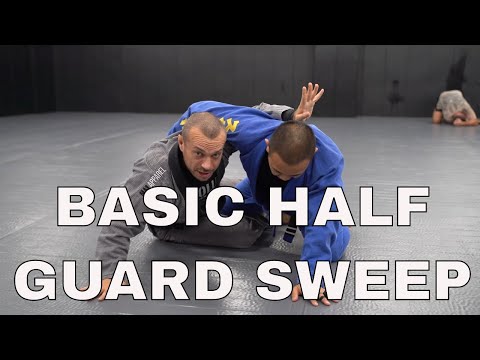
This sweep using the underhook is the primary sweep you should look for when playing half guard, there are many follow u…
Translation: underhook half guard
The Underhook Half Guard positions the guard player with a deep underhook on the opponent's far arm while maintaining half guard leg control, creating the most offensively oriented half guard configuration. [1] The underhook provides strong upper body control and hip access, enabling the classic old school sweep, dog fight transitions, and back takes. [1],[2] Getting the underhook from half guard is considered the primary offensive objective of half guard play, as it immediately creates sweep and transition opportunities. [2],[3]
The underhook half guard is the offensive foundation of half guard play, central to Roberto 'Gordo' Correa's original half guard system and subsequently developed by Lucas Leite, Tom DeBlass, and other half guard specialists. [1] The underhook is universally considered the most important grip in half guard. [2],[3]
The underhook half guard was systematised as the primary offensive half guard position in BJJ. [1]
The underhook half guard is the standard attacking half guard in BJJ competition. [1]
No images yet for this technique.
Sign in to suggest an image.
This sweep using the underhook is the primary sweep you should look for when playing half guard, there are many follow u…
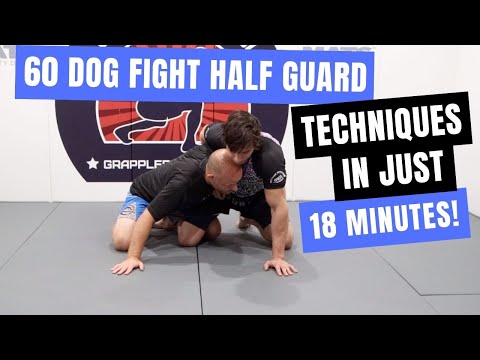
The "Dog Fight" Under-Hook Half Guard Is A Very Important Position To Understand. There Will Be Many Situations Where Yo…
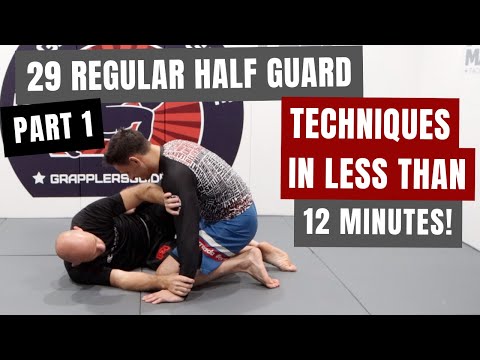
This videos covers "Part 1" of the half guard series. You will learn about the "Regular half guard" position. Understand…
The underhook half guard is a fundamental position within standard half guard that emphasizes controlling an opponent through an underhook grip combined with a high knee shield. According to Jiu Jitsu In Minutes' Jason Scully and Absolute MMA's Lachlan Giles, the core mechanics involve securing a high underhook while maintaining arm control on the opponent to prevent them from establishing head control and flattening you out. Giles stresses the importance of reaching the underhook high on the opponent's torso rather than at the waist, as this prevents the opponent from easily transitioning to a cross-body position. Once the underhook is established, the practitioner must "get around the corner"—a positional shift using the elbow or hand post to relocate laterally—before driving the chest forward and attaching tightly to the opponent's hips. Scully emphasizes protecting the inside space to prevent opponent underhooks and maintaining proper foot positioning: the bottom leg initially traps the opponent's leg, then transitions to the top leg for drive during the ascent to the dog fight position. Both instructors agree that the underhook half guard typically progresses into the dog fight position, from which numerous sweeps and submissions become available. Giles details the "roll under sweep" as a counter when opponents apply backward pressure, while Scully catalogs extensive offensive options including the knee pick, ankle grab sweeps, and various leg lock entries. The position requires constant arm framing and body awareness to prevent the opponent from establishing cross-face control or underhooking the bottom arm.
Synthesized from 3 instructors
No instructional courses yet for this technique.
Sign in to suggest a course.
Risk of injury to the person this technique is applied to
Guard positions are defensive; injury risk comes from transitions, not the position itself
Skill level needed to execute this technique reliably
Whether this technique is allowed under major competition rule sets
Jiu-Jitsu University (Saulo Ribeiro, 2008)
Alias sources — [1] Jiu-Jitsu University (Ribeiro, 2008) [2] The Guard (Moreira & Beneville, 2003) [3] Mastering Jujitsu (Gracie & Danaher, 2003)
Effectiveness sources — [1] Jiu-Jitsu University (Ribeiro, 2008) [2] Mastering Jujitsu (Gracie & Danaher, 2003)
Standard katakana transliteration of Western martial arts terminology (外来語) — used in Japanese MMA, boxing, and BJJ communities
Alias sources — [1] Jiu-Jitsu University (Ribeiro, 2008) [2] The Guard (Moreira & Beneville, 2003) [3] Mastering Jujitsu (Gracie & Danaher, 2003)
Effectiveness sources — [1] Jiu-Jitsu University (Ribeiro, 2008) [2] Mastering Jujitsu (Gracie & Danaher, 2003)
hip flexibility, active legs, grip management
long legs for distance control and guard retention
hip flexors, adductors, quadriceps, core, grip
Blocking your opponent's arm prevents them from flattening you out and getting head control, which allows you to stay on your side and access multiple attacking options. According to Jason Scully, if you get an underhook but fail to block their arm, they can flatten you out—this is critical to avoid.
Work an underhook on your opponent, swipe their leg open with your outside leg, and drive to your side while tucking your head and controlling their arm. Jason Scully emphasizes that swiping their leg open off-balances them and gives you a more advantageous position.
Continue to control and block your opponent's arm throughout the technique—this makes it much harder for them to get head control or escape. Jason Scully stresses that tracking your opponent's arm prevents them from flattening you while you execute your offense.
Keep your arm flared out as wide and as fast as possible to prevent your opponent from underhooking your bottom arm, which would allow them to collapse you back to the mat. Jason Scully notes that a loose arm position gives your opponent easy access to counter you.
The Underhook Half Guard positions the guard player with a deep underhook on the opponent's far arm while maintaining half guard leg control, creating the most offensively oriented half guard configuration. The underhook provides strong upper body control and hip access, enabling the classic old school sweep, dog fight transitions, and back takes.
The underhook half guard is the offensive foundation of half guard play, central to Roberto 'Gordo' Correa's original half guard system and subsequently developed by Lucas Leite, Tom DeBlass, and other half guard specialists. The underhook is universally considered the most important grip in half guard.
IBJJF: legal — Legal — guard is fundamental to BJJ, sweeps from guard score 2 points; IJF: restricted — Guard pulling penalized as non-combativity — groundwork from guard permitted …; ADCC: legal — Legal, guard pull penalized -1 point in points portion; Unified MMA: legal — Legal — no penalty for playing guard; FIAS Sport Sambo: legal — Legal
Danger rating 2/10. Low — guard positions are defensive; injury risk comes from transitions, not the position itself
The standard setup chain: Achieve Guard Contact → Control Grips → Manage Distance → Threaten Submissions/Sweeps.
Standard counters include: Guard Pass — systematically work to clear the legs and establish a dominant position / Leg Pin — control one or both legs to neutralize guard retention / Pressure Passing — use heavy chest pressure to flatten and immobilize the guard player.
Common variants: Standard half guard (one leg trapped between both legs with an underhook); Deep half guard (fully under the opponent with the leg fully entangled); Lockdown half guard (figure-four leg lock on the trapped leg (10th Planet)); Z-guard (knee shield) (knee across the opponent's chest creating a frame).
The underhook half guard is the standard attacking half guard in BJJ competition.
Top errors to watch for: Getting a shallow underhook — the hand must reach deep to the far lat or shoulder blade / Establishing the underhook but staying flat — immediately come to the knees or the hip / Not protecting the underhook — the opponent will try to strip it; maintain it aggressively / Using the underhook without advancing position — the underhook leads to sweeps and back takes; use it.
The Underhook Half Guard is also known as Andāfukku Hāfu Gādo, Underhook Half, Dog Fight Position, Battle Half Guard.