How To Use Lockdown to Escape a Tight Half Guard Smasher in BJJ
0
Lockdown Half Guard·Chewjitsu
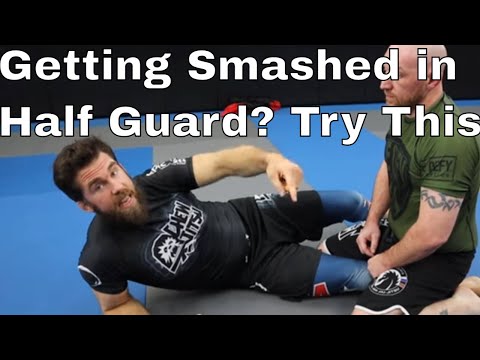
If you've played Half Guard long enough then I'm sure you've experienced the situation where you get smashed by the pers…
Translation: lockdown half guard
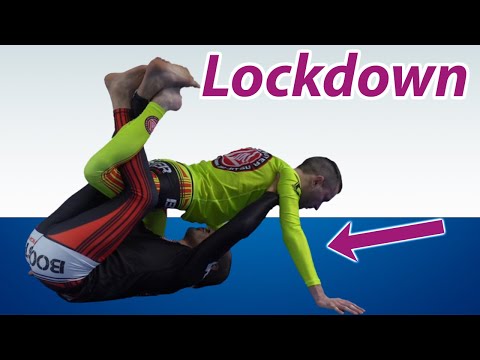
The Lockdown Half Guard uses a double-leg interlock (lockdown) on the opponent's trapped leg — both of the guard player's legs wrap around the opponent's leg in a figure-four configuration. [1] The lockdown provides extremely strong leg control that prevents the opponent from posturing or pulling the leg free, creating a platform for the electric chair sweep and whip-up attacks. [1],[2] The lockdown half guard is the signature position of Eddie Bravo's 10th Planet Jiu-Jitsu system. [2],[3]
The lockdown half guard was developed and popularised by Eddie Bravo as the foundation of his 10th Planet Jiu-Jitsu system, designed specifically for no-gi grappling. [1] Bravo's systematic development of the lockdown into a complete guard system demonstrated the potential of the half guard for no-gi competition. [2],[3]
The lockdown provides a powerful method of controlling the top player's leg and disrupting their base from the half guard, enabling sweeps and transitions to other positions. [1] Eddie Bravo developed the lockdown as a no-gi half guard control that does not rely on grips and integrates directly into his 10th Planet system. [1]
The lockdown half guard is used in BJJ competition, notably by Eddie Bravo's 10th Planet system practitioners. [1]
No images yet for this technique.
Sign in to suggest an image.
If you've played Half Guard long enough then I'm sure you've experienced the situation where you get smashed by the pers…
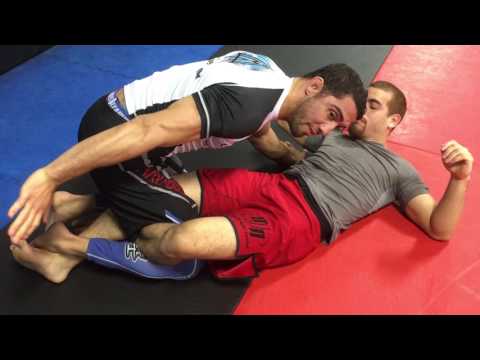
Matt Arroyo shows his tried and true way to easily bust out of anyones lockdown in the half guard . Enjoy! http://www.ma…
Half Guard: The Lockdown becomes even more effective with these tips - Half guard is kinda of a double edged sword as it…
The lockdown half guard is a leg lock position where the bottom player wraps their legs around the opponent's leg—typically the far leg—to control and destabilize the top player. Chewjitsu emphasizes using the lockdown defensively when smashed in half guard without an underhook, employing a "knees-up, whip-to-the-side" motion to off-balance the opponent and create space to obtain the underhook, rather than simply extending the legs which risks knee injury. Wim Deputter teaches a tibial (calf) lockdown variation where the bottom player uses dynamic resistance—pulling when the opponent pushes forward, pushing when they attempt to extend—combined with shoulder pressure to break down the top player's posture before transitioning to sweeps or the electric chair submission. He stresses pushing the opponent in the direction they're already moving to leverage their momentum. Matt Arroyo Jiu Jitsu, by contrast, provides the top player's defensive response: walking the hips down past the lockdown into a low, coiled position with chest-to-belly contact, then executing a controlled leg drive and torso swivel to generate pressure and friction that breaks the grip. All three instructors acknowledge the technique's injury potential if executed recklessly, particularly regarding knee strain from aggressive extension. The lockdown serves both as an offensive control tool and a defensive escape mechanism depending on player position.
Synthesized from 3 instructors
No instructional courses yet for this technique.
Sign in to suggest a course.
Risk of injury to the person this technique is applied to
Guard positions are defensive; injury risk comes from transitions, not the position itself
Skill level needed to execute this technique reliably
Whether this technique is allowed under major competition rule sets
Jiu-Jitsu University (Saulo Ribeiro, 2008)
Alias sources — [1] Jiu-Jitsu University (Ribeiro, 2008) [2] Advanced Rubber Guard (Bravo, 2006) [3] Advanced Rubber Guard (Bravo, 2006)
Effectiveness sources — [1] Mastering the Rubber Guard (Bravo, 2006)
Standard katakana transliteration of Western martial arts terminology (外来語) — used in Japanese MMA, boxing, and BJJ communities
Alias sources — [1] Jiu-Jitsu University (Ribeiro, 2008) [2] Advanced Rubber Guard (Bravo, 2006) [3] Advanced Rubber Guard (Bravo, 2006)
Effectiveness sources — [1] Mastering the Rubber Guard (Bravo, 2006)
hip flexibility, active legs, grip management
long legs for distance control and guard retention
hip flexors, adductors, quadriceps, core, grip
Bring your knees up and whip your hips to the side—your opponent will typically have to post their hand to avoid falling over, which creates an opening for your escape.
Use a tibial lockdown and react to their motion: if they move backward, push them away; if they move forward, pull them toward you to use their own momentum to your advantage.
Walk down to their hips and insert your shoulder on their belly button with your head on the same side as your trapped leg, then lock your hands and swivel your chest to face the wall while walking them down to create space.
Once your opponent stops resisting, bring your knee under their hips—try to touch your knee to your elbow—then climb your way up to the top position.
The Lockdown Half Guard uses a double-leg interlock (lockdown) on the opponent's trapped leg — both of the guard player's legs wrap around the opponent's leg in a figure-four configuration. The lockdown provides extremely strong leg control that prevents the opponent from posturing or pulling the leg free, creating a platform for the electric chair sweep and whip-up attacks.
The lockdown half guard was developed and popularised by Eddie Bravo as the foundation of his 10th Planet Jiu-Jitsu system, designed specifically for no-gi grappling. Bravo's systematic development of the lockdown into a complete guard system demonstrated the potential of the half guard for no-gi competition.
IBJJF: legal — Legal — guard is fundamental to BJJ, sweeps from guard score 2 points; IJF: restricted — Guard pulling penalized as non-combativity — groundwork from guard permitted …; ADCC: legal — Legal, guard pull penalized -1 point in points portion; Unified MMA: legal — Legal — no penalty for playing guard; FIAS Sport Sambo: legal — Legal
Danger rating 2/10. Low — guard positions are defensive; injury risk comes from transitions, not the position itself
The standard setup chain: Achieve Guard Contact → Control Grips → Manage Distance → Threaten Submissions/Sweeps.
Standard counters include: Guard Pass — systematically work to clear the legs and establish a dominant position / Leg Pin — control one or both legs to neutralize guard retention / Pressure Passing — use heavy chest pressure to flatten and immobilize the guard player.
Common variants: Standard half guard (one leg trapped between both legs with an underhook); Deep half guard (fully under the opponent with the leg fully entangled); Lockdown half guard (figure-four leg lock on the trapped leg (10th Planet)); Z-guard (knee shield) (knee across the opponent's chest creating a frame).
The lockdown half guard is used in BJJ competition, notably by Eddie Bravo's 10th Planet system practitioners.
Top errors to watch for: Applying the lockdown without upper body control — the lockdown controls the legs; you still need to control the uppe… / Holding the lockdown indefinitely without attacking — the lockdown creates opportunities that must be exploited / Not using the whip-up to establish the underhook — the whip-up is the critical transition from lockdown to offense / Applying the lockdown incorrectly — the figure-four must be tight; a loose lockdown is escapable.
The Lockdown Half Guard is also known as Rokkudaun Hāfu Gādo, Lockdown, Eddie Bravo Lockdown, Figure-Four Half Guard.