Overview of Three Tai Otoshi Variants
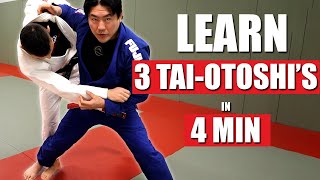
Tai otoshi has three primary variants, each suited to specific grip configurations and opponent stances. The three types are the classic three-step tai otoshi, the cross-grip version, and the one-handed tai otoshi. Selection depends on whether the practitioner and opponent are same-sided or opposite-sided.
Classic Three-Step Tai Otoshi Setup
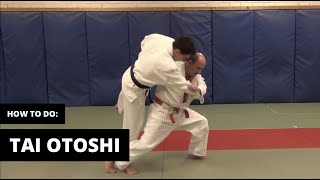
The classic three-step tai otoshi is used against opposite-sided opponents. The technique begins with kazushi, in which the practitioner collapses the opponent's near-side grip hand while pulling the far-side hand straight outward.
Classic Three-Step Execution
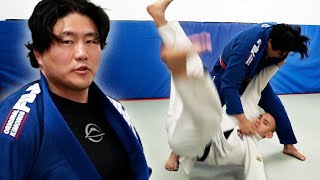
The second step involves circling around to the outside of the opponent's foot while dropping low and maintaining rotational momentum with the hands. The third step consists of the trip across the opponent's calf or ankle, combined with a hard pull of the hands away from the body. Completion is achieved by driving through the throw.
Cross-Grip Tai Otoshi for Same-Sided Opponents
When both practitioners share the same stance (lefty-lefty or righty-righty), the cross-grip tai otoshi is preferred. This grip is established by crossing the lapel with one hand while controlling the sleeve with the other.
Cross-Grip Execution and Advantages
From the cross-grip position, the practitioner requires only two steps rather than three since the leading foot is already positioned forward. After establishing kazushi by pulling the opponent in the desired direction, the practitioner jumps into position and executes the throw through rotational movement of the shoulders and head, avoiding excessive bending at the waist.
One-Handed Tai Otoshi Prerequisites
The one-handed tai otoshi occurs when the practitioner controls only the sleeve with one hand while the other hand remains free and has not yet established a grip on the neck or lapel. This variant is also used in same-sided situations.
One-Handed Tai Otoshi Entry and Completion
Kazushi is initiated using the single controlling hand. Once off-balance, the free hand crosses the opponent's body to establish a two-on-one grip on the same side. The practitioner then pivots on the front foot, circles around, drops low, and finishes through body rotation while maintaining contact between the elbow and opposite knee.
One-Handed Tai Otoshi Application Constraints
Despite its name, the one-handed tai otoshi concludes as a two-on-one grip technique on the same side of the opponent's body. This variant should never be applied against opposite-sided opponents.
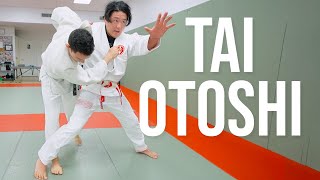
3 Types of Tai Otoshi
Key Takeaways
- •Overview of Three Tai Otoshi Variants
- •Classic Three-Step Tai Otoshi Setup
- •Classic Three-Step Execution
- •Cross-Grip Tai Otoshi for Same-Sided Opponents
Here's how you do tai-otoshi against an opposite-sided player as well as two variations to use against a similar-sided player.
Frequently Asked Questions
What does this video teach about tai otoshi?
This video covers overview of three tai otoshi variants, classic three-step tai otoshi setup, classic three-step execution. It provides detailed instruction from American Judo.
How long does it take to learn tai otoshi?
The basic mechanics can be understood in a single session, but developing reliable execution requires consistent drilling over weeks of practice. This 8-part breakdown helps structure your training by isolating each phase of the technique.
What are the key details for finishing tai otoshi?
Kazushi is initiated using the single controlling hand. Once off-balance, the free hand crosses the opponent's body to establish a two-on-one grip on the same side. The practitioner then pivots on the front foot, circles around, drops low, and finishes through body rotation while maintaining contact between the elbow and opposite knee.