How to do Tai Otoshi
0
Tai Otoshi·Sampson Judo
In this video Sampson discusses Tai Otoshi in great depth, focusing on the differences between a straight legged and a b…
Translation: body drop
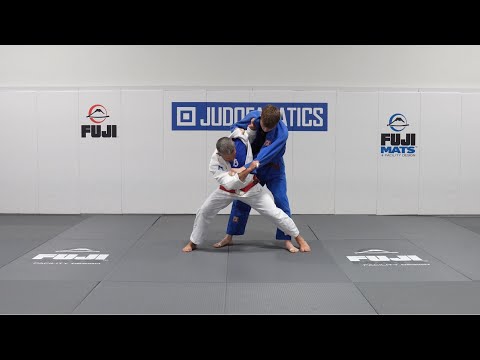
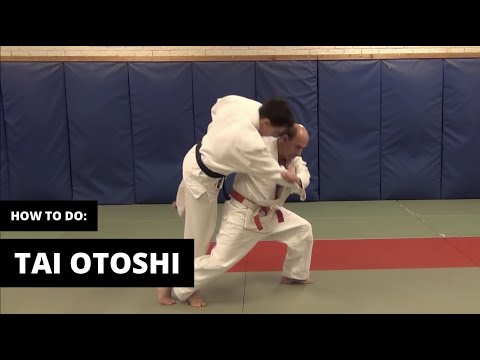
Tai Otoshi (body drop) is a te-waza technique in which the thrower turns in, extends one leg across and in front of the opponent's lead leg, and pulls the opponent forward and over the outstretched leg using a strong rotational hand action. [1] The extended leg acts as a trip or block — the opponent's lower body is stopped by the leg while the upper body is driven forward by the hands, creating a powerful rotational throw. [1],[2] Despite the prominent role of the extended leg, tai-otoshi is classified as a hand technique because the leg does not actively sweep or lift; all throwing force is generated by the hand action pulling the opponent over the obstacle. [2],[3]
Tai otoshi was included in the original 1895 Kodokan gokyo as a second-set technique and has been one of the most popular and effective competition throws throughout judo history. [1] The technique has been the primary throw of numerous World and Olympic champions, including Toshihiko Koga, who was renowned for his explosive tai-otoshi attacks. [2],[3]
Tai otoshi is among the top-scoring ippon techniques in IJF World Championship and Olympic competition. [1]
No images yet for this technique.
Sign in to suggest an image.
In this video Sampson discusses Tai Otoshi in great depth, focusing on the differences between a straight legged and a b…
Here's how you do tai-otoshi against an opposite-sided player as well as two variations to use against a similar-sided p…
No instructional courses yet for this technique.
Sign in to suggest a course.
Risk of injury to the person this technique is applied to
Tai-Otoshi uses body as fulcrum; controlled but high-velocity landing
Skill level needed to execute this technique reliably
Whether this technique is allowed under major competition rule sets
Kodokan Judo — Official Nage-waza Classification
Traditional Judo throwing technique terminology (Kodokan Institute)
Official Kodokan ground technique classification system
Standard Japanese martial arts terminology (kanji/hiragana)
Established Japanese martial arts naming convention — native Japanese term (和語/漢語)
Traditional Judo throwing technique terminology (Kodokan Institute)
precise timing, ankle coordination, upper body kuzushi ability
excellent balance and quick reflexes
tibialis anterior, calves, hip rotators, forearms (grip)
Every move, in any martial art, shares a few universal traits. Mix and match below to pinpoint the right tool — or compare equivalents across styles.
Reverse Tai Otoshi is a variation in which the thrower executes the body drop in the opposite direction from the classical form, reversing the rotation and leg placement to throw the opponent to the other side. [1] This variation is used when the opponent's stance, grip, or movement pattern makes the classical direction unfavourable, allowing the thrower to attack by rotating in the unexpected direction. [1,2] The mechanics remain the same — an extended blocking leg with rotational hand action — but the reversed direction creates a surprise element that catches defenders accustomed to the standard entry. [2,3]
Standard Tai Otoshi executes the classical body drop where the thrower pivots and turns the back to the opponent, extends one leg across and in front of the opponent's lead shin, and pulls strongly with both hands to rotate the opponent forward and over the blocking leg. [1] The tsurite (lapel hand) lifts and turns while the hikite (sleeve hand) pulls sharply across the body, creating the rotational force that wheels the opponent over. [1,2] The technique requires explosive rotation and precise leg placement to ensure the opponent's momentum carries them over the blocking leg. [2,3]
Sampson Judo recommends performing tai otoshi with a bent leg and both toes pointing in the same direction, rather than the conventional flat-footed stance with a straight leg. This bent-leg approach provides advantages and reduces vulnerabilities that can cause injury compared to the straight-leg method.
Being up on your toes prevents knee injury if your opponent resists or applies pressure to your knee—the bent position allows your knee to flex with the movement rather than absorbing direct force. This also gives you flexibility to use your opponent's movement to create the throw.
Your foot should be placed forward on the same line as your opponent's forward motion, not across their body on the same axis. Sampson Judo emphasizes that if both you and your opponent are standing on the same axis, neither has an advantage, so positioning your foot forward gives you better leverage and more options for combinations.
Break your opponent's balance in the direction their toes are pointing, using a motion like drawing a sword—pull and cut toward where they're facing. This directional break is critical for a crisp tai otoshi, and then you circulate your body into the throw as your hand directs them around.
Tai Otoshi (body drop) is a te-waza technique in which the thrower turns in, extends one leg across and in front of the opponent's lead leg, and pulls the opponent forward and over the outstretched leg using a strong rotational hand action. The extended leg acts as a trip or block — the opponent's lower body is stopped by the leg while the upper body is driven forward by the hands, creating a powerful rotational throw.
Tai otoshi was included in the original 1895 Kodokan gokyo as a second-set technique and has been one of the most popular and effective competition throws throughout judo history. The technique has been the primary throw of numerous World and Olympic champions, including Toshihiko Koga, who was renowned for his explosive tai-otoshi attacks.
IJF: legal — Legal throwing technique; IBJJF: legal — Legal at all belt levels; UWW: legal — Legal in both freestyle and Greco-Roman; Unified MMA: legal — Legal throwing technique; ADCC: legal — Legal; FIAS Sport Sambo: legal — Legal; FIAS Combat Sambo: legal — Legal
Danger rating 5/10. High — Tai-Otoshi uses body as fulcrum; controlled but high-velocity landing
The standard setup chain: Grip Setup (Kumi-kata) → Off-Balance (Kuzushi) → Entry (Tsukuri) → Execution (Kake).
Standard counters include: Lower Centre of Gravity — bend knees and drop hips to make the throw harder to execute / Lift the Targeted Leg — raise the foot being attacked above the sweeping action / Counter-Throw — exploit the attacker's committed weight to throw them instead / Grip Break — deny the thrower their preferred gripping configuration.
Common variants: Forward sweep (sweeping the foot in the direction the opponent is stepping); Rear sweep (sweeping the foot backward as the opponent retreats); Combination sweep (chaining sweeps to both feet); Counter sweep (timing the sweep as the opponent initiates their own attack).
Tai otoshi is among the top-scoring ippon techniques in IJF World Championship and Olympic competition.
Top errors to watch for: Blocking with the leg but not pulling with the hands — the hands generate all the throwing force / Placing the blocking leg after starting the pull — the leg must be in position as the pull begins / Not extending the blocking leg far enough — it must reach across the opponent's lead shin / Turning only the upper body and leaving the hips facing the opponent.
The Tai Otoshi is also known as Body Drop Throw, Body Drop, Tai Otoshi, Brosok Cherez Nogu (бросок через ногу).