Entry and Positioning
Harai goshi begins with a stepping pattern similar to seoi nage, circling wide and crossing past the left foot. The critical biomechanical principle is that both players must momentarily stand on the thrower's left leg, requiring the thrower's center of gravity to align directly over their base.
Biomechanical Efficiency
Improper weight distribution—with the base positioned away from center—requires excessive muscular effort and fails against larger opponents. The thrower must either pull the opponent laterally with significant force or risk collapsing sideways. Proper technique requires both centers of gravity to stack vertically over a single support point.
Grip Options and Head Control
Common grips include high collar, back grip, underhook, or belt grip. Regardless of grip choice, maximum head control—keeping the opponent's head hugged tightly to the thrower's chest—strengthens the throw. The collar grip should pull upward and outward, never downward, as downward pressure shifts weight onto the opponent's heels.
Foot Placement and Ball of Foot
The thrower's right foot crosses in front and inside the opponent's right foot, positioned approximately six inches forward and inward. Weight should rest on the ball of the foot rather than flat-footed, enabling easy pivoting and directional control.
The Lifting Phase
The sleeve grip pulls upward with a lawn-mower motion while the thrower presses through the floor. The high collar grip or underhook lifts the opponent's upper body, creating adhesion between the players. Once the opponent is on the balls of their feet, weight transitions to the thrower's right foot.
Cross-Step and Hip Positioning
The thrower takes a cross-step backward, placing the back foot approximately under the knot of the opponent's belt. The thrower remains angled to the side—not fully frontal—with the left hip pointer contacting the opponent's belt and the right hip elevated.
The Sweep Mechanics
The sweeping leg travels at approximately 45 degrees, moving around and upward rather than directly upward. The sweep must avoid contact with the opponent's knee to prevent mechanical inefficiency and potential injury from knee strikes.
Finishing the Throw
As the opponent goes over, the thrower rotates while pulling on the sleeve grip and pressing down toward the mat with the lapel grip. The opponent's weight should rest lightly on the thrower's elevated hip, which provides the lifting force for the throw.
Harai Goshi
Key Takeaways
- •Entry and Positioning
- •Biomechanical Efficiency
- •Grip Options and Head Control
- •Foot Placement and Ball of Foot
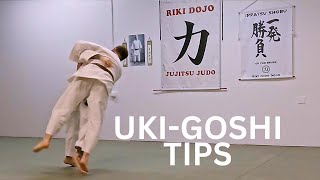
Mike gives an in depth explanation of Harai Goshi. www.eastcoastjiujitsu.com
Related Techniques
Frequently Asked Questions
What does this video teach about o goshi?
This video covers entry and positioning, biomechanical efficiency, grip options and head control. It provides detailed instruction from eyesofscyld.
How long does it take to learn o goshi?
The basic mechanics can be understood in a single session, but developing reliable execution requires consistent drilling over weeks of practice. This 8-part breakdown helps structure your training by isolating each phase of the technique.
What are the key details for finishing o goshi?
The sweeping leg travels at approximately 45 degrees, moving around and upward rather than directly upward. The sweep must avoid contact with the opponent's knee to prevent mechanical inefficiency and potential injury from knee strikes.