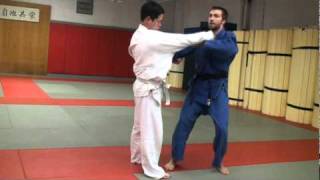
Understanding Uki Goshi Mechanics
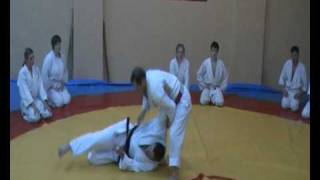
Uki goshi, meaning "floating hip," differs fundamentally from o goshi in that the instructor elevates the opponent's weight onto the balls of their feet rather than lifting them completely. This positioning reduces friction and allows for a rotational throw rather than a vertical lift, creating a more efficient technique.
Hand Position and Control
The hikite (pulling hand) must actively pull while the tsurita (throwing hand) follows in the same direction. Proper hand coordination ensures the opponent is drawn into the throw rather than hoisted, maintaining control throughout the technique.
Entry and Foot Positioning
The instructor enters by stepping forward and dropping the hand to wrap around the opponent's waist, then bringing the rear foot back to achieve a 45-degree angle. This perpendicular-to-diagonal transition is crucial for proper body positioning and leverage.
Creating the Triangle Formation
A key objective is establishing a triangle configuration between the instructor's feet and hip position relative to the opponent. This triangular base provides stability and control, regardless of whether the opponent's right or left foot is forward.
Shoulder Rotation and Execution
Shoulder impact and rotation are essential to turning the opponent; merely moving the hips without proper shoulder engagement fails to generate sufficient rotational force. The instructor demonstrates how initiating the throw with shoulder rotation creates the momentum necessary to complete the technique.
Hip Contact Technique
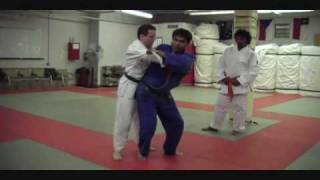
A hip check (proper contact) differs critically from a hip bump, which is ineffective. The correct method involves driving the hip into the opponent's midsection while maintaining the rotational movement, not attempting a lateral bump action.
Adapting to Stiff-Arm Defense
When an opponent locks their arm, a quarter-turn entry using shoulder contact proves more effective than attempting a full rotation. This adaptation allows the instructor to penetrate the opponent's defenses and continue the pulling motion for completion.
Integrated Striking and Throwing
Grounded in Okinawan martial traditions, the instructor demonstrates combining a striking motion with simultaneous rotation and pulling. This synchronized action disrupts the opponent's balance more effectively than isolated throwing mechanics.
Corner Movement Principle
Rather than exaggerated hip movement, the instructor emphasizes stepping toward the opponent's corner while maintaining the rear foot position. This subtle directional adjustment, combined with a minimal pulling action, generates the throwing momentum with minimal effort.
Uki-Goshi Tips | Riki Judo Dojo
Key Takeaways
- •Understanding Uki Goshi Mechanics
- •Hand Position and Control
- •Entry and Foot Positioning
- •Creating the Triangle Formation
Riki sensei explained uki-goshi (浮腰 - floating hip throw) during judo class on 11-10-2022. 0:00 definition 0:16 uki-goshi vs. o-goshi 0:29 kuzushi 1:09 use the lines on the tatami 1:20 how to practice 1:49 turn uke's shoulders 2:21 it's a hip check, not a butt bump 2:30 against a stiff arm defense 3:36 strike then throw 4:00 move to uke's corner entry Riki sensei began Judo in Okinawa and is a Shichidan with over 56 years of study, practice, competition and teaching. He competed for 25 years at the local, national and international levels. A few of the great Judoka Riki sensei has studied and practiced with include: Kotani, Daigo, Ito, Inokuma, Okano, Kimura, Kaminaga and Nakatani. See Riki sensei teach every Monday, Wednesday, Thursday and Friday evening at 535 W. Iron Ave, Mesa, AZ 85210. Youth classes are 6 - 6:55 PM, adult classes are 7:00 - 8:30 PM. For more info, please visit rikidojousa.com The purpose of this YouTube channel is to pass on the original, traditional, authentic Kodokan Judo that Riki sensei loves so much. Riki sensei's students maintain this YouTube channel (and are responsible for any errors), but you can find more of his thoughts at the Riki Judo Dojo Facebook page: https://www.facebook.com/Riki-Judo-Dojo-USA-194351210607759 15
Frequently Asked Questions
What does this video teach about standard uki goshi?
This video covers understanding uki goshi mechanics, hand position and control, entry and foot positioning. It provides detailed instruction from Riki Judo Dojo.
How long does it take to learn standard uki goshi?
The basic mechanics can be understood in a single session, but developing reliable execution requires consistent drilling over weeks of practice. This 9-part breakdown helps structure your training by isolating each phase of the technique.
What are the key details for finishing standard uki goshi?
Grounded in Okinawan martial traditions, the instructor demonstrates combining a striking motion with simultaneous rotation and pulling. This synchronized action disrupts the opponent's balance more effectively than isolated throwing mechanics.