Koshi Guruma
0
Koshi Guruma·WINNING
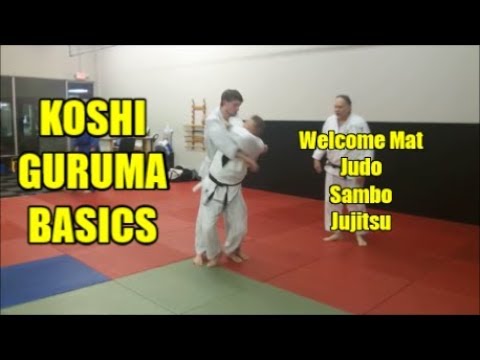
Fundamentals of Koshi Garuma (Hip Wheel) Throw as demonstrated by Sensai Max.
Translation: hip wheel
Koshi Guruma (hip wheel) is a koshi-waza technique in which the thrower turns in, wraps one arm around the opponent's neck or head, and uses the hip as a fulcrum to wheel the opponent over in a forward rotation. [1] The arm around the neck distinguishes koshi-guruma from o-goshi (arm around the waist), and this higher control point gives the thrower leverage over the opponent's head and posture. [1],[2] The neck control forces the opponent to bend forward and over the hip, creating a powerful wheeling action that is difficult to resist once the entry is secured. [2],[3]
Koshi guruma was included in the Kodokan gokyo as a foundational koshi-waza technique, valued for its powerful head-control mechanic and its effectiveness against a wide range of body types. [1] The technique has been widely taught in judo and also appears in wrestling and self-defence curricula. [2],[3]
Koshi guruma is part of the Kodokan judo koshi-waza syllabus. [1]
Koshi guruma is scored in IJF competition. [1]
No images yet for this technique.
Sign in to suggest an image.
Fundamentals of Koshi Garuma (Hip Wheel) Throw as demonstrated by Sensai Max.
Koshi Guruma (Hip Wheel Throw) is one of the core skills of Judo, Jujitsu and Sambo. It is an ideal throw for beginning …
No instructional courses yet for this technique.
Sign in to suggest a course.
Risk of injury to the person this technique is applied to
O-Goshi and variants; high amplitude hip throw with significant impact (Kano 1986)
Skill level needed to execute this technique reliably
Whether this technique is allowed under major competition rule sets
Kodokan Judo — Official Nage-waza Classification
Traditional Judo throwing technique terminology (Kodokan Institute)
Official Kodokan ground technique classification system
Standard Japanese martial arts terminology (kanji/hiragana)
Established Japanese martial arts naming convention — native Japanese term (和語/漢語)
Traditional Judo throwing technique terminology (Kodokan Institute)
hip rotation speed, core strength, lower back stability
strong hips and core, good flexibility for turning entry
hip rotators, core, quadriceps, latissimus dorsi
Every move, in any martial art, shares a few universal traits. Mix and match below to pinpoint the right tool — or compare equivalents across styles.
Koshi guruma (hip wheel) appears in 6 books in our corpus. It wraps the arm around the opponent's neck rather than under the arm — distinguishing it from o-goshi. One of the original forty throws of the Kodokan gokyo. (Kano, Kodokan Judo; KyokushinBudoKai Beginners Guide)
Koshi Guruma is very similar to O Goshi, but instead of grabbing around the waist, you grab around the neck and shoulder area. Like O Goshi, you're lifting your opponent up and over your hip rather than pulling them down into you.
According to Welcome Mat Steve Scott, most people focus too much on the hand around the neck, but the pulling hand (hiki te) is actually the most important. The pulling hand lifts and traps your opponent, while the hand around the neck mainly locks them to your body.
No—avoid pulling your opponent down into you, as this is a common mistake. Instead, focus on lifting them up and over your hip, just as you would with O Goshi.
Koshi Guruma (hip wheel) is a koshi-waza technique in which the thrower turns in, wraps one arm around the opponent's neck or head, and uses the hip as a fulcrum to wheel the opponent over in a forward rotation. The arm around the neck distinguishes koshi-guruma from o-goshi (arm around the waist), and this higher control point gives the thrower leverage over the opponent's head and posture.
Koshi guruma was included in the Kodokan gokyo as a foundational koshi-waza technique, valued for its powerful head-control mechanic and its effectiveness against a wide range of body types. The technique has been widely taught in judo and also appears in wrestling and self-defence curricula.
IJF: legal — Legal throwing technique; IBJJF: legal — Legal at all belt levels; UWW: legal — Legal in both freestyle and Greco-Roman; Unified MMA: legal — Legal throwing technique; ADCC: legal — Legal; FIAS Sport Sambo: legal — Legal; FIAS Combat Sambo: legal — Legal
Danger rating 6/10. High — O-Goshi and variants; high amplitude hip throw with significant impact (Kano 1986)
The standard setup chain: Grip Setup (Kumi-kata) → Off-Balance (Kuzushi) → Entry (Tsukuri) → Execution (Kake).
Standard counters include: Lower Centre of Gravity — bend knees and drop hips to make the throw harder to execute / Block the Hip — post hand on the thrower's hip to prevent loading / Step Around — circle away from the throw direction to avoid being loaded / Grip Break — deny the thrower their preferred gripping configuration.
Common variants: Standard hip throw (full turn-in with hip below the opponent's centre of gravity); No-gi hip throw (adapted without gi grips, using overhook and collar tie); Drop hip throw (dropping to one knee to lower the fulcrum point); Combination hip throw (chaining from a failed foot technique or hand technique).
Koshi guruma is scored in IJF competition.
Top errors to watch for: Cranking the neck aggressively — koshi guruma is a throw, not a neck crank; the arm guides, it doesn't squeeze / Entering too shallowly so the arm reaches the neck but the hip isn't loaded — uke won't go over / Not bending the knees enough during entry — koshi guruma requires getting very low because you're controlling the head / Pulling uke's head down without rotating the hips — this just bends them over without throwing.
The Koshi Guruma is also known as Hip Wheel, Hip Wheel Throw, Koshi Guruma, Headlock Hip Throw.