Technique Introduction
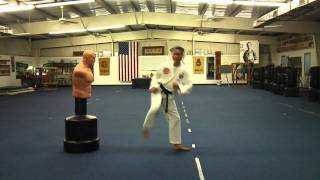
The instructor introduces the push kick to flying roundhouse kick combination, noting it is an uncommon technique in most training environments. The technique requires prior knowledge of both the push kick and roundhouse kick fundamentals.
Stance and Foot Positioning
The practitioner begins in a fighting stance with the left leg forward. Unlike a standard push kick executed with the heel, this combination uses the toes for initial ground contact, similar to the mechanics of jumping off a wall or dirt surface.
Toe Dig Mechanics
Upon landing the push kick, the practitioner must dig the toes firmly into the ground to generate lift for the subsequent roundhouse kick. This dig-in action, compared to pressing a car's accelerator, provides the vertical momentum needed for the flying roundhouse.
Slow Motion Progression
Training begins at slow speed and light contact, with the practitioner tapping the bag repeatedly to develop timing. The movement sequence involves the front foot touching down while the rear hip rotates upward for the roundhouse kick chamber.
Partner Communication and Conditioning
When training with an opponent, repeated light push kicks should be thrown to condition the defender to expect and block the initial strike. On the final repetition, the flying roundhouse is executed as the opponent's defensive focus remains on the push kick.
Execution Under Pressure
The technique has a narrow execution window and high failure rate in actual application, succeeding only approximately two out of ten attempts in live training. The flying roundhouse achieves greater height than a standard roundhouse since the toe dig provides additional elevation.
Advancing Forward Application
The technique is most effective when the practitioner advances into the opponent's space with forward momentum. This charging approach provides both the initial push kick impact and the ground contact needed for the flying roundhouse follow-up.
Meeting Advancing Opponent
The technique becomes more reliable when executed against an opponent moving forward, as their advancing body provides a stable surface for the toe dig and subsequent roundhouse rotation. Preliminary jabs can disguise the technique's setup.
Power Generation Alternative
The instructor recommends throwing the push kick and roundhouse as separate strikes rather than a continuous combination to maximize power output. Power generation derives from ground connection and hip rotation, which becomes compromised when executing the techniques sequentially without resetting.
Hip Rotation and Ground Connection
Proper roundhouse execution requires heel rotation and full hip engagement while maintaining ground connection. The flying variation reduces rotational efficiency since foot placement becomes unstable mid-air, potentially diminishing strike force compared to traditional roundhouse mechanics.
Push Kick To Flying Roundhouse Kick
Key Takeaways
- •Technique Introduction
- •Stance and Foot Positioning
- •Toe Dig Mechanics
- •Slow Motion Progression
Ever wonder how to throw a flying kick? Well, if you know the roundhouse kick and push kick then you may be able to do this push kick to flying roundhouse kick. The power will still come from hip rotation. This technique can be used to have fun when training and is also great for coordination. Let me know if there are any other flying moves you would like to see. WARNING: Do not try these moves on other people without consent. Done improperly, these actions can lead to serious injury. Don't forget to turn on the notification button to catch my next videos!
Related Techniques
Frequently Asked Questions
What does this video teach about flying roundhouse kick?
This video covers technique introduction, stance and foot positioning, toe dig mechanics. It provides detailed instruction from Astral Kinetics.
How long does it take to learn flying roundhouse kick?
The basic mechanics can be understood in a single session, but developing reliable execution requires consistent drilling over weeks of practice. This 10-part breakdown helps structure your training by isolating each phase of the technique.
What are the key details for finishing flying roundhouse kick?
The instructor recommends throwing the push kick and roundhouse as separate strikes rather than a continuous combination to maximize power output. Power generation derives from ground connection and hip rotation, which becomes compromised when executing the techniques sequentially without resetting.