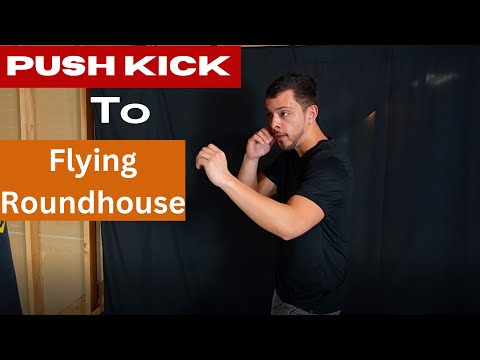
Push Kick To Flying Roundhouse Kick
0
Flying Roundhouse Kick·Astral Kinetics
Ever wonder how to throw a flying kick? Well, if you know the roundhouse kick and push kick then you may be able to do t…
Translation: flying roundhouse kick
The Flying Roundhouse Kick subfamily covers roundhouse kicks delivered while the attacker is airborne, combining a forward leap with a circular kicking motion to strike the opponent's head or body with the shin or instep. [1] The jump adds height to the kick, allowing the attacker to target over the opponent's guard, and the forward momentum increases the mass behind the impact. [1],[2] Flying roundhouse kicks are visually spectacular and can be devastatingly powerful, but they require precise timing and distance to avoid landing in a vulnerable position. [2],[3]
Flying roundhouse kicks are featured in taekwondo, karate, and Chinese kung fu, where aerial kicks have been developed as both martial techniques and acrobatic displays. [1] In competitive MMA, fighters such as Anthony Pettis and Edson Barboza have used flying roundhouse kicks to produce spectacular knockouts. [2],[3]
The flying roundhouse delivers a roundhouse kick while airborne. [1]
From TKD and karate. [1]
Used in TKD and MMA competition. [1]
No images yet for this technique.
Sign in to suggest an image.
Ever wonder how to throw a flying kick? Well, if you know the roundhouse kick and push kick then you may be able to do t…
No instructional courses yet for this technique.
Sign in to suggest a course.
Risk of injury to the person this technique is applied to
Airborne kicks maximize momentum; high injury risk to both fighters
Skill level needed to execute this technique reliably
Whether this technique is allowed under major competition rule sets
Karate-Do Kyohan: The Master Text (Gichin Funakoshi, 1935)
Alias sources — [1] Kukkiwon Taekwondo Textbook (Kukkiwon, 2006) [2] Dynamic Karate (Nakayama, 1966) [3] Taekwondo: The State of the Art (Park, 1989)
Effectiveness sources — [1] Comprehensive Asian Fighting Arts (Draeger & Smith, 1969)
Official karate technique names (和語/漢語)
Established Japanese martial arts naming convention — native Japanese term (和語/漢語)
Alias sources — [1] Kukkiwon Taekwondo Textbook (Kukkiwon, 2006) [2] Dynamic Karate (Nakayama, 1966) [3] Taekwondo: The State of the Art (Park, 1989)
Effectiveness sources — [1] Comprehensive Asian Fighting Arts (Draeger & Smith, 1969)
hip flexibility, rotational hip power, balance on support leg
long legs for reach, flexible hips for high kicks
hip flexors, glutes, quadriceps, obliques, calves
Every move, in any martial art, shares a few universal traits. Mix and match below to pinpoint the right tool — or compare equivalents across styles.
Yes, you need to know how to do a push kick first, as it's a prerequisite technique for the flying roundhouse kick combination.
After landing from your push kick, dig in your toes into the ground to lift off for the roundhouse—this toe dig is what generates the necessary lift to get airborne.
You can do this slightly with a partner since digging in hard isn't pleasant; save the harder version for heavy bags or tournament situations where you're not concerned about your partner's comfort.
The Flying Roundhouse Kick subfamily covers roundhouse kicks delivered while the attacker is airborne, combining a forward leap with a circular kicking motion to strike the opponent's head or body with the shin or instep. The jump adds height to the kick, allowing the attacker to target over the opponent's guard, and the forward momentum increases the mass behind the impact.
Flying roundhouse kicks are featured in taekwondo, karate, and Chinese kung fu, where aerial kicks have been developed as both martial techniques and acrobatic displays. In competitive MMA, fighters such as Anthony Pettis and Edson Barboza have used flying roundhouse kicks to produce spectacular knockouts.
Unified MMA: legal — Legal striking technique; WBC/Boxing: banned — All kicks prohibited in boxing; WKF: legal — Legal, chudan (body) kick scores 2 points, jodan (head) kick scores 3 points; Kyokushin: legal — Legal at full power to body and head; WT: legal — Legal, body kick 2 points, head kick 3 points, spinning body 4 points, spinni…; WAKO: legal — Legal in Full Contact and Low Kick formats; K: legal — 1/GLORY — Legal; IFMA: legal — Legal — kicks are a core Muay Thai technique
Danger rating 7/10. Very High — airborne kicks maximize momentum; high injury risk to both fighters
The standard setup chain: Stance and Range → Chamber the Leg → Execute the Kick → Recover.
Standard counters include: Check (Shin Block) — raise the shin to intercept the kick before it lands / Catch and Sweep — catch the kicking leg and sweep the standing leg / Step Inside — close distance inside the kick's effective range to smother it.
Common variants: Standard roundhouse (rear leg) (full hip rotation, shin strikes the target); Lead leg roundhouse (switch kick) (switch-step to generate power from the lead side); Low roundhouse (leg kick) (targeting the thigh to damage the opponent's base); Head kick (high roundhouse targeting the temple or jaw).
Used in TKD and MMA competition.
Top errors to watch for: Not rotating the hip over while airborne — the kick becomes a jumping slap without proper hip turnover / Jumping too high and landing heavily instead of jumping forward and landing on balance / Not spotting the target before leaping — a flying kick to an empty space is a dangerous waste of energy / Landing with the kicking leg extended, unable to retract and defend.
The Flying Roundhouse Kick is also known as Tobi Mawashi-geri, Twi-eo Dollyo Chagi, Tobi Mawashi Geri, Jumping Roundhouse.