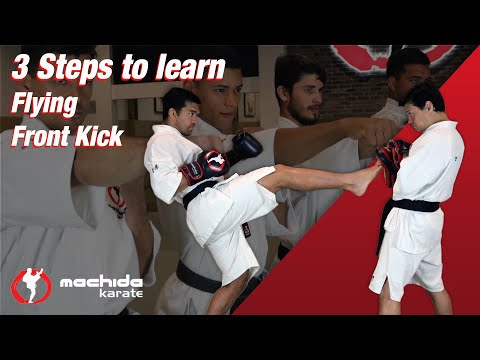
Machida Flying Kick! 3 steps to learn the famous Machida Flying Front kick
0
Flying Front Kick·Machida Karate
Kick like Lyoto Machida and Daniel San! Sensei Chinzo Machida teaches in 3 steps how you can do the famous Machida flyi…
Translation: flying front kick
The Flying Front Kick subfamily covers front kicks executed while the attacker is airborne, combining a forward leap with a linear front kick thrust to strike the opponent's face, chest, or midsection with increased range and momentum. [1] The jumping motion adds bodyweight and forward momentum to the kick, making the flying front kick substantially more powerful than its grounded counterpart. [1],[2] The technique requires explosive leg power for the jump and precise timing to extend the kicking leg at the apex of the leap. [2],[3]
Flying front kicks are found in taekwondo (twi-myo ap chagi), karate, and numerous kung fu styles, where aerial techniques have been developed for centuries. [1] The technique gained massive public attention when Lyoto Machida and Anderson Silva both used flying front kicks for high-profile UFC knockouts in 2011, citing their karate backgrounds as the source of the technique. [2],[3]
The flying front kick launches forward with a thrusting front kick in the air. [1]
Found in TKD, karate, and MMA. [1]
Used in MMA; Anderson Silva's flying front kick KO of Vitor Belfort at UFC 126 is one of MMA's most iconic finishes. [1]
No images yet for this technique.
Sign in to suggest an image.
Kick like Lyoto Machida and Daniel San! Sensei Chinzo Machida teaches in 3 steps how you can do the famous Machida flyi…
My Front Kick Focus course is available at http://hard2hurt.teachable.com @SenseiSeth has a sidekick course at http://…
No instructional courses yet for this technique.
Sign in to suggest a course.
Risk of injury to the person this technique is applied to
Airborne kicks maximize momentum; high injury risk to both fighters
Skill level needed to execute this technique reliably
Whether this technique is allowed under major competition rule sets
Karate-Do Kyohan: The Master Text (Gichin Funakoshi, 1935)
Alias sources — [1] Kukkiwon Taekwondo Textbook (Kukkiwon, 2006) [2] Dynamic Karate (Nakayama, 1966) [3] Taekwondo: The State of the Art (Park, 1989)
Effectiveness sources — [1] Comprehensive Asian Fighting Arts (Draeger & Smith, 1969)
Official karate technique names (和語/漢語)
Established Japanese martial arts naming convention — native Japanese term (和語/漢語)
Alias sources — [1] Kukkiwon Taekwondo Textbook (Kukkiwon, 2006) [2] Dynamic Karate (Nakayama, 1966) [3] Taekwondo: The State of the Art (Park, 1989)
Effectiveness sources — [1] Comprehensive Asian Fighting Arts (Draeger & Smith, 1969)
hip flexion power, knee extension speed, balance
long legs for range, hip flexibility
hip flexors, quadriceps, tibialis anterior, core
Every move, in any martial art, shares a few universal traits. Mix and match below to pinpoint the right tool — or compare equivalents across styles.
Keep your upper body relaxed and loose rather than tense, as tension prevents you from executing a good kick. Focus on relaxing in your center as you move forward with your hips before extending the kick.
Break your opponent's timing and confuse them by setting up the kick with feints or multiple movements, so they contract their body in defense to the first setup. This timing disruption makes the actual technique land with greater power and effect.
Yes, the front kick can be executed effectively from any range—from close distance to far away—unlike some other kicks that only work within specific ranges.
The Flying Front Kick subfamily covers front kicks executed while the attacker is airborne, combining a forward leap with a linear front kick thrust to strike the opponent's face, chest, or midsection with increased range and momentum. The jumping motion adds bodyweight and forward momentum to the kick, making the flying front kick substantially more powerful than its grounded counterpart.
Flying front kicks are found in taekwondo (twi-myo ap chagi), karate, and numerous kung fu styles, where aerial techniques have been developed for centuries. The technique gained massive public attention when Lyoto Machida and Anderson Silva both used flying front kicks for high-profile UFC knockouts in 2011, citing their karate backgrounds as the source of the technique.
Unified MMA: legal — Legal striking technique; WBC/Boxing: banned — All kicks prohibited in boxing; WKF: legal — Legal, chudan (body) kick scores 2 points, jodan (head) kick scores 3 points; Kyokushin: legal — Legal at full power to body and head; WT: legal — Legal, body kick 2 points, head kick 3 points, spinning body 4 points, spinni…; WAKO: legal — Legal in Full Contact and Low Kick formats; K: legal — 1/GLORY — Legal; IFMA: legal — Legal — kicks are a core Muay Thai technique
Danger rating 7/10. Very High — airborne kicks maximize momentum; high injury risk to both fighters
The standard setup chain: Stance and Range → Chamber the Leg → Execute the Kick → Recover.
Standard counters include: Check (Shin Block) — raise the shin to intercept the kick before it lands / Catch and Sweep — catch the kicking leg and sweep the standing leg / Step Inside — close distance inside the kick's effective range to smother it.
Common variants: Push kick (teep) (pushing the opponent away with the ball of the foot); Snap front kick (snapping the foot to the target and quickly retracting); Side teep (angled teep pushing the opponent laterally); Body teep (driving into the solar plexus or chest for maximum push-back).
Used in MMA; Anderson Silva's flying front kick KO of Vitor Belfort at UFC 126 is one of MMA's most iconic finishes.
Top errors to watch for: Jumping too high and losing the horizontal drive that makes the kick powerful / Not extending the kicking leg fully, resulting in a knee or a weak push / Landing on one foot in an unstable position after the kick / Leaping from too far away so the kick falls short of the target.
The Flying Front Kick is also known as Tobi Mae-geri, Twi-eo Ap Chagi, Tobi Mae Geri, Jumping Front Kick.