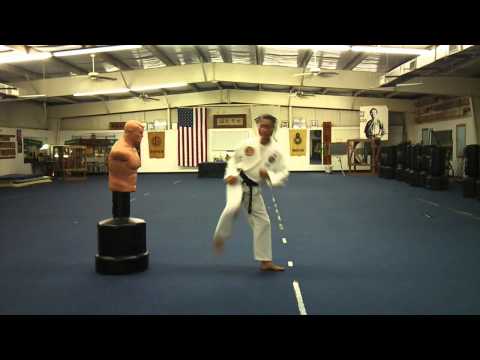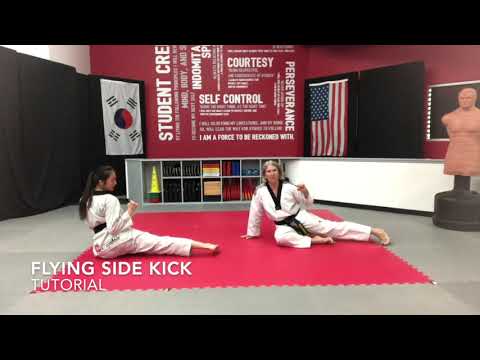
Flying Side Kick
0
Flying Side Kick·Beyond Taekwondo
This Flying Side Kick Tutorial Breaks down each step to help increase power, flow and accuracy.
Translation: flying side kick
The Flying Side Kick subfamily covers side kicks delivered while the attacker is airborne, involving a leap followed by a lateral thrusting kick that drives the heel or blade of the foot into the target. [1] The flying side kick is perhaps the most iconic aerial technique in martial arts, frequently used in board-breaking demonstrations, and it combines the linear power of the side kick with the momentum of a full-body leap. [1],[2] The technique can cover impressive distance — up to two metres or more in elite practitioners — making it useful for closing the gap against a retreating opponent. [2],[3]
The flying side kick is most closely associated with taekwondo, where twi-myo yeop chagi is a staple demonstration and testing technique required for belt promotions. [1] The technique also appears in karate (tobi yoko geri) and Chinese martial arts, and was popularised in Western culture through martial arts films featuring Bruce Lee and other action stars. [2],[3]
The flying side kick thrusts the foot sideways while airborne. [1]
From TKD and karate. [1]
Used in TKD and MMA. [1]
No images yet for this technique.
Sign in to suggest an image.
This Flying Side Kick Tutorial Breaks down each step to help increase power, flow and accuracy.
The Flying side kick is a classic martial arts kick commonly demonstrated when breaking boards. I recommend mastering a …
No instructional courses yet for this technique.
Sign in to suggest a course.
Risk of injury to the person this technique is applied to
Airborne kicks maximize momentum; high injury risk to both fighters
Skill level needed to execute this technique reliably
Whether this technique is allowed under major competition rule sets
Karate-Do Kyohan: The Master Text (Gichin Funakoshi, 1935)
Alias sources — [1] Kukkiwon Taekwondo Textbook (Kukkiwon, 2006) [2] Dynamic Karate (Nakayama, 1966) [3] Taekwondo: The State of the Art (Park, 1989)
Effectiveness sources — [1] Comprehensive Asian Fighting Arts (Draeger & Smith, 1969)
Official karate technique names (和語/漢語)
Established Japanese martial arts naming convention — native Japanese term (和語/漢語)
Alias sources — [1] Kukkiwon Taekwondo Textbook (Kukkiwon, 2006) [2] Dynamic Karate (Nakayama, 1966) [3] Taekwondo: The State of the Art (Park, 1989)
Effectiveness sources — [1] Comprehensive Asian Fighting Arts (Draeger & Smith, 1969)
hip abduction power, lateral hip flexibility, single-leg balance
flexible hips for high side kicks
gluteus medius, hip abductors, quadriceps, core
Every move, in any martial art, shares a few universal traits. Mix and match below to pinpoint the right tool — or compare equivalents across styles.
You need a really good standard sidekick and a strong step-behind sidekick as precursors, because if those kicks aren't solid, you'll struggle with the flying side kick and get frustrated.
You can get everything you need from a two-step approach, which also allows you to practice with control rather than running all out.
Many practitioners extend the kick and then pull the bottom leg up, or pull the leg up and put it down as they're extending the kick, meaning they're already on the ground by the time they kick. Instead, you want your bottom leg tucked at the exact same time your extended leg fires.
Angel Ochoa explains that you combine a regular back-leg sidekick with the airborne rotation of a jumping sidekick—the hips turn to direct the kick just like a standard sidekick, but you execute it while airborne and turn in the air like a jumping sidekick.
The Flying Side Kick subfamily covers side kicks delivered while the attacker is airborne, involving a leap followed by a lateral thrusting kick that drives the heel or blade of the foot into the target. The flying side kick is perhaps the most iconic aerial technique in martial arts, frequently used in board-breaking demonstrations, and it combines the linear power of the side kick with the momentum of a full-body leap.
The flying side kick is most closely associated with taekwondo, where twi-myo yeop chagi is a staple demonstration and testing technique required for belt promotions. The technique also appears in karate (tobi yoko geri) and Chinese martial arts, and was popularised in Western culture through martial arts films featuring Bruce Lee and other action stars.
Unified MMA: legal — Legal striking technique; WBC/Boxing: banned — All kicks prohibited in boxing; WKF: legal — Legal, chudan (body) kick scores 2 points, jodan (head) kick scores 3 points; Kyokushin: legal — Legal at full power to body and head; WT: legal — Legal, body kick 2 points, head kick 3 points, spinning body 4 points, spinni…; WAKO: legal — Legal in Full Contact and Low Kick formats; K: legal — 1/GLORY — Legal; IFMA: legal — Legal — kicks are a core Muay Thai technique
Danger rating 7/10. Very High — airborne kicks maximize momentum; high injury risk to both fighters
The standard setup chain: Stance and Range → Chamber the Leg → Execute the Kick → Recover.
Standard counters include: Check (Shin Block) — raise the shin to intercept the kick before it lands / Catch and Sweep — catch the kicking leg and sweep the standing leg / Step Inside — close distance inside the kick's effective range to smother it.
Common variants: Standard side kick (driving the heel or blade of the foot laterally with hip …); Checking side kick (low side kick targeting the knee to stop the opponent's a…); Spinning side kick (adding a spin for extra rotational power); Step-through side kick (stepping through for deeper penetration).
Used in TKD and MMA.
Top errors to watch for: Not turning the body sideways in the air — if you stay facing forward, the kick becomes a jumping front kick / Jumping too high instead of driving forward — the power is in horizontal momentum / Not extending the hip at the moment of impact, reducing the thrust to a leg push / Landing flat on both feet from the height of the jump, which jars the spine and knees.
The Flying Side Kick is also known as Tobi Yoko-geri, Twi-eo Yop Chagi, Tobi Yoko Geri, Jumping Side Kick.