Introduction and Setup
Professor Gustav Gaspari demonstrates how to establish a triangle choke from the mount position using gift wrap control. The technique begins from a standard mounted position when the opponent attempts to turn to their side.
Transitioning to Modified Mount
When the opponent turns to their side to escape or defend, the instructor immediately transitions from a traditional knee-on-belly mount to a modified mount position. This shift involves lightening the legs using hand placement on the mat and positioning both knees closer to the opponent's head.
Establishing Gift Wrap Control
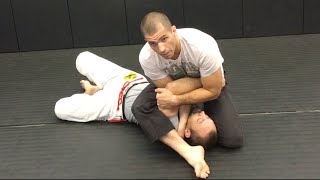
From the modified mount, the instructor catches the opponent's arm and secures gift wrap control by pushing the elbow down while controlling the wrist. This grip prevents the opponent from turning into the instructor and creates multiple attacking options including arm bars, Kimura grips, and back takes.
Creating Space for Triangle Entry
To set up the triangle, the instructor punches the opponent's arm downward to create space for leg insertion. If the opponent maintains connected arms, lifting the head slightly provides additional clearance for foot placement between the arms.
Proper Leg Positioning
The instructor ensures the attacking leg passes between the opponent's arms rather than over them, which is critical for a functional triangle. After securing foot placement, the grip transitions from wrist control to ankle control.
Locking the Triangle Configuration
The instructor posts the hand on the mat to achieve better positioning, then loops the leg completely around the opponent's body with the calf positioned directly behind the neck. Maintaining zero space and proper calf placement is essential before attempting to lock the figure-four leg configuration.
Securing and Finishing
Once the figure-four lock is secured, the instructor transitions to a flattening position with both knees on the mat to maximize pressure. The finish is executed by driving weight behind the tricep, connecting the opponent's shoulder to their neck, with an optional head pull to increase pressure.
Alternative Finishes and Adjustments
If the triangle angle is incorrect or the opponent resists the submission, the instructor has multiple alternatives including arm bars, shoulder locks, and wrist locks from this controlling position. In cases where position is lost, the technique can be finished from bottom position as a closed guard triangle.
How to set up the Triangle Choke from Mount/Gift Wrap
Key Takeaways
- •Introduction and Setup
- •Transitioning to Modified Mount
- •Establishing Gift Wrap Control
- •Creating Space for Triangle Entry
Professor Gustavo Gasperin teaches how to set up the triangle choke from the mount position, using the gift wrap control. Watch our Special FREE Tutorials at http://www.mmaleech.com/free-stuff/ Go to our Facebook page for the latest trends in BJJ and MMA. https://www.facebook.com/mmaleech.
Related Techniques
Frequently Asked Questions
What does this video teach about gift wrap mount?
This video covers introduction and setup, transitioning to modified mount, establishing gift wrap control. It provides detailed instruction from MMA Leech.
How long does it take to learn gift wrap mount?
The basic mechanics can be understood in a single session, but developing reliable execution requires consistent drilling over weeks of practice. This 8-part breakdown helps structure your training by isolating each phase of the technique.
What are the key details for finishing gift wrap mount?
Once the figure-four lock is secured, the instructor transitions to a flattening position with both knees on the mat to maximize pressure. The finish is executed by driving weight behind the tricep, connecting the opponent's shoulder to their neck, with an optional head pull to increase pressure.