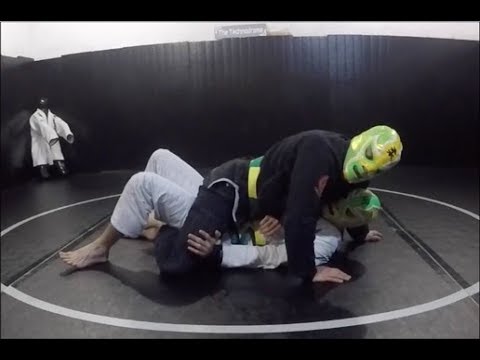
1 - Mount Retention - Grapevines
0
Grapevine Mount·Secret Jiu Jitsu·Added by Admin
The Green Mask introduces basic concepts for controlling the mount position. This lecture focuses on grapevines - under…
Translation: grapevine mount
The Grapevine Mount uses the legs to hook inside the opponent's legs (like grapevines wrapping around a post), spreading the legs apart to flatten the opponent and prevent bridging. [1] The grapevine eliminates the bottom fighter's primary escape tool — the bridge — by spreading the legs and taking away hip movement. [1],[2] The grapevine mount is particularly effective in MMA for ground-and-pound because it flattens the opponent and prevents them from generating the hip movement needed to escape. [2],[3]
The grapevine mount is a traditional mount control method used in BJJ and MMA. [1]
Grapevine mount is commonly used in MMA for ground-and-pound control. [1]
No images yet for this technique.
Sign in to suggest an image.
The Green Mask introduces basic concepts for controlling the mount position. This lecture focuses on grapevines - under…
No instructional courses yet for this technique.
Sign in to suggest a course.
Risk of injury to the person this technique is applied to
Top positions enable pressure and striking; rib compression risk under heavy pressure
Skill level needed to execute this technique reliably
Whether this technique is allowed under major competition rule sets
Mastering Jujitsu (Renzo Gracie & John Danaher, 2003)
Alias sources — [1] Jiu-Jitsu University (Ribeiro, 2008) [2] Mastering Jujitsu (Gracie & Danaher, 2003) [3] UWW Wrestling Rules
Effectiveness sources — [1] Mastering Jujitsu (Gracie & Danaher, 2003) [2] Jiu-Jitsu University (Ribeiro, 2008)
Standard katakana transliteration of Western martial arts terminology (外来語) — used in Japanese MMA, boxing, and BJJ communities
Alias sources — [1] Jiu-Jitsu University (Ribeiro, 2008) [2] Mastering Jujitsu (Gracie & Danaher, 2003) [3] UWW Wrestling Rules
Effectiveness sources — [1] Mastering Jujitsu (Gracie & Danaher, 2003) [2] Jiu-Jitsu University (Ribeiro, 2008)
base stability, heavy hips, ride ability
heavier build with strong hips for pressure
hip adductors, core, glutes, quadriceps
Transition to a high grapevine by moving your legs higher up on their body as soon as you feel them initiating the escape. The high grapevine makes elbow escapes very difficult to execute.
Keep the soles of your feet together like a pyramid shape, but stay relaxed rather than rigid—allow your knees to flex while maintaining solid downward hip pressure. Staying too stiff will cause the position to open up.
A low grapevine at the ankles is great for stopping the bridge bump escape but poor against elbow escapes, while the high grapevine excels at stopping elbow escapes but struggles against the bump—each has different strengths and weaknesses.
The Grapevine Mount uses the legs to hook inside the opponent's legs (like grapevines wrapping around a post), spreading the legs apart to flatten the opponent and prevent bridging. The grapevine eliminates the bottom fighter's primary escape tool — the bridge — by spreading the legs and taking away hip movement.
The grapevine mount has been used in wrestling and grappling throughout history as a method of immobilising an opponent. Its effectiveness in MMA for controlling and striking opponents on the ground has made it a standard mount control technique.
IBJJF: legal — Legal, mount scores 4 points — highest-scoring position; IJF: legal — Legal, osaekomi (pin) — 10-19 seconds scores waza-ari, 20 seconds scores ippon; ADCC: legal — Legal, mount scores 2 points; Unified MMA: legal — Legal dominant position; UWW: legal — Legal, back exposure scores points, pin ends match by fall; FIAS Sport Sambo: legal — Legal, pin scores points
Danger rating 3/10. Moderate — top positions enable pressure and striking; rib compression risk under heavy pressure
The standard setup chain: Pass the Guard → Settle Weight → Control Arms → Threaten Submissions.
Standard counters include: Bridge (Upa) — explosive hip elevation to off-balance the top player / Elbow-Knee Escape (Shrimp) — create space by driving elbow to knee and hip-escaping / Frame — establish forearm frames to prevent the top player from settling weight.
Common variants: Low mount (hips heavy on the opponent's belly, grapevines in for sta…); High mount (knees under the armpits, arms isolated for submissions); S-mount (one knee high under the armpit, other leg across for arm …); Technical mount (one leg hooked, one knee posted, modified for back-take t…).
Grapevine mount is commonly used in MMA for ground-and-pound control.
Top errors to watch for: Hooking the legs but not maintaining chest pressure — the grapevine and chest pressure must work together / Crossing the feet under the opponent instead of hooking inside the thighs — the hooks go inside, not underneath / Not spreading the opponent's legs with the hooks — the hooks should actively push the legs apart / Using the grapevine exclusively without transitioning to attack — grapevine controls; eventually release a hook to at….
The Grapevine Mount is also known as Gurēpubain Maunto, Grapevine, Hooks-In Mount, Grapevine Pin.