Introduction to Mounted Crucifix
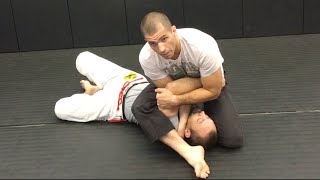
The mounted crucifix, also called the salivary position, is a dominant ground-and-pound position in mixed martial arts and grappling. This technique is typically achieved when a defender attempts to escape side control by pushing on the attacker's hip to recover guard.
Entry and Arm Control
As the opponent pushes the hip to create space for knee insertion, the attacker posts the opponent's wrist down and steps over the arm. The attacker's shin is laid across the crook of the opponent's elbow with both knee and foot in contact, creating a stable base that prevents the opponent from sliding the arm free in either direction.
Body Positioning and Underhook
The attacker maintains chest pressure while securing an underhook on the opposite arm, described as "answering the phone." This configuration leaves the opponent with minimal defensive options and allows the attacker to deliver strikes with their free arm from a mechanically advantaged position.
Managing Defensive Bucking
When the opponent attempts to bridge or buck to escape, the attacker uses the striking arm to post and maintain position. Most defenders quickly tire from these escape attempts and cease their resistance, allowing the attacker to land successive strikes that may lead to a technical knockout.
Strike Generation and Hip Movement
Opening the hips increases punching power but also creates escape opportunities for the opponent. Given that only a few strikes are typically needed to achieve a technical knockout from this position, sacrificing power for security is generally not necessary.
Americana Submission from Crucifix
If the opponent attempts a cross-face or pulls the hand upward in defense, the attacker can transition to an Americana lock. The attacker controls the opponent's wrist and secures it with the previously-posted underhook hand.
Americana Finishing Mechanics
To properly finish the Americana, the attacker drives the opponent's wrist in a circular motion toward their hip while maintaining the opponent's elbow at approximately 90 degrees. The attacker then raises their forearm against the opponent's elbow joint to generate the submission.
Americana Hand Placement and Leverage
Proper finishing position requires the attacker's own elbow to align with the opponent's hip bone. From this configuration, a vertical raising motion of the attacker's forearm applies the finishing pressure to secure the submission.
Mounted crucifix or salavery position: Basic instruction
Key Takeaways
- •Introduction to Mounted Crucifix
- •Entry and Arm Control
- •Body Positioning and Underhook
- •Managing Defensive Bucking
Technical ground and pound is a type of ground and pound used by combining grappling and striking skills to get your opponent into a position where they are defense less, then smash their face.
Related Techniques
Frequently Asked Questions
What does this video teach about mounted crucifix?
This video covers introduction to mounted crucifix, entry and arm control, body positioning and underhook. It provides detailed instruction from Matthew Elliott.
How long does it take to learn mounted crucifix?
The basic mechanics can be understood in a single session, but developing reliable execution requires consistent drilling over weeks of practice. This 8-part breakdown helps structure your training by isolating each phase of the technique.
What are the key details for finishing mounted crucifix?
To properly finish the Americana, the attacker drives the opponent's wrist in a circular motion toward their hip while maintaining the opponent's elbow at approximately 90 degrees. The attacker then raises their forearm against the opponent's elbow joint to generate the submission.