Foundation: Understanding Side Control Dynamics
When defending bottom side control, proper framing is essential—a detail many practitioners overlook until receiving direct instruction. The opponent's position beside the defender fundamentally changes how force distribution works compared to mount position, making bridging ineffective unless the defender establishes proper body alignment.
Critical Body Alignment: The 45-Degree Angle
The defender must turn onto their side at a 45-degree angle, ensuring knees, hips, chest, and head all point in the same direction. This alignment creates a functional base and matches the direction of the opponent's pressure, preventing postural breakdown that eliminates defensive leverage.
Upper Frame Technique: Shoulder-to-Shoulder Positioning
The top arm frames across the opponent's chest or throat, positioning dependent on relative arm length and opponent height. A throat frame discourages aggressive driving, while a chest frame requires the defender to manage sustained pressure over time through proper positioning.
Head Control Defense: Elbow Tracking Method
The defender blocks the opponent's head control at the bicep using the forearm, with the elbow opening slightly to access additional leverage and prevent pummeling. This elbow must track the opponent's movements, maintaining constant defensive engagement rather than allowing a static hand placement.
Frame Purpose: Creating Space, Not Pushing Backward
Frames function to hold the opponent stationary using bone structure, allowing the defender to create space by moving their hips backward—not by pushing the opponent away. Attempting to push against a dominant position wastes energy and works against gravity.
Hip Escape Mechanics: Lift and Back Away
The defender bridges to lift their hip off the mat, creating sufficient space to move hips backward and downward. The amount of bridge height depends on opponent positioning; tighter upper body control requires greater hip elevation to clear the opponent's base.
Knee-Elbow Reconnection: Controlled Engagement
After creating space, the defender brings their top knee toward their elbow and across the opponent's body, prioritizing the knee-elbow connection over a shin-across position. Resisting the urge to push away prevents opening additional space that the opponent can exploit.
Lower Frame: Knee-on-Hip Contact
The defender maintains their bottom knee against the opponent's hip to prevent upper body control transitions and knee ride advancement. This lower frame remains engaged throughout hip movement, protecting against shoulder girdle and neck control while the defender manages the upper body defense.
Escape Side Control: The Frame and Hip Escape
Key Takeaways
- •Foundation: Understanding Side Control Dynamics
- •Critical Body Alignment: The 45-Degree Angle
- •Upper Frame Technique: Shoulder-to-Shoulder Positioning
- •Head Control Defense: Elbow Tracking Method
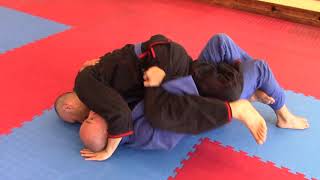
Escaping bad positions is always difficult, but it will be much harder if you don't protect your alignment. You must frame out your opponent to stop them from controlling your head, or getting an under hook. Don't expect to survive if you don't take that part seriously. Here is a fundamental hip escape from bottom side control. Frame and Hip Escape Proper Angle And Frames: (00:00) The Hip Escape: (03:12) Bringing In The Bottom Leg: (04:45) Key Detail Of The Near Leg: (05:43) *** WANT MORE? *** Join hundreds of other BJJ athletes in our online academy led by BJJ Black Belt, Rob Biernacki. Access Rob’s constantly evolving concepts from beginner to advanced, personalized Q&A, and much more. Click here for the details – https://go.bjjconcepts.net/ytlink Use code "immunity" for a free week to try and 15% off after. Check out my Mantis Guard course, or my course for Health Care professionals (self defense and control strategies) at - https://courses.rvvbjj.ca
Frequently Asked Questions
What does this video teach about standard frame and reguard?
This video covers foundation: understanding side control dynamics, critical body alignment: the 45-degree angle, upper frame technique: shoulder-to-shoulder positioning. It provides detailed instruction from RVV BJJ.
How long does it take to learn standard frame and reguard?
The basic mechanics can be understood in a single session, but developing reliable execution requires consistent drilling over weeks of practice. This 8-part breakdown helps structure your training by isolating each phase of the technique.
What are the key details for finishing standard frame and reguard?
After creating space, the defender brings their top knee toward their elbow and across the opponent's body, prioritizing the knee-elbow connection over a shin-across position. Resisting the urge to push away prevents opening additional space that the opponent can exploit.
Related videos
Using the UNDERHOOK to Escape Side Control
The Grapple Lab
Fundamentals: Underhook escape from side control
Bellingham BJJ
The Easy Way to Learn Side Control Escape
JonThomasBJJ
Dealing With Frames by Using Your Own Frame - Andre Galvao
Atos Jiu-Jitsu HQ | World's Best BJJ Academy - Home Page
Video 8 - Side Control Escape Bridge and Roll Series
Brazilian Jiu Jitsu Incorporated