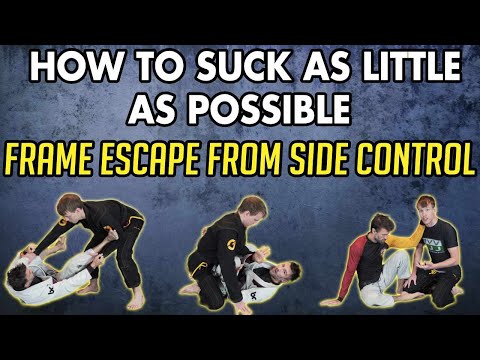
Escape Side Control: The Frame and Hip Escape
0
Standard Frame And Reguard·RVV BJJ·Added by Admin
Escaping bad positions is always difficult, but it will be much harder if you don't protect your alignment. You must fr…
Translation: standard frame and reguard
The Standard Frame And Reguard places the inside forearm across the opponent's throat or collar bone and the outside hand on the opponent's hip, creating a two-point frame that generates space. [1] The defender uses the frame to push the opponent away while simultaneously hip escaping, creating enough room to slide the inside knee through and recover guard. [1],[2] The frame must maintain pressure throughout the escape to prevent the opponent from collapsing back into a tight side control. [2],[3]
The standard frame and reguard is the baseline side control escape. [1]
A fundamental BJJ escape. [1]
Used in BJJ competition. [1]
No images yet for this technique.
Sign in to suggest an image.
Escaping bad positions is always difficult, but it will be much harder if you don't protect your alignment. You must fr…
No instructional courses yet for this technique.
Sign in to suggest a course.
Risk of injury to the person this technique is applied to
Bottom escapes from mount/side control; bridge and hip escape mechanics (Ribeiro 2008)
Skill level needed to execute this technique reliably
Whether this technique is allowed under major competition rule sets
Jiu-Jitsu University (Saulo Ribeiro, 2008)
Alias sources — [1] Jiu-Jitsu University (Saulo Ribeiro, 2008) [2] Brazilian Jiu-Jitsu: Theory and Technique (Renzo Gracie & Royler Gracie, 2001)
Effectiveness sources — [1] Jiu-Jitsu University (Ribeiro, 2008)
Standard katakana transliteration of Western martial arts terminology (外来語) — used in Japanese MMA, boxing, and BJJ communities
Alias sources — [1] Jiu-Jitsu University (Saulo Ribeiro, 2008) [2] Brazilian Jiu-Jitsu: Theory and Technique (Renzo Gracie & Royler Gracie, 2001)
Effectiveness sources — [1] Jiu-Jitsu University (Ribeiro, 2008)
hip escape (shrimping) speed, framing strength, timing
flexible hips and quick lateral movement
hip flexors, obliques, triceps (framing), core
Framing is crucial because it allows you to hold your opponent in place while you create space to escape, rather than trying to push them away directly. According to RVV BJJ, frames are not meant to push your opponent back—they're designed to keep them stationary so you can back up and create the positioning needed for a hip escape.
The most important thing is preventing your opponent from controlling your head—never allow them to cross-face you or gain head control. RVV BJJ emphasizes that losing head control makes escaping significantly harder and puts you in a much worse defensive position.
Use your forearm and bicep to block your opponent's shoulder and prevent them from driving forward, while placing your knee against their hip to prevent transitions to knee ride or mount. Your elbow should be positioned to block at the bicep, and your knee frame is critical for avoiding being advanced into a more dominant position.
Turn your body at a 45-degree angle and make sure your knees, hips, chest, and head are all pointing in the same direction. This alignment is essential because it matches the direction your opponent will be driving, which is fundamental to effective defense.
The Standard Frame And Reguard places the inside forearm across the opponent's throat or collar bone and the outside hand on the opponent's hip, creating a two-point frame that generates space. The defender uses the frame to push the opponent away while simultaneously hip escaping, creating enough room to slide the inside knee through and recover guard.
The standard frame and reguard is the most taught side control escape in BJJ, representing the art's defensive philosophy of using skeletal frames and hip movement to escape pressure positions. It is a foundational technique in every BJJ curriculum.
Unified MMA: legal — Legal defensive technique; IBJJF: legal — Legal — escapes and sweeps are fundamental to BJJ, sweep from bottom scores 2…; IJF: legal — Legal; ADCC: legal — Legal, sweep scores 2 points (4 from mount/back); FIAS Sport Sambo: legal — Legal; FIAS Combat Sambo: legal — Legal
Danger rating 3/10. Moderate — bottom escapes from mount/side control; bridge and hip escape mechanics (Ribeiro 2008)
The standard setup chain: Create Space → Disrupt Control → Execute Escape → Recover Position.
Standard counters include: Maintain Pressure — keep consistent weight distribution to limit escape space / Anticipate Direction — read escape attempt direction and block early / Transition — flow to a new position when the current one is threatened.
Common variants: Shrimp to guard (framing and hip-escaping to recover full guard or half guard); Underhook escape (winning the underhook and coming to knees or reversing); Bridge to knees (bridging into the opponent and transitioning to turtle or…); Ghost escape (inverting under the opponent to re-guard from the opposit…).
Used in BJJ competition.
Top errors to watch for: Placing frames incorrectly — hip and neck frames, not chest or shoulder frames / Bridging without shrimping — the bridge alone doesn't escape; the shrimp creates distance / Shrimping toward the opponent — always shrimp away / Inserting the knee shield too tentatively — push the knee in firmly.
The Standard Frame And Reguard is also known as Sutandādo Furēmu Rigādo, Basic Frame Escape, Standard Reguard.